Surveillance snapshot: Mid-year populations by sex, age, and race and ethnicity of U.S. active component service members, 2023–2025

Image of Photo3_ToC_Snapshotmidyearpopulations_7048784. The minimum and maximum mid-year populations of U.S. active component service members ranged from 1,063,862 to 1,085,521 men and 230,260 to 240,065 women from 2023 to 2025.

This Surveillance Snapshot describes the mid-year population for active component service members (ACSMs) of the U.S. Army, Navy, Air Force, Marine Corps, Space Force, and Coast Guard from 2023 to 2025, stratified by age, sex, and race and ethnicity. Population counts were obtained from June of each calendar year using personnel data from the Defense Manpower Data Center (DMDC) maintained in the Defense Medical Surveillance System (DMSS). Counts and percentages were stratified by sex, age group, and race and ethnicity.

In DMSS, race and ethnicity are categorized as non-Hispanic White, non-Hispanic Black, Hispanic, Asian/Pacific Islander, and American Indian/Alaskan Native, and Other. Both sex and race and ethnicity are self-reported by individual service members. As of 2021, the values for Asian/Pacific Islander and American Indian/Alaskan Native are not populated in DMSS for the Air Force and Coast Guard, and these 2 groups have been included in the ‘other’ category for this report.

The minimum and maximum mid-year populations of ACSMs ranged from 1,063,862 to 1,085,521 among men and 230,260 to 240,065 among women during the surveillance period. Demographic shifts among ACSMs varied by age and sex. In 2025, 81.8% of the active component was comprised of men, and 18.2% was comprised of women (Table). Stratified by age, the proportion of women was highest among the younger than age 20 years group (21.3%) and lowest in the ages 50-54 years group (15.1%).
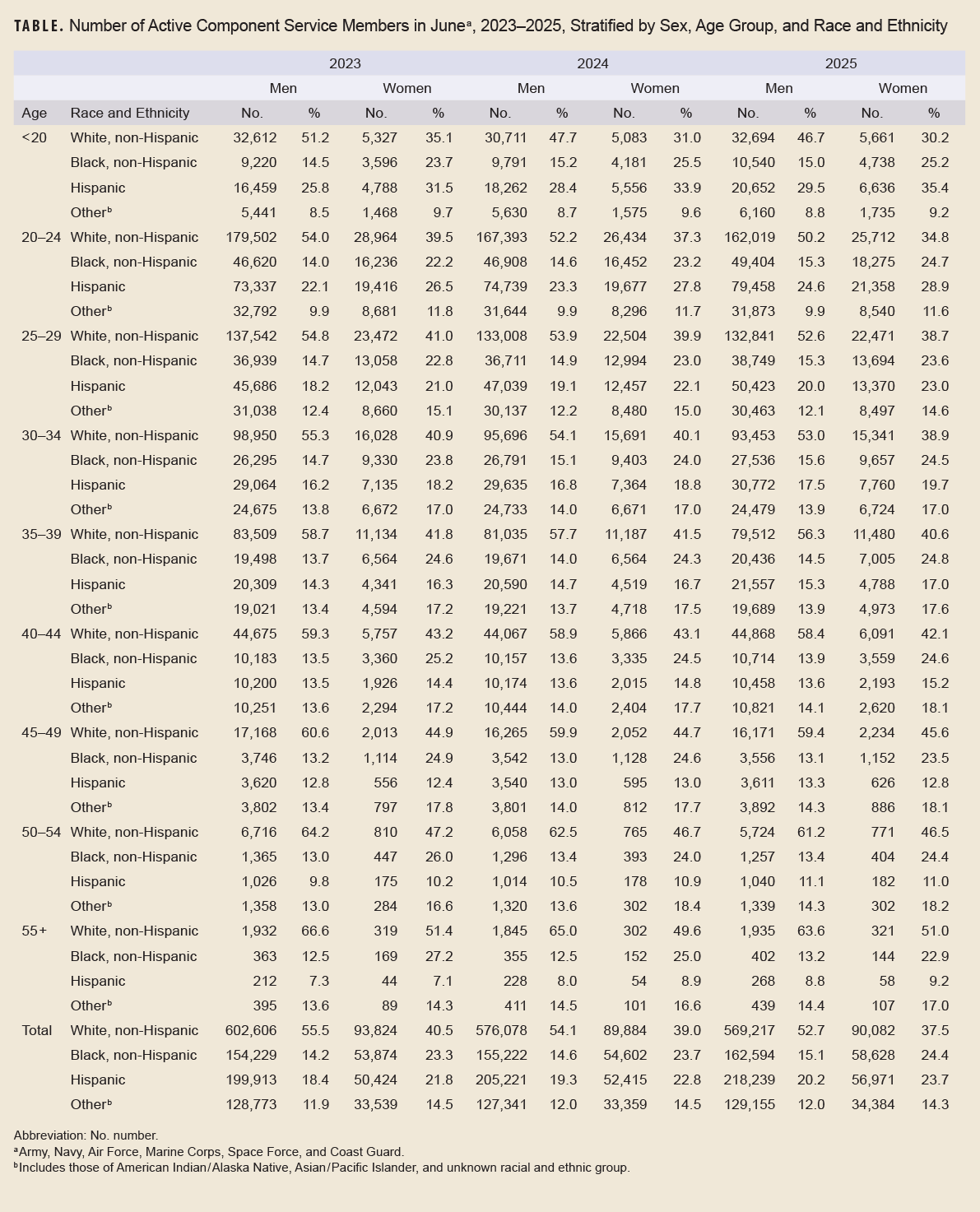
Overall, while non-Hispanic White service members represented the largest proportion by race and ethnicity in 2025, that proportion declined over the surveillance period. The proportion of Hispanic service members increased throughout the surveillance period, continuing a recent trend.1 The greatest demographic shifts are seen in the younger than age 20 years group, with the greatest percent increase in numbers among service members identifying as Black, non-Hispanic, Hispanic, and ‘other’ for both sexes. Among female service members younger than age 20 years, those identifying as Hispanic constituted the largest group (35.4%) in 2025. Similar trends are seen among male service members younger than age 20 years, where non-Hispanic White male service members represented less than half of men in that age group (46.7%), and the proportion of Hispanic men has increased since 2023 (29.5%). Among older age groups, demographic shifts are less pronounced. These data can be used to provide additional context for health surveillance analyses for U.S. ACSMs.

Reference

  1. McQuistan A, Dreyer E, Mabila S. Mid-year populations by sex, age, and race and ethnicity of active component service members of the U.S. Armed Forces, 2018–2022. MSMR. 2023;30(12):12. Accessed Feb. 26, 2026. https://health.mil/reference-center/reports/2023/12/01/msmr-vol-30-no-12-dec-2023

You also may be interested in...

Topic
April 28, 2026

Medical Surveillance Monthly Report

The Medical Surveillance Monthly Report, a peer-reviewed journal launched in 1995, is the Armed Forces Health Surveillance Division's flagship publication. The MSMR provides monthly evidence-based estimates of the incidence, distribution, impact, and trends of health-related conditions among service members.

Report
Feb. 1, 2026

MSMR Vol. 33 No. 2 - February 2026

.PDF | 1.29 MB

The February 2026 MSMR features a report on the number of tuberculosis tests and diagnoses of latent tuberculosis infection in the U.S. Army; a historical review on post-infection symptoms in U.S. soldiers with malaria during World War II and its major limitation to return to duty; a Surveillance Snapshot on adherence to disease and injury ...

Article
Feb. 1, 2026

Number of tuberculosis tests and diagnoses of latent tuberculosis infection among U.S. Army active component service members, January 2014–December 2023

This report describes the trends of tuberculosis testing and latent tuberculosis infection positivity in U.S. Army active component soldiers during the first decade following the 2013 U.S. Army Medical Command policy revision to a targeted, risk-based tuberculosis testing strategy.

Article
Feb. 1, 2026

Historical perspective: Post-infection symptoms in U.S. soldiers with malaria during the Second World War: major limitation to return to duty

This historical review discusses how the primary challenge presented by malaria infections in the Pacific theater during World War II was an inability to return recovered soldiers quickly to their units, with nearly one percent of malaria patients repatriated for ‘chronic malaria’.

Article
Jan. 1, 2026

Case report: An atypical Ross River Virus infection in an Australian Army service member

This case report details the process of differential diagnosis of Ross River virus in an individual diagnosed in Queensland, Australia in 2024. The report demonstrates the need for better clinical awareness among medical care providers for U.S. service members presenting with febrile illness or joint pain following deployment to Australia.

Report
Jan. 1, 2026

MSMR Vol. 33 No. 1 - January 2026

.PDF | 3.43 MB

The January 2026 MSMR features a full report on Guillain-Barré syndrome among U.S. active component service members, 2014–2022; and a report on distinct approaches to racial and ethnic classification to the surveillance of obstetric and neonatal outcomes in the U.S. military, 2010–2021; followed by a case report an atypical Ross River virus infection ...

Article
Dec. 1, 2025

Update: Cold weather injuries among the active and reserve components of the U.S. Armed Forces, July 2020–June 2025

Since 2004, MSMR has published annual updates on the incidence of cold weather injuries affecting U.S. Armed Forces members for the five most recent cold seasons. This 2025 report discusses the occurrence of frostbite, immersion hand and foot injuries, hypothermia, as well as “other specified and unspecified effects of reduced temperature.”

Refine your search