Reportable Medical Events at Military Health System Facilities Through Week 44, Ending November 4, 2023

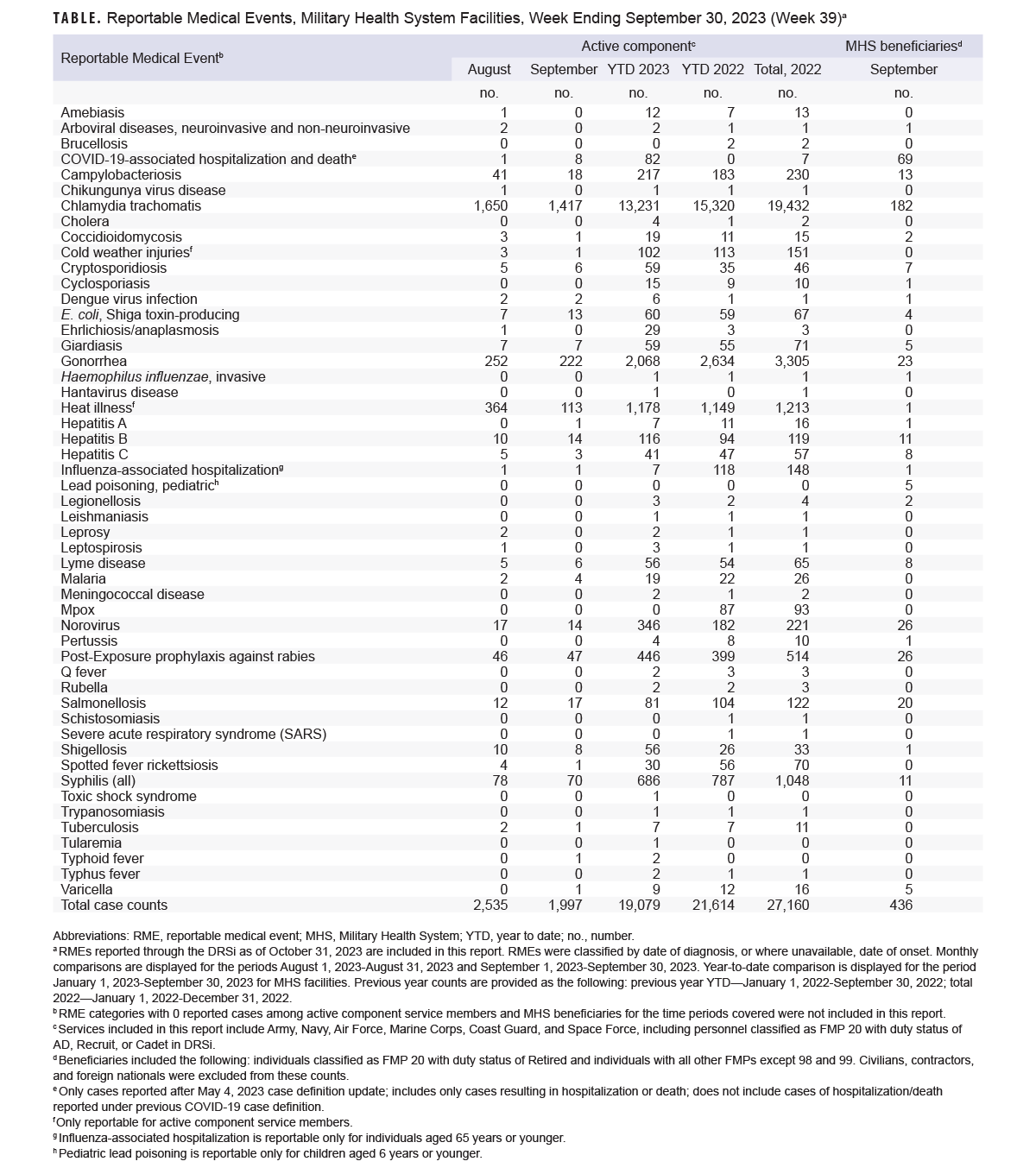
Image of 5RMEs. MSMR publishes a monthly RME update for active component service members and MHS beneficiaries.

Reportable Medical Events are documented in the Disease Reporting System internet by health care providers and public health officials throughout the Military Health System for monitoring, controlling, and preventing the occurrence and spread of diseases of public health interest or readiness importance. These reports are reviewed by each service’s public health surveillance hub. The DRSi collects reports on over 70 different RMEs, including infectious and non-infectious conditions, outbreak reports, STI risk surveys, and tuberculosis contact investigation reports. A complete list of RMEs is available in the 2022 Armed Forces Reportable Medical Events Guidelines and Case Definitions.1 Data reported in these tables are considered provisional and do not represent conclusive evidence until case reports are fully validated.
This graph comprises five lines on the horizontal, or x-, axis that depict case counts for the five most frequent reportable medical event conditions among active component service members during the past 52 weeks. Chlamydia remains the most common reportable medical condition, with counts consistently around 300 cases per week. Gonorrhea is generally the second-most common reported condition, averaging approximately 80 cases per week, but in week 26 of 2023 it was surpassed by heat illness, which outnumbered gonorrhea cases for the next eight of nine weeks, but declined to the same number gonorrhea cases by the end of week 35 and has been declining steadily thereafter. Campylobacteriosis cases rose briefly at the end of week 34 to become the fourth-most common reported condition,but declined in number through week 39 to again become the fifth-most common condition, with a temporary spike in week 40, followed by further declines thereafter, through week 44. With the overall decline of heat illnesses starting in week 35, syphilis reclaimed the position of the third-most common condition in week 44, with just over 10 reported cases per week.

Total active component cases reported per week are displayed for the top five RMEs for the previous year. Each month, the graph is updated with the top five RMEs, and is presented with the current month’s (October 2023) top five RMEs, which may differ from previous months. COVID-19 is excluded from these graphs due to changes in reporting and case definition updates in 2023.

For questions about this report, please contact the Disease Epidemiology Branch at the Defense Centers for Public Health–Aberdeen. Email: dha.apg.pub-health-a.mbx.disease-epidemiologyprogram13@health.mil

Authors' Affiliation

Defense Health Agency, Disease Epidemiology Branch, Defense Centers for Public Health–Aberdeen

References

  1. Armed Forces Health Surveillance Division. Armed Forces Reportable Medical Events. Accessed Sep. 6, 2023. https://health.mil/Reference-Center/Publications/2022/11/01/Armed-Forces-Reportable-Medical-Events-Guidelines
  2. Defense Manpower Data Center. Department of Defense Active Duty Military Personnel by Rank/Grade of Service, October 31, 2022. https://dwp.dmdc.osd.mil/dwp/app/dod-data-reports/workforce-reports
  3. Defense Manpower Data Center. Armed Forces Strength Figures for January 31, 2023. https://dwp.dmdc.osd.mil/dwp/app/dod-data-reports/workforce-reports
  4. Navy Medicine. Surveillance and Reporting Tools–DRSI: Disease Reporting System Internet. https://www.med.navy.mil/Navy-and-Marine-Corps-Force-Health-Protection-Command/Preventive-Medicine/Program-and-Policy-Support/Disease-Surveillance/DRSI

You also may be interested in...

Article
Mar 1, 2022

Brief report: Using syndromic surveillance to monitor MIS-C associated with COVID-19 in Military Health System beneficiaries

Air Force 1st Lt. Anthony Albina, a critical care nurse assigned to Joint Base Andrews, Md., checks a patient’s breathing and heart rate during an intubation procedure while supporting COVID-19 response operations in Cleveland, Jan. 20, 2022.

SARS CoV-2 and the illness it causes, COVID-19, have exacted a heavy toll on the global community. Most of the identified disease has been in the elderly and adults. The goal of this analysis was to ascertain if user-built ESSENCE queries applied to records of outpatient MHS health care encounters are capable of detecting MIS-C cases that have not ...

Article
Mar 1, 2022

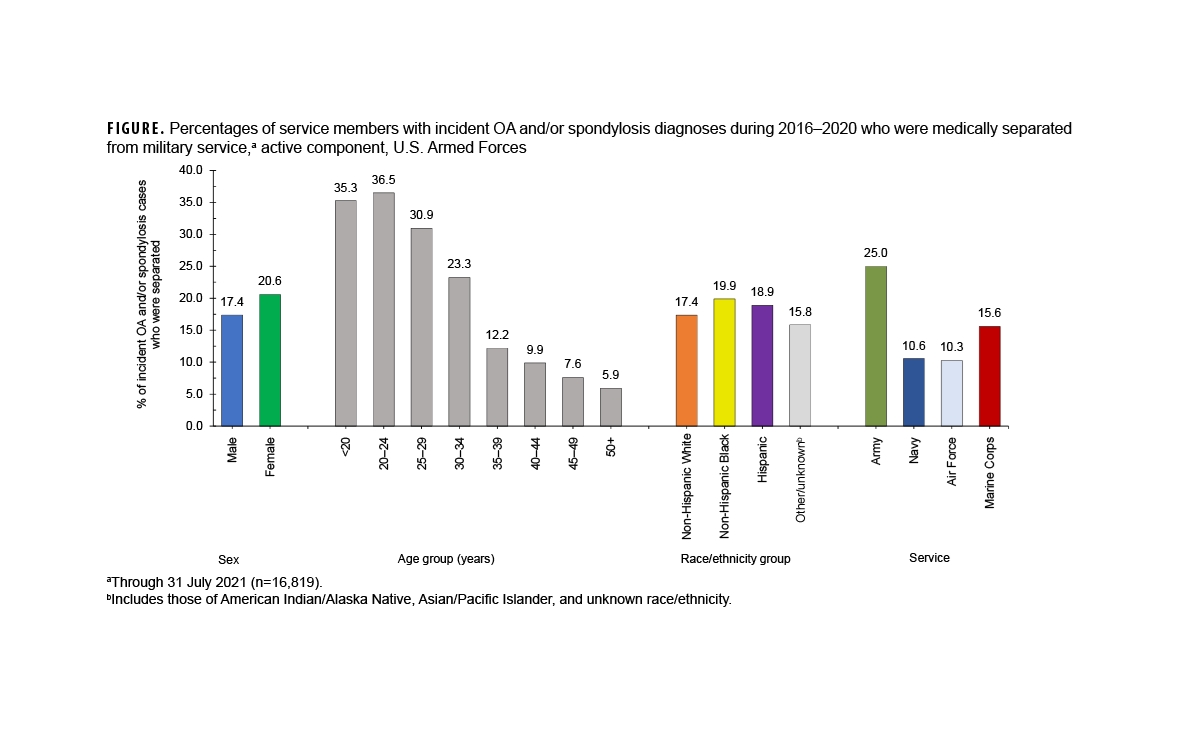
Surveillance Snapshot: Medical Separation from Service Among Incident Cases of Osteoarthritis and Spondylosis, Active Component, U.S. Armed Forces, 2016–2020

Marines hike to the next training location during Exercise Baccarat in Aveyron, Occitanie, France, Oct.16, 2021. Exercise Baccarat is a three-week joint exercise with Marines and the French Foreign Legion that challenges forces with physical and tactical training. Photo By: Marine Corps Lance Cpl. Jennifer Reyes

Osteoarthritis (OA) is the most common adult joint disease and predominantly involves the weight-bearing joints. This condition, including spondylosis (OA of the spine), results in significant disability and resource utilization and is a leading cause of medical separation from military service.

Article
Mar 1, 2022

Brief Report: Refractive Surgery Trends at Tri-Service Refractive Surgery Centers and the Impact of the COVID-19 Pandemic, Fiscal Years 2000–2020

Cadet Saverio Macrina, U.S. Military Academy West Point, receives corneal cross-linking procedure at Fort Belvoir Community Hospital, Va., Nov. 21, 2016. (DoD photo by Reese Brown)

Since the official introduction of laser refractive surgery into clinical practice throughout the Military Health System (MHS) in fiscal year 2000, these techniques have been heavily implemented in the tri-service community to better equip and improve the readiness of the U.S. military force.

Fact Sheet
Mar 30, 2017

Demographic and Military Traits of Service Members Diagnosed as Traumatic Brain Injury Cases

.PDF | 283.00 KB

This fact sheet provides details on the demographic and military traits of service members diagnosed as traumatic brain injury (TBI) cases during a 16-year surveillance period from 2001 through 2016, a total of 276,858 active component service members received first-time diagnoses of TBI - a structural alteration of the brain or physiological ...

Fact Sheet
Mar 30, 2017

Rhabdomyolysis by Location, Active Component, U.S. Armed Forces, 2012-2016 Fact Sheet

.PDF | 313.80 KB

This fact sheet provides details on Rhabdomyolysis by location for active component, U.S. Armed Forces during a five-year surveillance period from 2012 through 2016. The medical treatment facilities at nine installations diagnosed at least 50 cases each and, together approximately half (49.9%) of all diagnosed cases.

Fact Sheet
Mar 30, 2017

Heat Illnesses by Location, Active Component, U.S. Armed Forces, 2012-2016 Fact Sheet

.PDF | 267.04 KB

This fact sheet provides details on heat illnesses by location during a five-year surveillance period from 2012 through 2016. 11,967 heat-related illnesses were diagnosed at more than 250 military installations and geographic locations worldwide. Three Army Installations accounted for close to one-third of all heat illnesses during the period.

Refine your search