The editors of MSMR are announcing a call for papers to be published in the May 2025 issue of MSMR that will be dedicated to the health of women serving in the military, to coincide with Women’s Health Awareness Month and Women’s Health Week. The editors of MSMR are inviting researchers and investigators with an interest in women’s health issues and their relationship to the U.S. military to submit manuscripts in the coming months to be considered for the MSMR 2025 women’s health issue.
Women in Military Service
The U.S. Department of Defense has recognized that increasing gender diversity in the military is contingent upon more female recruits, which requires emphasis on the importance of recruiting and retaining women, as part of maintaining diversity within the military.1 In 2016 all gender restrictions on military service were lifted, allowing female service members to assume direct combat positions. The Defense Health Board found that active duty women have been incorporated into all military occupational specialties and proven themselves critical to DOD mission success.2 Figure 1 shows the distribution of female service members by service type from 1990 to 2023.
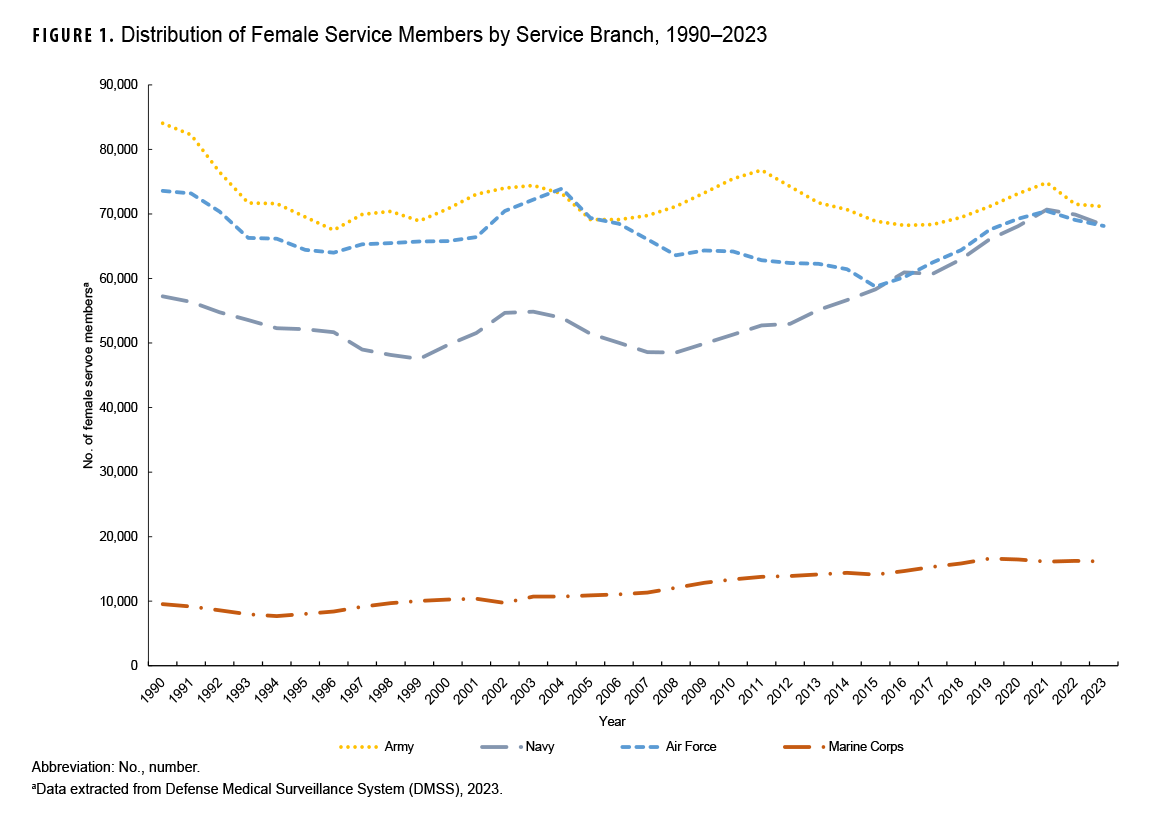
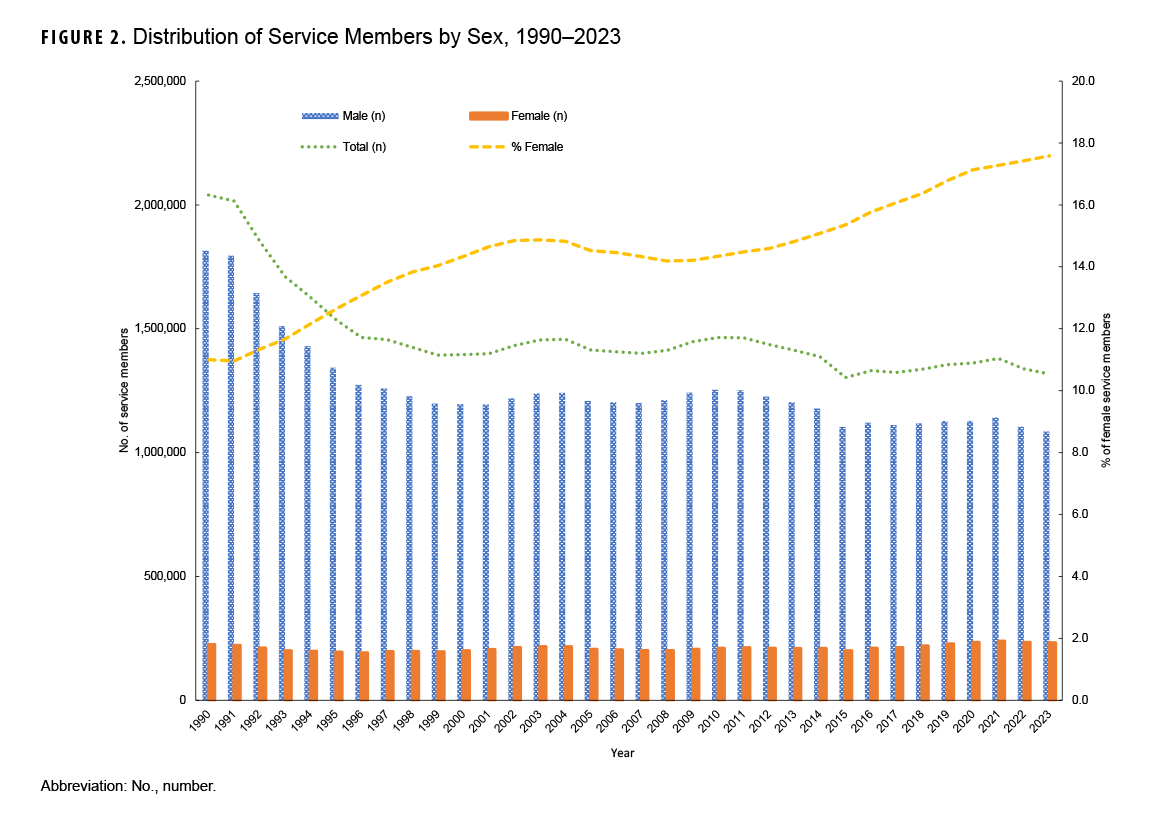
Since the introduction of the all-volunteer force in 1973, the number of women entering the Army and Reserve components has increased significantly. As a result of targeted recruiting, revised training, and greater opportunities, the total number of women in the Army increased from 12,260 in 1972 to 52,900 in 1978,3 and as of 2023 the number of active component female service members in the U.S. Armed Forces was 231,651, accounting for 17.6% of the active component force. A concurrent decline in the male service member population contributed to a relatively rapid increase in the proportion of the women serving in the U.S. military (Figure 2). As the total population of the active component force decreased from 2,040,099 in 1990 to 1,317,194 in 2023, the number of male service members decreased from 1,815,683 in 1990 to 1,194,003 in 2001, and then stabilized, meanwhile the number of female service members remained substantially unchanged.
As military demographics continue to shape a proportionally larger female force in which the roles of women become increasingly important, there is a growing need to understand the unique challenges women face while serving, with a focus on their empowerment in addition to their retention. It is critical to evaluate whether the health needs of active component service women are appropriately managed within the military environment, taking into account their unique health concerns including occupational physical demands, gender-specific physical and mental stresses, and reproductive health issues.4
Women's Health and Its Challenges
“Women’s health” is often too narrowly focused on sexual and reproductive health, which are generally considered synonymous with gender-specific conditions or reproductive health.5,6 A focus on sexual and reproductive health is relevant but insufficient. Despite the strong need for evidence-based information to achieve better outcomes, a lack of research on women’s health persists. Women’s health burdens are under-represented in clinical research and treatment.7 Historically, women’s health needs have lagged in medical research, resulting in limited knowledge about women’s health, which has restricted the health information available to women and the quality of their health care.8 Fundamental and translational knowledge gaps specific to many women’s health conditions and diseases have inhibited generation of robust scientific data needed to provide high quality, evidence-based care to women.9
To better understand and address the health of women, especially groups of women who bear a disproportionate burden of disease, it is crucial to acknowledge women’s fundamental differences. It is also important to assess the health burdens associated with women’s health inequities by measuring years of potential life expectancy, and to consider contributing factors including race and ethnicity, socioeconomic status, age, education, geographic location, gender identity, and disability status.6 In 2023 the National Institutes of Health reported numerous health disparities between women and men in the U.S.—in addition to disparities with women in other high-income countries. Women in the U.S. have shown a slower increase in life expectancy, far behind women in other high-income countries, along with higher rates of obesity, more experiences of pain and physical disability, and more concurrent chronic conditions than men, in addition to an increase in overall maternal mortality in the U.S.5
Women’s complex health needs require health care that includes the whole woman, encompassing all the parts of the female body, all medical disciplines, and all life stages.10 Women are more likely than men to need health care throughout their lifespans, but they are also more likely to be poor, which means health care costs can put both their health and economic security at risk. Consequently, women may delay diagnosis and treatment of serious health problems, leading to poorer health.11 Women also experience different degrees or types of health problems that are dependent upon socioeconomic status. This year the World Economic Forum reported that women spend more of their lives in poor health and with greater degrees of disability, resulting in a women’s health gap that equates to 75 million years of life lost annually due to poor health or early death, or the equivalent of 7 days per year for every woman.6
Women’s health is tied to long-term economic productivity, with the development and economic performance of a country dependent upon how well it protects and promotes women’s health. Societies are more likely to demonstrate better population health overall and remain more productive for generations to come when they prioritize women’s health.12 A McKinsey Health Institute report assessing the health burden associated with health disparities among women found 10 conditions that accounted for more than 50% of detrimental economic impacts: Click to closepremenstrual syndromeA term used to describe a group of physical and behavioral changes that some women experience before their menstrual periods every month which may include may include sharp mood swings, irritability, hopelessness, anxiety, problems concentrating, changes in appetite, sleep problems, and bloating.premenstrual syndrome, depressive symptoms, migraines, other gynecological diseases, anxiety disorders, ischemic heart disease, osteoarthritis, asthma, drug use disorders, and ovarian cancer.6
A 2021 RAND report argues that investing in women’s health research produces significant societal benefits and returns over investing in general research, such as increased life-years, reduced years with disease, fewer years of functional dependence, and reductions in disruptions to work productivity.13 The McKinsey report estimated that closing the gender health gap could reduce the time women spend in poor health by almost two-thirds and add up to $1 trillion to the global economy annually by 2040. McKinsey also estimated that for every $1 invested in women's health, approximately $3 can be projected in economic growth—creating the same impact as employing 137 million women in full-time jobs by 2040.14
Women already play a critical role in the U.S. economy, making up nearly 60% of U.S. workers and 65% of the unpaid workforce of caregivers.10 One study estimating the economic burdens associated with the increases in U.S. maternal mortality rates over the past 2 decades, along with various maternal mortality disparities, found a substantial increase in potential years of lives lost and further calculated a statistical valuation, estimating a national economic burden of $27.4 billion due to maternal mortality from 2018 to 2020.15
Military Women's Health and Its Challenges
Women in the military experience health care and research inequities similar to their civilian counterparts. A recent scoping review of military women’s health research found that a significant portion of published studies either did not include active duty women as research participants or failed to examine outcomes by gender or active duty status.16 As a result, Trego and et al. conducted a military women’s health Delphi study to determine priorities for military women’s health research and reported five priority research topics: genitourinary health, sleep, physical assault, behavioral health, and menstrual cycle research.17
MSMR is dedicated to disseminating important information on women’s health within the military and has published on women’s health topics over the past decade that include vaginosis, chlamydia trachomatis, human papillomavirus, urinary tract infections, pelvic inflammatory disease, menstrual suppression, menorrhagia, fibroids, ovarian and other gynecological disorders including birth and complications, infertility, contraceptive use, breast cancer, aggressive behaviors, and mental health among military women.
In 2023, female U.S. service members were hospitalized at more than three times the rate of male service members (116.5 per 1,000 and 34.3 per 1,000, respectively), which is consistent with the national hospitalization trend for women and men ages 18-44 (95 per 1,000 and 37 per 1,000, respectively) reported in 2022. Excluding pregnancy and delivery-related conditions, hospitalization rates for women in 2023 in the U.S. military were 33.0% higher (45.6 per 1,000) than for men (34.3 per 1,000), likely due to hospitalizations for mental health disorders.18
In 2023 female U.S. service members’ annual outpatient visit rate was 87.5% higher than male service members’ rate for all illness-and injury-related visits. Even when excluding pregnancy and delivery-related visits, female service members’ outpatient visit rate in 2023 was still 70.5% higher than the male rate. In all major diagnostic categories except some specific diagnoses, women evinced illness- and injury-specific diagnoses rates 50% higher than men. The leading categories of female service members’ outpatient visits in 2023 were musculoskeletal, “other,” mental, “ill-defined,” pregnancy, neurological, genitourinary, respiratory, injury, and dermatological diagnoses.19
Musculoskeletal disorders were the most common diagnosis at outpatient clinics for female service members in 2023.19 According to a study examining intrinsic risk factors for exercise-related injuries among male and female army trainees, women are at higher risk for musculoskeletal injuries than men: at 30.1% incidence of time-loss injuries during army basic training compared to 20.2% for men.20 Other studies have reported a higher risk of MSIs in women, with one reporting a total lifetime cost (sum of medical and work loss cost) among 302 Marines (84 women and 218 men) of approximately $1.4 million (in 2019 U.S. dollars), and another demonstrating increased health care utilization due to MSIs.21,22 One study examining total costs of combat-related MSIs reported a cost per casualty of approximately $157,000, with medical costs associated with orthopedic care reaching $8.52 billion in the first year of treatment documented.23
Although these studies did not provide or investigate specific direct and indirect costs of health care utilization by female service members, service women’s higher rates of outpatient and hospitalization, including increased use of health care resources, in addition to the expenditures associated with long-term consequences of MSIs, demonstrate the importance of prevention and effective management of health problems in female service members.
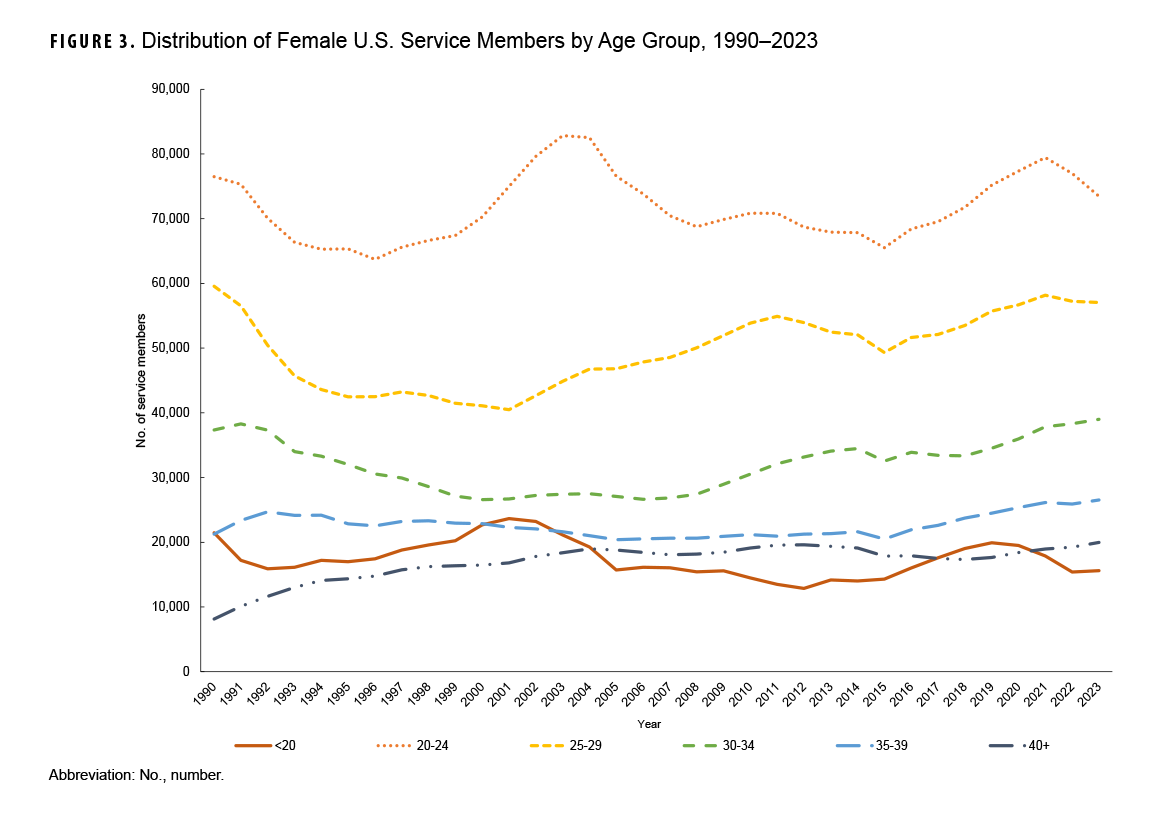
According to a U.S. Government Accountability Office report, the percentage of female active duty service members tends to decrease between 10 and 20 years of service. Women are 28% more likely than men to leave military service due to gender discrimination in health care, reproductive health needs, higher rates of MSIs and mental health issues, in addition to serious invisible injuries such as UTIs, with detrimental immediate impacts on military fitness and readiness.1,24 In 2023, the largest proportion of female service members was in the 20-24-year age group (31.7%), followed by 25-29 years (24.6%), and then 30-34 years (16.8%), comprising a female majority in the U.S. military of childbearing age (Figure 3). These demographics also highlight the importance of understanding and investigating general health issues women may face during their service, including contraceptive use as well as unintended pregnancy, and providing the support they need to meet their health needs.25
Advancing Research on Military Women's Health
President Biden’s March 18, 2024 executive order advancing women’s health research and innovation will require more research that prioritizes women’s health within the federal research portfolio, to translate knowledge into impact to improve the health of all women.26 Given their crucial role and the challenging environments in which female service members currently perform vital operations,3 it is critical to identify the challenges they face in the military and recognize gaps in knowledge about their health needs, particularly in military settings.
Improving women’s health requires an understanding of the determinants of disease, function, and well-being in women, in addition to the ability to intervene in relation and response to those determinants.8 To provide effective care for women, gender-specific research, knowledge, and approaches to treatment are essential.10 Quality research into women’s health is critical for preventing and mitigating potential detrimental impacts on women’s health. To estimate the economic impact of women’s health, not only the medical costs due to medical encounters and hospitalizations, but the long-term physical as well as mental burdens thereafter, need to be quantified.
The health of women serving in the military is affected by gender-specific health conditions as well as general environmental conditions that can affect each woman differently. Due to the growing role and importance of women in the military, continued and improved research is needed to support them, through a variety of studies.
Submissions for the May 2025 women’s health issue of MSMR may consider any number of aspects, including preparedness, gender-specific risk assessment, prevention efforts, quality of care, health care expenditures and utilization, as well as health issues that may be differentiated from major health issues routinely studied. The editors of MSMR look forward to receiving submissions via email to the editor at dha.ncr.health-surv.mbx.msmr@health.mil. For detailed information on criteria for MSMR submissions, please visit Instructions for Authors on Health.mil. Manuscripts should be submitted no later than February 2, 2025 to be considered for publication in the issue.
References
- U.S. Government Accountability Office. Report to Congressional Committees: Female Active-Duty Personnel–Guidance and Plans Needed for Recruitment and Retention Efforts, GAO-20-61. United States Government. 2020. Accessed Jul. 23, 2024. https://www.gao.gov/assets/gao-20-61.pdf
- Defense Health Board. Defense Health Board Report: Active Duty Women's Health Care Services. U.S. Dept. of Defense. 2020. Updated Nov. 5, 2020. Accessed Jul. 11, 2024. https://www.health.mil/Reference-Center/Reports/2020/11/05/Active-Duty-Womens-Health-Care-Services
- Department of the Army. Women in the Army. Army.mil. U.S. Dept. of Defense. Accessed Aug. 9, 2024. https://www.army.mil/women/history
- Committee on Health Care for Underserved Women. Committee Opinion 547: Health Care for Women in the Military and Women Veterans. American College of Obstetricians and Gynecologists. 2022. Accessed Sep. 2, 2024. https://www.acog.org/clinical/clinical-guidance/committee-opinion/articles/2012/12/health-care-for-women-in-the-military-and-women-veterans
- National Institutes of Health. Advancing Science for the Health of Women: The 2019-2023 Trans-NIH Strategic Plan for Women’s Health Research. 2023. Accessed Jul. 19, 2024. https://orwh.od.nih.gov/sites/orwh/files/docs/ORWH_Strategic_Plan_2019_02_21_19_V2_508C.pdf
- World Economic Forum, McKinsey Health Institute. Closing the Women’s Health Gap: A $1 Trillion Opportunity to Improve Lives and Economies–Insight Report, January 2024. 2024. Accessed Jul. 22, 2024. https://www.weforum.org/publications/closing-the-women-s-health-gap-a-1-trillion-opportunity-to-improve-lives-and-economies
- Tobb K, Kocher M, Bullock-Palmer RP. Underrepresentation of women in cardiovascular trials–it is time to shatter this glass ceiling. Am Heart J Plus. 2022;13:100109. doi:10.1016/j.ahjo.2022.100109
- Institute of Medicine (US) Committee on Women's Health Research. Research on determinants of women’s health. In: Women’s Health Research: Progress, Pitfalls, and Promise. National Academies Press;2010. doi:10.17226/12908
- Temkin SM, Noursi S, Regensteiner JG, Stratton P, Clayton JA. Perspectives from Advancing National Institutes of Health Research to Inform and Improve the Health of Women: a conference summary. Obstet Gynecol. 2022;140(1):10-19. doi:10.1097/AOG.0000000000004821
- Deloitte. The Future of Health Is Female: Understanding the Impact of Women+Health on Society. 2021. Accessed Jul. 22, 2024. https://www2.deloitte.com/us/en/pages/life-sciences-and-healthcare/articles/impact-of-womens-health-on-society.html
- Borchelt G. The impact poverty has on women’s health. Human Rights Magazine. 2018;43(3). Accessed Jul. 22, 2024. https://www.americanbar.org/groups/crsj/publications/human_rights_magazine_home/the-state-of-healthcare-in-the-unitedstates/poverty-on-womens-health
- Onarheim KH, Iversen JH, Bloom DE. Economic benefits of investing in women's health: a systematic review. PLoS One. 2016;11(3):e0150120. doi:10.1371/journal.pone.0150120
- Baird MD, Zaber MA, Chen A, et al. Research Funding for Women's Health: Modeling Societal Impact. RAND;2021. Accessed Jul. 30, 2024. https://www.rand.org/pubs/research_reports/RRA708-4.html
- Ellingrud K, Pérez L, Petersen A, Sartori V. McKinsey Health Institute. Closing the Women’s Health Gap: A $1 Trillion Opportunity to Improve Lives and Economies. McKinsey & Company;2024. Accessed Jul. 22, 2024. https://www.mckinsey.com/mhi/our-insights/closing-the-womens-health-gap-a-1-trillion-dollar-opportunity-to-improve-lives-and-economies
- White RS, Lui B, Bryant-Huppert J, et al. Economic burden of maternal mortality in the USA, 2018-2020. J Comp Eff Res. 2022;11(13):927-933. doi:10.2217/cer-2022-0056
- Iobst SE, Best N, Smith DC,et al. Promoting military women’s health through research design. Mil Med. 2023;188(3-4):71-76. doi:10.1093/milmed/usac310
- Trego LL, Deuster PA. Introduction to women in combat. Mil Med. 2023;188(Suppl 4):1-2. doi:10.1093/milmed/usac358
- Armed Forces Health Surveillance Division. Hospitalizations among active component members of the U.S. Armed Forces, 2023. MSMR. 2024;31(6):11-18.
- Armed Forces Health Surveillance Division. Ambulatory health care visits among active component members of the U.S. Armed Forces, 2023. MSMR. 2024;31(6):19-25.
- Jones BH, Bovee MW, Harris JM, Cowan DN. Intrinsic risk factors for exercise-related injuries among male and female army trainees. Am J Sports Med. 1993;21(5):705-710. doi:10.1177/036354659302100512
- Lovalekar M, Keenan KA, Beals K, et al. Incidence and pattern of musculoskeletal injuries among women and men during Marine Corps training in sex-integrated units. J Sci Med Sport. 2020;23(10):932-936. doi:10.1016/j.jsams.2020.03.016
- Krauss MR, Garvin NU, Boivin MR, Cowan DN. Excess stress fractures, musculoskeletal injuries, and health care utilization among unfit and overweight female Army trainees. Am J Sports Med. 2017;45(2):311-316. doi:10.1177/0363546516675862
- Hering K, Fisher MWA, Dalton MK, et al. Health-care utilization and expenditures associated with long-term treatment after combat and non-combat-related orthopaedic trauma. J Bone Joint Surg Am. 2022;104(10):864-871. doi:10.2106/JBJS.21.01124
- Nolan M. Women’s health can no longer be an afterthought in the military. The Hill. 2022. Accessed Jul. 25, 2024. https://thehill.com/opinion/national-security/3746537-womens-health-can-no-longer-be-an-afterthought-in-the-military
- Witkop CT, Kostas-Polston EA, Degutis LC. Improving the health and readiness of military women. Mil Med. 2023;188:8-14. doi:10.1093/milmed/usac354
- Office of Research on Women’s Health, National Institutes of Health. President Biden Issues Executive Order on Advancing Women’s Health Research and Innovation. U.S. Dept. of Health and Human Services. 2024. Accessed Jul. 25, 2024. https://orwh.od.nih.gov/in-the-spotlight/all-articles/president-biden-issues-executive-order-on-advancing-womens-health-research-and-innovation