The first hepatitis B virus vaccine was licensed by the U.S. Food and Drug Administration in 1982, and the Advisory Committee on Immunization Practices recommended universal infant HBV immunization in 1991.2,3 The U.S. Department of Defense required HBV immunization for all military accessions in 2002. In contrast, DOD mandated hepatitis A virus immunization for all accessions in 1995, the same year the FDA licensed the vaccine. Initially, ACIP recommended HAV vaccination for children only in states with high HAV incidence rates; however, ACIP expanded this recommendation to include universal pediatric HAV immunization (ages 12-23 months) in 2006.1
The Department of the Air Force performs universal antibody serology testing for hepatitis B surface antibody (anti-HBs) and hepatitis A immunoglobulin G (IgG anti-HAV) among enlisted recruits presenting to basic military training at Joint Base San Antonio-Lackland. These results, along with previous vaccination records, if available at the time of accession, guide HBV and HAV vaccination during BMT. Previous studies indicate that HBV titers wane in most adolescents and young adults,2,5,6 while HAV immunization induces a long-lasting IgG response, persisting for at least 10 to 20 years.4
Data from January 1, 2023, through December 31, 2023, in the electronic health record, MHS-GENESIS, was used for this analysis. At JBSA-Lackland, 30,200 recruits were screened for HAV antibodies (81.3% positive), with the prevalence exceeding 80% in both men and women and in all races and ethnicities (Table). American Indians or Alaska Natives (89.4%) showed the highest prevalence of HAV-positive serology by race and ethnicity, and women (83.1%) were higher than men (80.8%). Trainees with positive IgG anti-HAV results were, on average, younger (20.7 years) than those with negative HAV serology (23.5 years). For HBV, 30,189 trainees completed screening (29.4% positive). Asians (37.8%) showed the highest prevalence of HBV-positive serology by race and ethnicity. Women (31.6%) had a higher prevalence of HBV-positive serology than men (28.8%). Trainees with positive anti-HBs screening results were, on average, older (22.1 years) than those with negative HBV serology (20.8 years).
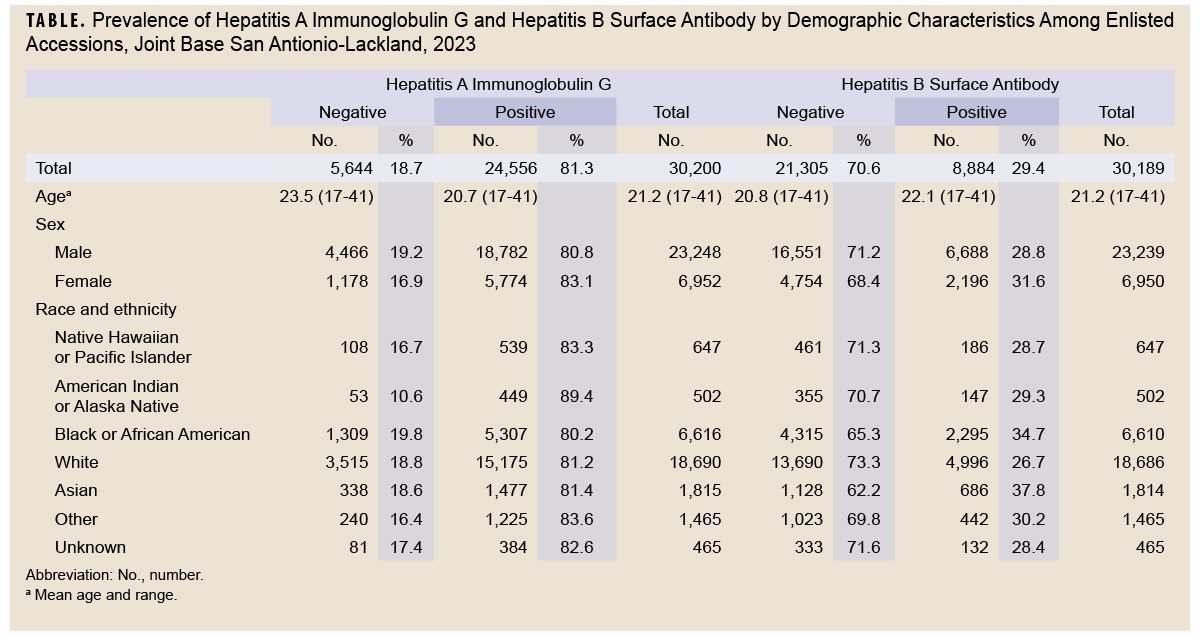
This analysis shows a much higher prevalence of HAV antibodies compared to HBV in the trainee population at JBSA-Lackland during 2023. Trainees negative for anti-HBs may have never been vaccinated, were non-responders to HBV vaccination, or had waning anti-HBs titers. These data are consistent with published studies demonstrating that 75-93% of adolescents and young adults who were vaccinated as infants have anti-HBs levels under 10 mIU/mL.2,5,6 Young adults who completed the HBV vaccine series as infants may not, however, need to be revaccinated due to persistent memory cell immunity.7 In contrast, the HAV vaccine series induces a long-lasting, measurable IgG response.4 Prior MSMR reports describe HAV and HBV antibody positivity in U.S. Army enlisted accessions.8,9 This Surveillance Snapshot updates results for 2023 in a similar population, enlisted recruits at JBSA-Lackland. The data presented herein were reviewed by the 59th Medical Wing Institutional Review Board, and there is no objection to its publication.
Author Affiliations
Uniformed Services University of the Health Sciences, Department of Preventive Medicine and Biostatistics, Bethesda, MD: Maj Kelly, Maj Ching, Lt Col Winkler, Lt Col Sayers; Trainee Health Surveillance, Joint Base San Antonio-Lackland, TX: Dr. Casey, Ms. Osuna, Ms. Jung, Lt Col Winkler
Disclaimer
The views expressed are those of the authors and do not reflect the official views of the Uniformed Services University of the Health Sciences, U.S. Air Force, nor the Department of Defense. This work was prepared by a military or civilian employee of the U.S. Government as part of the individual’s official duties and therefore is in the public domain and does not possess copyright protection (public domain information may be freely distributed and copied; however, as a courtesy it is requested that the Uniformed Services University and the author be given an appropriate acknowledgement). Mention of trade names, commercial products, or organizations does not imply endorsement by the U.S. Government.
References
- Nelson NP, Weng MK, Hofmeister MG, et al. Prevention of hepatitis A virus infection in the United States: recommendations of the Advisory Committee on Immunization Practices, 2020. MMWR Morb Mortal Wkly Rep. 2020;69(5):1-38. doi:10.15585/mmwr.rr6905a1
- Schillie S, Murphy TV, Sawyer M, et al. CDC guidance for evaluating health-care personnel for hepatitis B virus protection and for administering postexposure management. MMWR Morb Mortal Wkly Rep. 2013;62(Rr-10):1-19.
- Mast EE, Margolis HS, Fiore AE, et al. A comprehensive immunization strategy to eliminate transmission of hepatitis B virus infection in the United States: recommendations of the Advisory Committee on Immunization Practices (ACIP) part 1: immunization of infants, children, and adolescents. MMWR Morb Mortal Wkly Rep. 2005;54(Rr-16):1-31.
- Herzog C, Van Herck K, Van Damme P. Hepatitis A vaccination and its immunological and epidemiological long-term effects–a review of the evidence. Hum Vaccin Immunother. 2021;17(5):1496-1519. doi:10.1080/21645515.2020.1819742
- Wang CW, Wang LC, Chang MH, et al. Long-term follow-up of hepatitis B surface antibody levels in subjects receiving universal hepatitis B vaccination in infancy in an area of hyperendemicity: correlation between radioimmunoassay and enzyme immunoassay. Clin Diagn Lab Immunol. 2005;12(12):1442-1447. doi:10.1128/cdli.12.12.1442-1447.2005
- Al Ateeq MA, Al Enazi LM, Al Shammari MS, et al. Long-term immunity against hepatitis B virus after routine immunization among adults visiting primary care centers in Riyadh, Saudi Arabia. Cureus. 2022;14(1):e21266. doi:10.7759/cureus.21266
- Bruce MG, Bruden D, Hurlburt D, et al. Antibody levels and protection after hepatitis B vaccine: results of a 30-year follow-up study and response to a booster dose. J Infect Dis. 2016;214(1):16-22. doi:10.1093/infdis/jiv748
- Green D. Hepatitis B immunity among U.S. Army basic trainees, Fort Leonard Wood, MO, July 2005-December 2005. MSMR. 2006;12(5):7-8.
- Eick A, Hu Z, Wang Z, Hughes H, Remington N. Hepatitis A immunity among enlisted accessions to the U.S. Army, Fort Benning, GA, April-August 2006. MSMR. 2006;12(7):18-20.