What are the new findings?
In 2024 the rate of ambulatory visits in U.S. military and non-military medical facilities was 16.5 visits per person-year, 10.8% higher than the 2023 rate. Excluding administrative visits, the crude annual rate of 13.4 visits per person-year for illnesses and injuries in 2024 was 17.4% higher than in 2022 and 55.6% higher than in 2020. The numbers and rates of primary causes for ambulatory visits have increased in 16 of 18 diagnostic categories from 2020 to 2024, except for ‘other’ and COVID-19 diagnoses. Musculoskeletal, mental, and nervous system or sensory organ disorders remain the leading causes of ambulatory visits, with substantial increases from 2020 to 2024. Musculoskeletal disorders showed the largest absolute ambulatory visit increase, with 1,675,234 total additional visits in 2024 in comparison to 2020, followed by mental health disorders, which increased by 650,888 visits during the same period.
What is the impact on readiness and force health protection?
Disorders of the musculoskeletal, mental, and nervous system and sensory organ major diagnostic categories are already known to have significant impacts on the well-being of military personnel and operational readiness. Unaddressed musculoskeletal injuries and mental health disorders may lead to prolonged periods of unoccupied time, reduced ability to meet the physical and psychological demands of military service, and contribute to attrition.
Background
This report documents the frequencies, rates, trends, and characteristics of ambulatory health care visits in 2024 of active component members of the U.S. Army, Navy, Air Force, Marine Corps, and Space Force. Ambulatory visits of U.S. service members in fixed military and non-military (reimbursed through the Military Health System) hospitals and clinics are documented by standardized records that are routinely archived in the Defense Medical Surveillance System for health surveillance purposes. Ambulatory visits not routinely and completely documented within fixed military and non-military hospitals and clinics (e.g., during deployments, field training exercises, or at sea) are not included in this analysis.
As in prior MSMR reports, all records of ambulatory health care visits by active component service members were categorized according to the International Classification of Diseases, 10th Revision codes entered in the primary (i.e., first-listed) diagnostic position of the visit records. Incidence rates were calculated per 1,000 person-years. Percent change in incidence was calculated using unrounded rates.
Frequencies, rates and trends
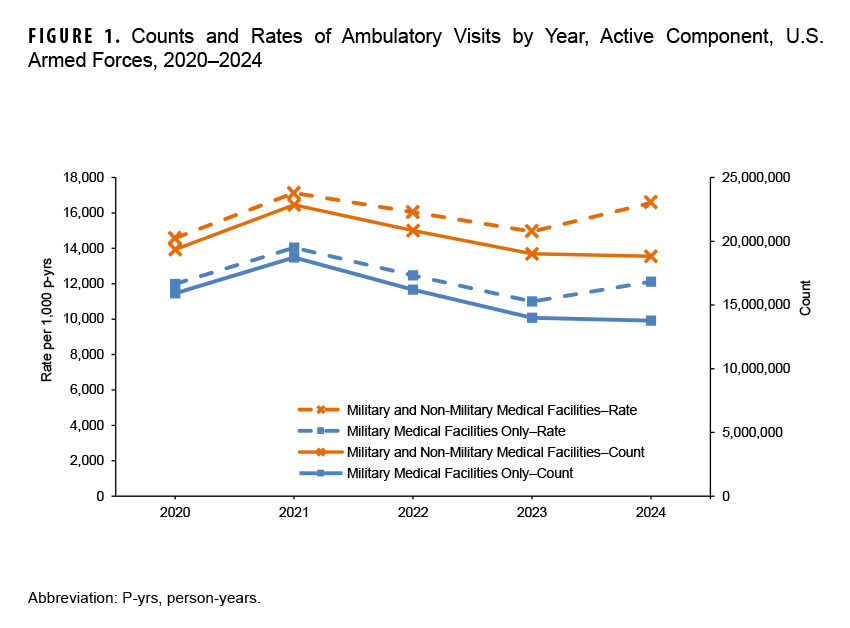
In 2024, U.S. ACSMs completed 18,821,239 ambulatory visits for medical care, resulting in a crude annual rate—for all causes—of 16,563.4 visits per 1,000 p-yrs, or 16.5 visits per p-yr (Table 1). 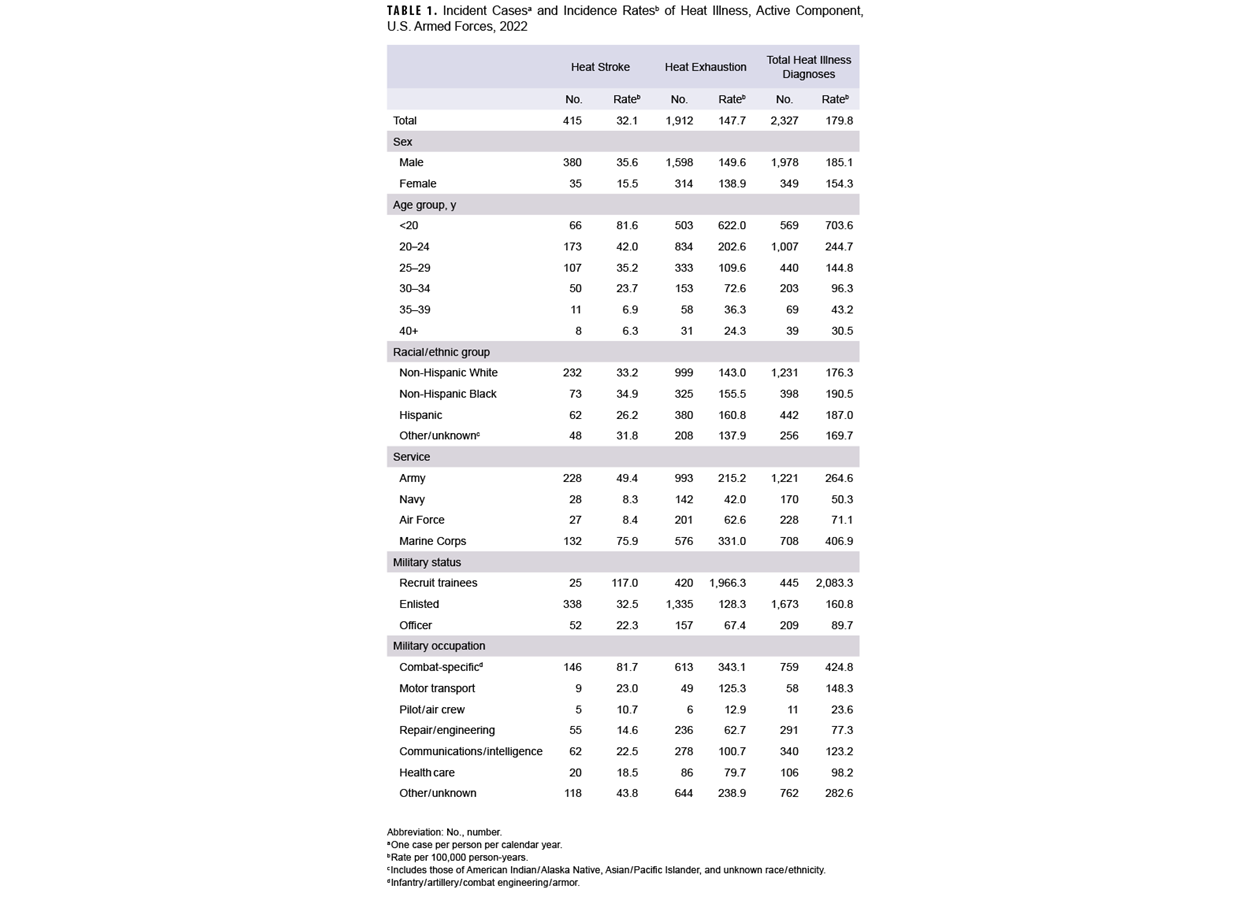 The observed rate represents an increase of 10.8% from 2023, despite the absolute number of visits continuing a decline from a peak in 2021 (Figure 1). Excluding the ‘other’ major diagnostic category, there were 15,220.739 documented ambulatory visits for illnesses and injuries (ICD-10: A00–T88, including relevant pregnancy ‘Z’ codes) in 2024, corresponding to a crude rate of 13.4 visits per p-yr, which is 17.4% higher than in 2022 (11.4 per p-yr) and 55.6% higher than in 2020 (8.6 per p-yr).
A ‘Z’ code in the first diagnostic position identifies administrative visits within the ‘other’ category that reflects the care related to other factors influencing health status and contact with health services (excluding pregnancy). After a sharp decline observed in Z-coded encounters in 20231 compared to 2021 and 2019, the frequency in 2024 remained relatively stable, with a slight 3.7% increase over the previous year (data not shown).
Ambulatory visits, by ICD-10 major diagnostic categories
As in prior years, the leading 5 major diagnostic categories in 2024 remained consistent, accounting for almost four-fifths (79.5%) of all ambulatory visits among ACSMs. Musculoskeletal system/connective tissue disorders (28.1%) rose to become the leading category in 2024, surpassing ‘other’ (19.1%), which was the dominant category in 2020 and 2022. Mental health disorders (14.5%), disorders of the nervous system and sensory organs (9.8%), and signs, symptoms and ill-defined conditions (7.9%) maintained stable rankings (Table 1). Rankings for other diagnostic categories were largely stable, with only a modest shift in endocrine disorders surpassing infectious diseases. In contrast, COVID-19 fell to the lowest rank, representing only 0.1% of visits, down from 0.8% in 2022, reflecting pandemic peak and decline.
Excluding the ‘other’ category, rates of ambulatory visits increased in all but 1 of the 17 major diagnostic categories of illnesses and injuries between 2020 and 2024. As in prior years, diagnostic ‘S’ codes (for injuries), as opposed to ‘T’ codes (burns and poisonings), accounted for nearly 90% of all ambulatory encounters within this major diagnostic category (data not shown). Excluding the ‘other’ major diagnostic category, COVID-19 was the sole diagnostic category to decline in both numbers and rates within the illness and injury major category, with visits decreasing by 62.9%. Musculoskeletal system conditions accounted for the highest growth in ambulatory visits, totaling an additional 1,675,234 visits (rate increase of 70.9%) from 2020 to 2024, followed by mental health disorders (650,888 more visits, 53.2% rate increase). Except for infectious diseases and pregnancy and delivery-related visits, all other diagnostic categories exhibited rate increases exceeding 40% (Figure 2). Infectious diseases increased by only 5%, while pregnancy and delivery-related visits increased by 27.8%.
Ambulatory visits, by sex
For both male and female ACSMs, joint pain comprised over 40% of all diagnoses within the musculoskeletal system category. Adjustment disorder was the leading diagnosis in the mental health category, representing approximately 20% among both sexes (Tables 2 and 3). Unspecified and iron deficiency types of anemia were among the leading diagnoses within the hematological and immune disorders major diagnostic category, accounting for 28.2% and 56.7% of diagnoses among service men and women, respectively (Tables 2 and 3). Unspecified viral infection and unspecified acute upper respiratory infection were the leading diagnoses in 2024 for infectious and parasitic diseases and disorders of the respiratory system, respectively (Tables 2 and 3). While congenital anomalies were not frequently diagnosed among women, nearly a quarter (24.4%) of the congenital anomalies in men were attributed to congenital deformities of feet, including congenital pes planus (flat foot) and congenital pes cavus (high arch) (Table 2).
In 2024, service men accounted for nearly three-fourths (71.6%) of all illness- and injury-related visits, but the annual crude rate for service women (21.3 visits per p-yr) was 82.8% higher than among service men (11.7 visits per p-yr) (data not shown). Excluding pregnancy- and delivery-related visits, which accounted for 9.4% of all non-Z-coded ambulatory visits among service women, the illness and injury ambulatory visit rate was 19.4 visits per p-yr, 65.9% higher than among service men.
Rates of illness- and injury-specific diagnoses among service women exceeded male rates by 50% in all major diagnostic categories except diagnoses for nervous system and sensory organs, circulatory system, digestive system, and injury (data not shown). Female rates were more than twice those of male rates for conditions in the hematological, mental, genitourinary, and endocrine-, nutritional- and metabolic-related disorder categories.
Relationships between age group and ambulatory visit rates were broadly similar among men and women within all diagnostic categories (Figure 2). Ambulatory rates for musculoskeletal system, mental health disorders, neoplasms, disorders in nervous, digestive, circulatory systems, and endocrine-, nutritional- and metabolic-related conditions rose more steeply with advancing age than other categories of illness or injury (Figure 2).
Eight of the 10 leading diagnoses among ambulatory visits were the same for male and female service members: pain in joint; lower back pain; adjustment disorders; pain in limb, hand, foot, fingers, or toes; posttraumatic stress disorder; cervicalgia (neck pain); unspecified anxiety disorder; and sleep apnea. Sleep apnea was the second-most frequent illness- or injury-specific primary diagnosis for men, but ninth for women. The difference in the rate rank order of mental disorders is also worth noting. Alcohol dependence and unspecified acute respiratory infections were the sixth and tenth most frequent diagnoses, respectively, for men but were not identified among the leading 10 causes of ambulatory visits for women, while generalized anxiety disorder and unspecified dorsalgia were among the 10 most common diagnoses for women (Tables 2 and 3).
Discussion
In 2024, ambulatory visits among ACSMs increased by 10.8% compared to 2023, reaching 16.5 visits per person-year, although remaining below the 2021 peak. Rates for all major diagnostic categories increased, with the exception of the ‘other’ major diagnostic category and COVID-19. The largest absolute increase in the number of ambulatory visits was observed for musculoskeletal system disorders, which surpassed the ‘other’ category as the most frequent diagnosis. Notable growth was also seen within the mental health, nervous system, injury, and respiratory system categories. While infectious, endocrine, circulatory, neoplasms, hematological, and congenital anomalies experienced modest increases, their rankings remained relatively stable, at the lower end of the spectrum. When excluding visits documented by ICD-10 Z codes, the rate of illness- and injury-specific ambulatory visits was approximately 17% higher than in 2022, and over 55% higher than in 2020. The rate of encounters for COVID-19 peaked in 2022 (when it ranked fourteenth) and then sharply declined to last place by 2024, reflecting the pandemic peak and decline.
The sex-specific rate ratio for illness and injury-specific ambulatory encounters showed that female service members used outpatient care more often than their male counterparts (21.3 vs. 11.7 visits per p-yr, respectively). This is consistent with a recent report based on the 2022 National Ambulatory Medical Care Survey indicating that civilian women use health care services approximately 1.8 times more than civilian men.2 The crude annual rate of illness- and injury-related visits among ACSMs (13.4 visits per p-yr), however, far exceeds the rate of ambulatory visits among civilians ages 18-44 years (324.6 visits per 1,000 persons, or about 0.3 visits per p-yr).2 Future analyses comparing the major diagnostic category rates to civilian counterparts may be useful to further elucidate the costs of readiness.
Several limitations should be considered when interpreting these findings. Unit level ambulatory care, care by non-credentialed providers (e.g., medics, corpsmen), and at deployed medical treatment facilities (including ships at sea) are not included. This summary does not reflect that the nature and rates of illnesses and injuries may vary between deployed and non-deployed ACSMs.
Prior reports described the number of virtual versus in-person ambulatory encounters, but data quality issues about the variable delineating this encounter type have also been identified; it is an area of active inquiry.
This summary is based on primary (i.e., first-listed) diagnosis codes reported on ambulatory visit records, and the current summary discounts morbidity related to co-morbid and complicating conditions that may have been documented in secondary diagnostic positions within health care records. The accuracy of reported diagnoses likely varies according to medical condition, clinical setting, care provider, and treatment facility, as the information is collected for non-surveillance purposes. Although specific diagnoses during individual encounters were potentially not definitive, final, or even correct, summaries of the frequencies, trends, and natures of ambulatory encounters among ACSMs provide descriptive evidence to inform further research and evaluation.
Rates and frequencies reported do not reflect unique individuals, but a rate of total ambulatory visits per person-year. This report documents all ambulatory health care visits but does not estimate incidence rates for the diagnoses described. These data provide descriptors for health care provision, which elevate rates for disorders requiring increased numbers of ambulatory visits. In contrast to common, self-limited, and minor illnesses and injuries that require little, if any, follow-up or continuing care, illnesses and injuries necessitating multiple ambulatory visits for evaluation, treatment, and rehabilitation are over-represented in this summary.
References
- Armed Forces Health Surveillance Division. Ambulatory health care visits among active component members of the U.S. Armed Forces, 2023. MSMR. 2024;31(6):19-25. Accessed Aug. 21, 2025. https://www.health.mil/news/articles/2024/06/01/msmr-ambulatory-care-2023
- Santo L, Peters ZJ, Guluma L, Ashman JJ. Visits to health centers among adults, by selected characteristics: United States, 2022. Natl Health Stat Report. 2024;22(211):cS353454. doi:10.15620/cdc/59282