Abstract
This report provides an update, through June 2025, of routine screening results for antibodies to the human immunodeficiency virus (HIV) among members of the U.S. military. The HIV-antibody seropositivity rates for active component service members from 2024 through mid-year 2025 were highest for the Navy (0.23 per 1,000 tested) and Marine Corps (0.22 per 1,000 tested), followed by the Army (0.17 per 1,000 tested), and lowest for the Air Force (0.13 per 1,000 tested) and Coast Guard (0.11 per 1,000 tested). Mid-year HIV seropositivity rates, in comparison to 2024, increased for active component service members of the Army but decreased or remained stable for all other services, as of June 2025.
What are the new findings?
From January 2020 through June 2025, approximately 7 million U.S. military service members among the active component, reserve component, National Guard) were tested for antibodies to HIV, and 1,463 were identified as HIV-antibody-positive (seropositivity 0.21 per 1,000 tested). Of the 1,463 new infections identified during this period, only 40 (2.7%) were among female service members.
What is the impact on readiness and force health protection?
The HIV-antibody screening program remains an important element of U.S. force health protection, particularly for men under age 35 years, for all branches of service and service components. The measurement of military retention for HIV-positive service members reflects changes in U.S. Department of Defense policies that allow asymptomatic individuals with undetectable viral loads to serve without restrictions.
Background
The U.S. Department of Defense (DOD) has conducted an active surveillance program for HIV since 1986. All service members of the active component, reserve component and National Guard are screened at specific points in time: prior to entry (all accessions must be HIV-negative prior to the start of service), before deployment or any change in status (e.g., change in component, between branches, or commissioning), and once every 2 years while a member of the U.S. military.1 From 1990 through 2024, over 46 million tests for HIV antibodies were conducted to screen service members of the U.S. Armed Forces, resulting in the identification of 11,280 HIV new diagnoses (24.3 per 100,000 persons tested). While initial control efforts barred HIV-positive individuals from entering or serving in the military, leading to a precipitous drop in the rate of HIV diagnoses during the first decade of screening, the rate has remained stable for the last 2 decades.2
Infection with HIV remains a disqualifying diagnosis for entry into U.S. military service; however, in June 2022, the DOD amended policies to prevent HIV-positive service members with an undetectable viral load from being discharged or separated solely on the basis of HIV status.1 In addition, HIV-positive personnel are not non-deployable solely for a positive status, as decisions related to deployability should be made on a case-by-case basis, justified by a service member’s ability to perform assigned duties.3
Summaries of HIV seropositivity for members of the U.S. military have been published with MSMR since 1995. The current report summarizes numbers and trends of newly identified HIV-antibody seropositivity from January 1, 2020 through June 30, 2025 among military members of 5 services under the active and reserve components of the U.S. Armed Forces, in addition to the Army and Air Force National Guard.
Methods
The surveillance population included all individuals eligible for HIV antibody screening from January 1, 2020 through June 30, 2025 while serving in the active or reserve components of the U.S. Army, Navy, Air Force, Marine Corps, or Coast Guard. Space Force service members were categorized as Air Force for this analysis. All individuals who were tested, and all initial detections of HIV antibodies, through U.S. military medical testing programs were ascertained from the Department of Defense Serum Repository (DODSR) specimens accessioned to the Defense Medical Surveillance System (DMSS).
An incident case of HIV-antibody seropositivity was defined as an individual with positive HIV test results on 2 different, serial specimens. Individuals who had just 1 positive result without a subsequent negative result were also defined as positive, to capture those who had yet to test positive for a second time. The total number of HIV-positive tests were acquired from DMSS to calculate seropositivity rates as a standardized methodology for all services.
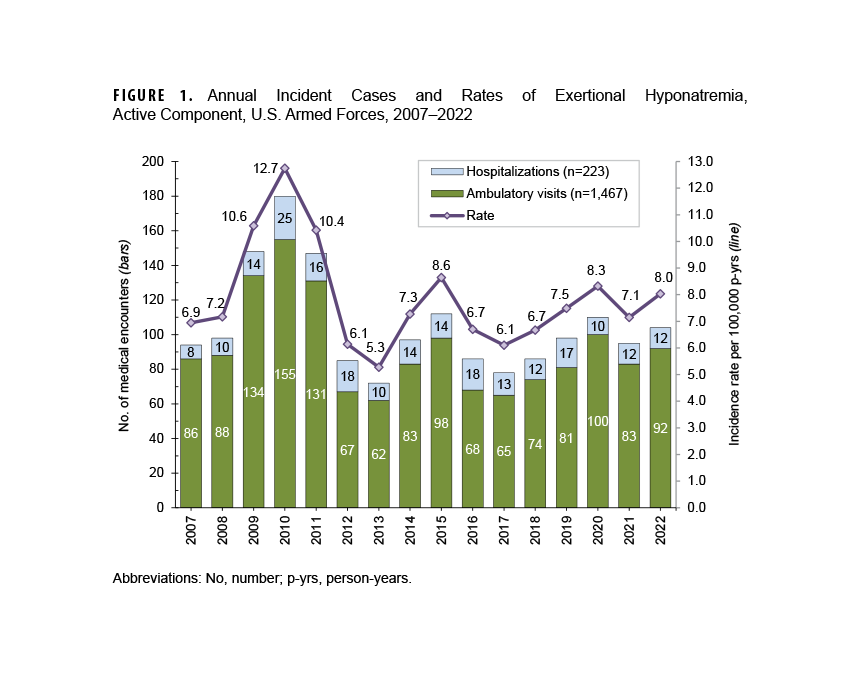 Annual rates of HIV seropositivity among service members were calculated by dividing the number of incident cases of HIV-antibody seropositivity during each calendar year by the number of individuals tested at least once during the relevant calendar year. Rates were further stratified by service, component, and sex. Overall rates by age category were calculated for all services for the complete annual years 2020 through 2024.
Results
From January 2020 through June 2025, approximately 7 million service members (active component, Guard, reserve) were tested for antibodies to HIV, and 1,463 were identified as HIV-antibody-positive (seropositivity 0.21 per 1,000 tested) (data not shown). The male rate (0.26 per 1,000 tested) persisted above the female rate (0.03 per 1,000 tested) throughout the surveillance period, as only 40 women were identified as newly HIV-antibody-positive during this time. Age-specific HIV seropositivity rates are presented for complete annual years in Figure 1; service members 25 to 34 years continually represented the highest age-specific rates from 2020 to 2024. In 2023, the seropositivity rate for service members ages 45-54 years increased to 0.21 per 1,000 tested, corresponding to an increase from 1 HIV seropositive cases identified in 2022 to 12 cases in 2023 (data not shown).
U.S. Army, active component
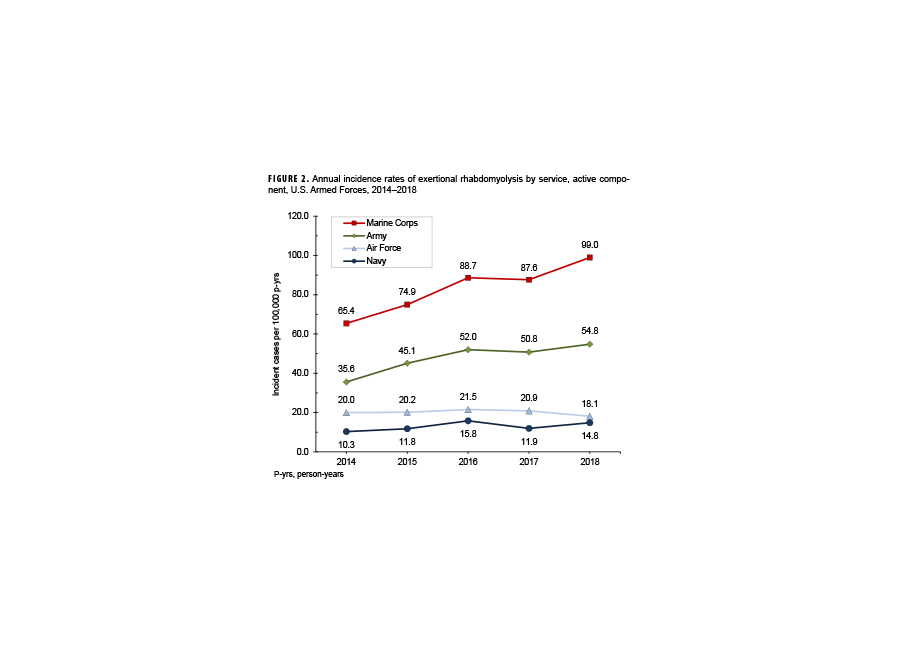
From January 2024 through June 2025, a total of 445,309 U.S. Army active component soldiers were tested for HIV antibodies, and 77 were identified as HIV-antibody-positive (seropositivity 0.17 per 1,000 tested) (Table 1). During the surveillance period, annual seropositivity rates fluctuated between a low of 0.15 per 1,000 tested in 2024 and a high of 0.28 per 1,000 tested in 2021 (Table 1, Figure 2). Annual seropositivity rates for male active component soldiers were considerably higher than the seropositivity rates of female active component soldiers (Figure 2). In 2024, 1 new HIV infection on average was detected among active component soldiers per 8,051 screening tests (Table 1). Of the 389 active component soldiers diagnosed since 2020 with HIV infection, 242 (62.2%) were still in military service in 2025.

Army National Guard
From January 2024 through June 2025, a total of 286,365 U.S. Army National Guard members were tested for HIV antibodies, and 102 soldiers were identified as HIV-antibody-positive (seropositivity 0.36 per 1,000 tested) (Table 2). On average, 1 new HIV infection was detected in 2024 among Army National Guard soldiers per 3,309 screening tests. Of the 301 National Guard soldiers diagnosed since 2020 with HIV infection, 214 (71.1%) were still in service in 2025.

Army Reserve
From January 2024 through June 2025, a total of 127,024 U.S. Army Reserve members were tested for HIV antibodies, and 42 were identified as HIV-antibody-positive (seropositivity 0.33 per 1,000 tested) (Table 3). During 2024, on average 1 new HIV infection was detected among Army reservists per 3,965 screening tests. Of the 153 Army reservists diagnosed since 2020 with HIV infection, 105 (68.6%) were still in service in 2025.
U.S. Navy, active component
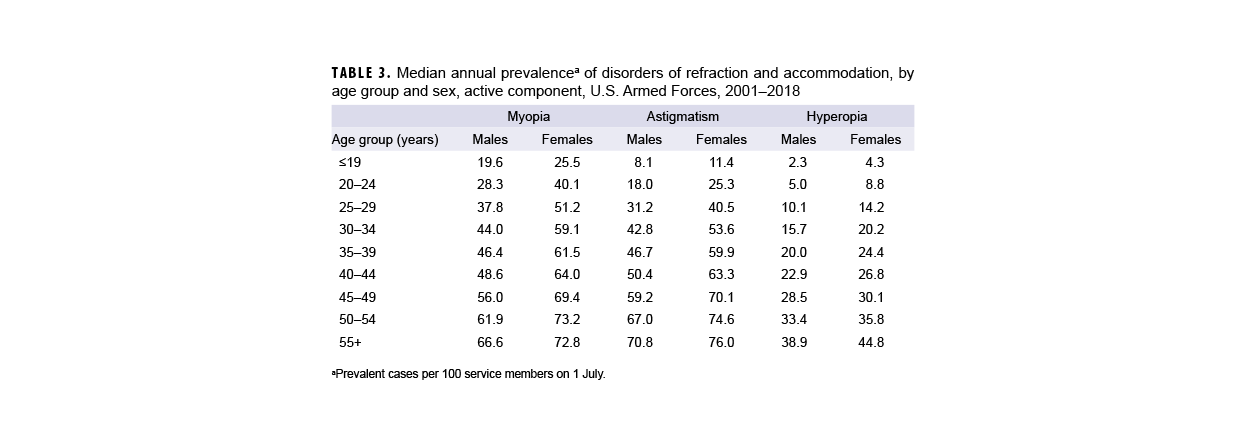
A total of 282,755 members of the U.S. Navy active component were tested for HIV antibodies from January 2024 through June 2025, and 65 sailors were identified as HIV-antibody-positive (seropositivity 0.23 per 1,000 tested) (Table 4). During the surveillance period, annual seropositivity rates fluctuated between a low of 0.16 per 1,000 tested in 2020 and a high of 0.29 per 1,000 tested in 2023 (Table 4, Figure 3). Annual seropositivity rates for male active component sailors were considerably higher than the seropositivity rates of female active component soldiers (Figure 3). During 2024, on average, 1 new HIV infection was detected among active component sailors per 4,990 screening tests. Of the 256 active component sailors diagnosed since 2020 with HIV infection, 181 (70.7%) were still in service in 2025.

Navy Reserve
From January 2024 through June 2025, a total of 45,073 members of the U.S. Navy Reserve were tested for HIV antibodies, with 9 sailors identified as HIV-antibody-positive (seropositivity 0.20 per 1,000 tested) (Table 5). On average, 1 new HIV infection was detected in 2024 among Navy reservists per 4,468 screening tests. Of the 33 reserve component sailors diagnosed since 2020 with HIV infection, 19 (57.6%) were still in service in 2025.
U.S. Air Force, active component
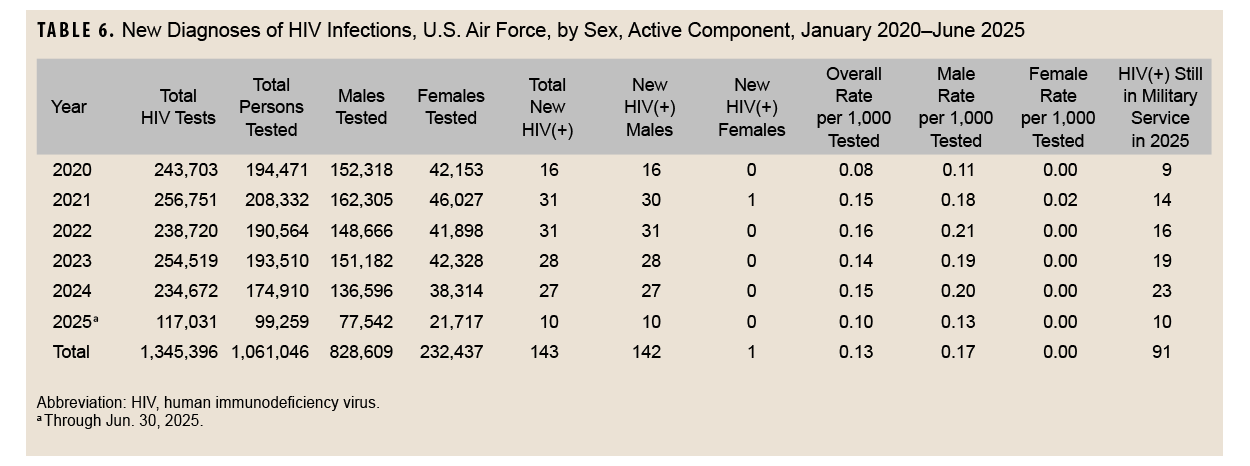
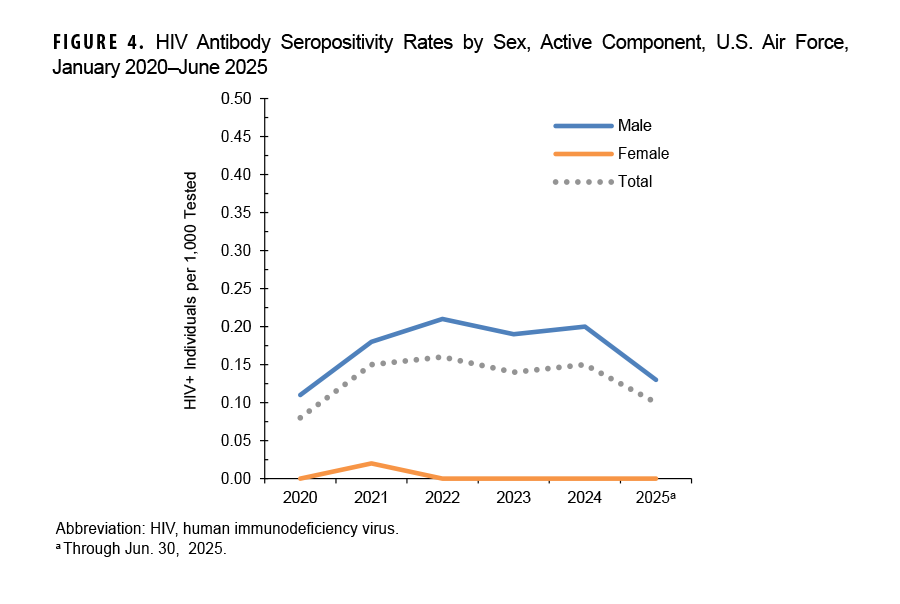
From January 2024 through June 2025, a total of 274,169 active component members of the U.S. Air Force were tested for HIV antibodies, and 37 Air Force members were diagnosed with HIV infection (seropositivity 0.13 per 1,000 tested) (Table 6). On average, 1 new HIV infection was detected in 2024 among active component Air Force members per 8,692 screening tests. Of the 143 active component Air Force members diagnosed since 2020 with HIV infection, 91 (63.6%) were still in service in 2025. During the surveillance period, seropositivity rates among male members ranged from a low of 0.08 per 1,000 tested in 2020 to a high of 0.16 per 1,000 tested in 2022 (Figure 4).
Air National Guard
From January 2024 through June 2025, a total of 85,121 members of the Air National Guard were tested for HIV antibodies, and 8 Air National Guard members were diagnosed with HIV infection (seropositivity 0.09 per 1,000 airmen tested) (Table 7). During 2024, on average 1 new HIV infection was detected among Air National Guard members per 13,930 screening tests. Of the 32 Air National Guard members diagnosed since 2020 with HIV infection, 24 (75.0%) were still in service in 2025.
Air Force Reserve
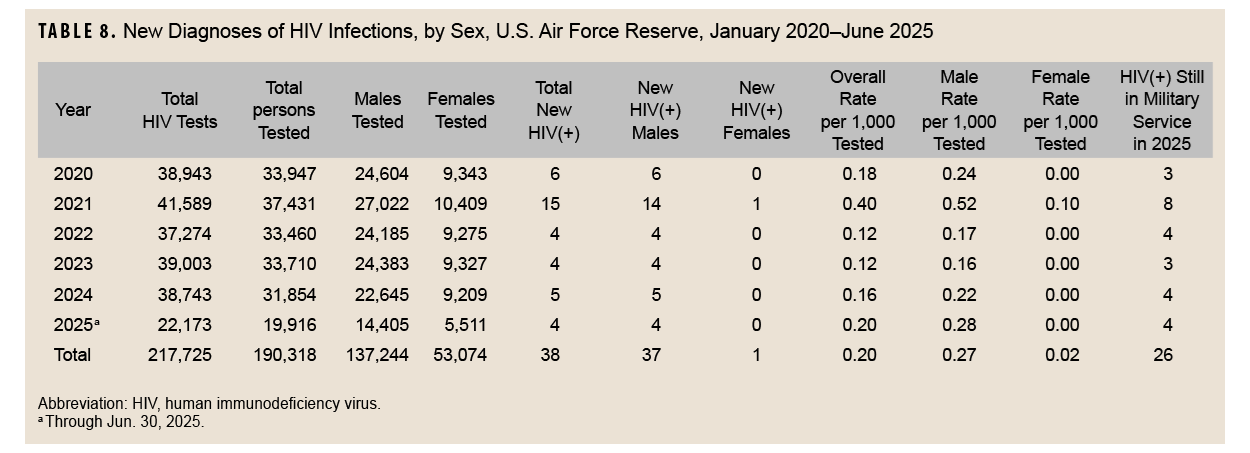
From January 2024 through June 2025, a total of 51,770 members of the Air Force Reserve were tested for HIV antibodies, with 9 Air Force reservists diagnosed with HIV infection (seropositivity 0.17 per 1,000 tested) (Table 8). On average, in 2024 1 new HIV infection was detected among Air Force reservists per 7,749 screening tests. Of the 38 Air Force reservists diagnosed since 2020 with HIV infection, 26 (68.4%) were still in service in 2025.
U.S. Marine Corps, active component
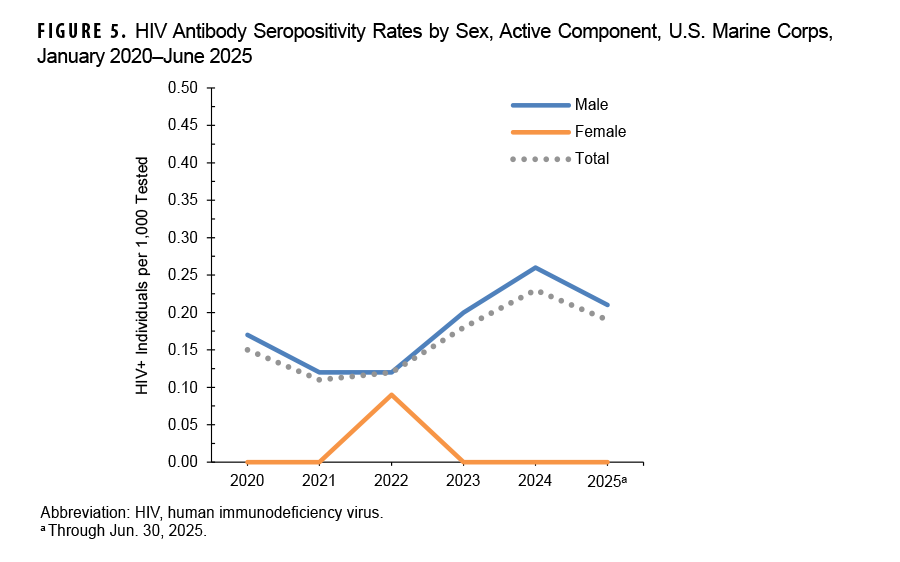
From January 2024 through June 2025, a total of 154,093 active component members of the U.S. Marine Corps were tested for HIV antibodies, and 34 were identified as HIV-antibody-positive (seropositivity 0.22 per 1,000 tested) (Table 9). Annual seropositivity rates rose from a low of 0.11 per 1,000 tested in 2021 to a high of 0.23 per 1,000 tested in 2024 (Table 9, Figure 5). In 2024, on average, 1 new HIV infection per 5,031 screening tests was detected among active component marines. Of the 100 active component marines diagnosed since 2020 with HIV infection, 58 (58.0%) were still in service in 2025.
Marine Corps Reserve
From January 2024 through June 2025, a total of 28,972 Marine Corps Reserve members were tested for antibodies to HIV, and 2 reservists were identified as HIV-antibody-positive (seropositivity 0.07 per 1,000 tested) (Table 10). During 2024, on average, 1 new HIV infection was detected among Marine Corps reservists per 10,730 screening tests. Of the 12 active component marine reservists diagnosed since 2020 with HIV infection, 5 (41.7%) were still in service in 2025.
U.S. Coast Guard, active component
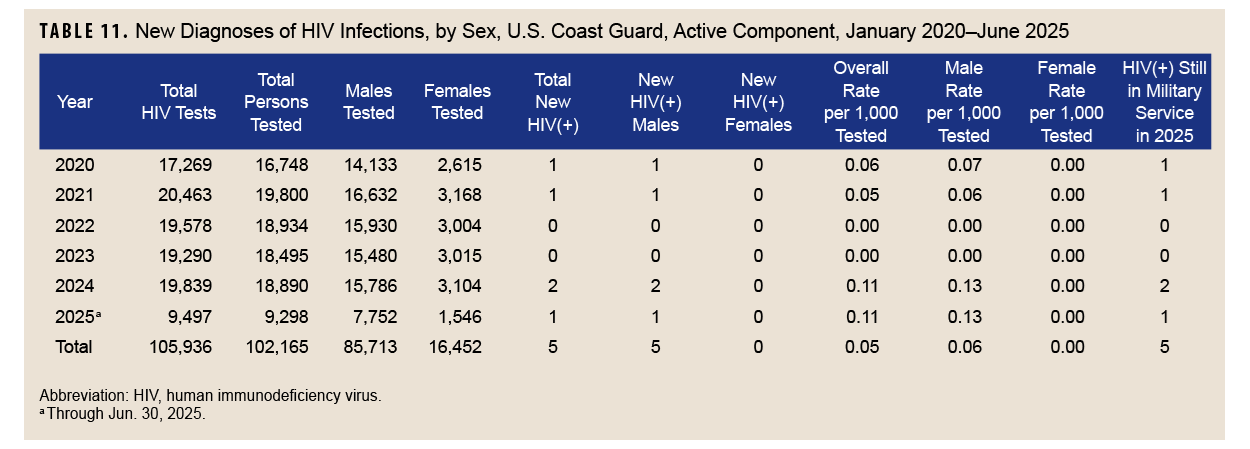
From January 2024 through June 2025, a total of 28,188 active component members of the U.S. Coast Guard were tested for antibodies to HIV, and 3 were identified as HIV-antibody-positive (seropositivity 0.11 per 1,000 tested) (Table 11). During 2024, on average, 1 new HIV infection was detected among active component members of the U.S Coast Guard per 9,920 screening tests. Of the 5 active component Coast Guard service members diagnosed since 2020 with HIV infection, all 5 were still in service in 2025.
Coast Guard Reserve
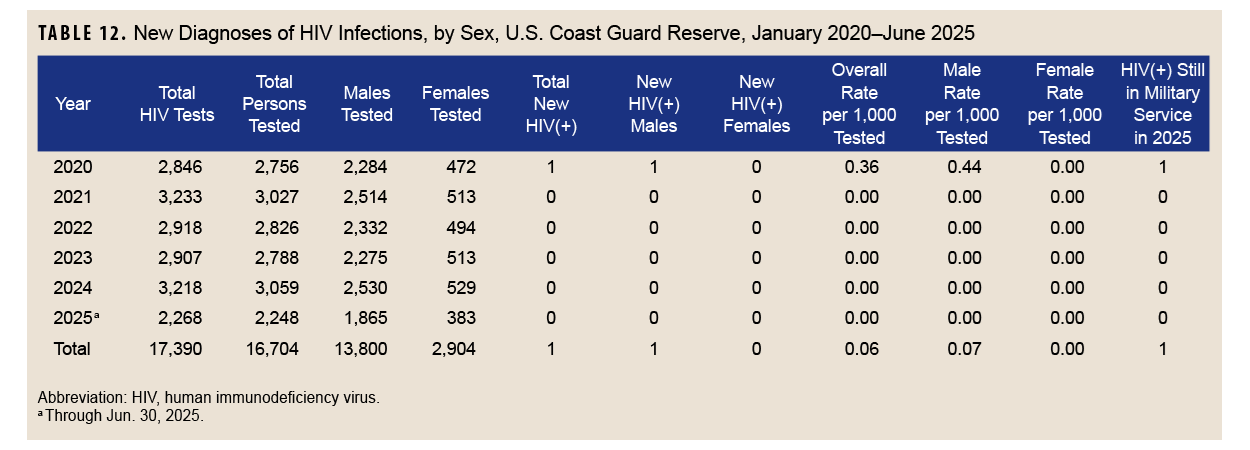
From January 2024 through June 2025, a total of 5,307 U.S. Coast Guard Reserve members were tested for HIV antibodies, with none identified as HIV-antibody-positive (Table 12).
Discussion
The most current seropositivity rate (0.21 per 1,000 tested) reported for January 1, 2024 through June 30, 2025 remains consistent with the seropositivity rate reported in the prior annual report (0.22 per 1,000 tested from January 1, 2023 to June 30, 2025).4 The U.S. military has conducted routine screening for antibodies to HIV among all civilian applicants for service and all service members for more than 30 years.5-8 In 1995, the U.S. Army tested approximately 1.1 million specimens annually, demonstrating an economically efficient, large-scale model for HIV testing.9 The first MSMR article to publish results from HIV screening programs indicates that antibody seropositivity rates in 1994 for the Army active duty (0.19 per 1,000 soldiers) and reserve component (0.23 per 1,000 soldiers) remain comparable to rates presented in 2025.10
A review of archived surveillance data also reflects improved retention of HIV-positive service members, in alignment with recent DOD policy that recognizes significant advances in the diagnosis, prevention, and treatment of the disease. From 1990 to 1994, a total of 889 active and reserve component soldiers were diagnosed with HIV-1 infection. By 1995, only 234 (26.0%) were still in service.10 Today, a comparative retention figure for active component Army service members has increased to 66.4%.
The 2022-2025 National HIV/AIDS strategy identifies youth ages 13-24 years as a priority population, based on increased risk for HIV transmission.11 While the seropositivity results presented in this report do partially represent this priority population, as over 43% of all new HIV infections were identified in service members younger than age 25 years, these results should not be generalized to the U.S. population. Data from HIV screening in U.S. military populations are based on a negative test prior to entry, as well as voluntary service. Previous MSMR reports presented HIV screening results for civilian applicants to the military service; however, those data are no longer available in the Defense Medical Surveillance System (DMSS), as the U.S. Military Entrance Processing Command stopped reporting data to the DMSS at the end of calendar year 2020. Thus, the data presented in this report reflect service members who had a negative HIV test upon entry to military service, followed by a positive test during uniformed service.
Routine screening of civilian applicants for service and periodic testing of all active and reserve component members have been fundamental components of the military’s HIV control and clinical management efforts.12 The most current HIV annual seropositivity rates indicate the HIV-antibody screening program remains an important element of force health protection, particularly for men younger than age 35 years, for all branches of service and components of the U.S. Armed Forces.
Acknowledgment
The editors would like to thank Gi-Taik Oh, MS, Principal Research Analyst, Epidemiology and Analysis Branch, Armed Forces Health Surveillance Division, for analyzing the data presented in this report.
References
- U.S. Department of Defense. Department of Defense Instruction 6485.01: Human Immunodeficiency Virus (HIV) in Military Service Members. Updated Jun. 6, 2022. Accessed Oct. 17, 2024. https://www.esd.whs.mil/portals/54/documents/dd/issuances/dodi/648501p.pdf
- Aumakhan B, Eick-Cost AA, Oh GT, Stahlman S, Johnson R. Four decades of HIV antibody screening in the U.S. military: a review of incidence and demographic trends, 1990–2024. MSMR. 2025;32(4):13-20. Accessed Oct. 9, 2025. https://www.health.mil/reference-center/reports/2025/04/01/msmr-vol-32-no-4-apr-2025
- The Secretary of Defense. Secretary of Defense Memorandum for Senior Pentagon Leadership, Commanders of the Combatant Commands, Defense Agency and DOD Field Activity Directors: Policy Regarding Human Immunodeficiency Virus-Positive Personnel Within the Armed Forces. U.S. Dept. of Defense. Jun. 6, 2022. Accessed Jan. 13, 2026. https://media.defense.gov/2022/jun/07/2003013398/-1/-1/1/policy-regarding-human-immunodeficiency-virus-positive-personnel-within-the-armed-forces.pdf
- Armed Forces Health Surveillance Center. Routine screening for antibodies to human immunodeficiency virus in the U.S. Armed Forces, active and reserve components, January 2019–June 2024. MSMR. 2024;31(10):2-10. Accessed Oct. 9, 2025. https://www.health.mil/reference-center/reports/2024/10/01/msmr-vol-31-no-10-oct-2024
- Brown AE, Brundage JF, Tomlinson JP, Burke DS. The U.S. Army HIV testing program: the first decade. Mil Med. 1996;161(2):117-122. doi:10.1093/milmed/161.2.117
- Armed Forces Epidemiological Board. Testing Interval for Human Immunodeficiency Virus (HIV-1) Infection in Military Personnel–2003-05. U.S. Dept. of Defense. Updated Mar. 29, 2004. Accessed Oct. 17, 2024. https://www.health.mil/reference-center/policies/2004/03/29/policy-memorandum---humanimmunodeficiency-virus-interval-testing
- Office of the Under Secretary of Defense for Personnel and Readiness. Department of Defense Instruction 6485.01: Human Immunodeficiency Virus (HIV) in Military Service Members. U.S. Dept. of Defense. Updated Jun. 6, 2022. Accessed Oct. 17, 2024. https://www.esd.whs.mil/portals/54/documents/dd/issuances/dodi/648501p.pdf
- Office of the Under Secretary of Defense for Personnel and Readiness. DoD Instruction 6130.03, Volume 1: Medical Standards for Appointment, Enlistment, or Induction. U.S. Dept. of Defense. Updated May 28, 2024. Accessed Oct. 17, 2024. https://www.esd.whs.mil/portals/54/documents/dd/issuances/dodi/613003_vol01.pdf?ver=b0uhh9e1k_mdtz4punu8aw%3d%3d
- Brown AE, Burke DS. Cost of HIV testing in the U.S. Army. NEJM. 1995;332(14):963. doi:10.1056/nejm199504063321419
- Army Medical Surveillance Activity. Supplement: HIV-1 in the Army. MSMR. 1995;1(3):12-15. Accessed Oct. 9, 2025. https://www.health.mil/reference-center/reports/1995/01/01/medical-surveillance-monthly-report-volume-1-number-3
- Hiv.gov, U.S. Dept of Health and Human Services. National HIV/AIDS Strategy for the United States 2022–2025. White House Office of National AIDS Policy;2021. Accessed Jan. 13, 2026. https://files.hiv.gov/s3fs-public/NHAS-2022-2025.pdf
- Okulicz JF, Beckett CG, Blaylock JM, et al. Review of the U.S. military’s human immunodeficiency virus program: a legacy of progress and a future of promise. MSMR. 2017;24(9):2-7. Accessed Oct. 9, 2025. https://www.health.mil/reference-center/reports/2017/01/01/medical-surveillance-monthly-report-volume-24-number-9