Reportable medical events at Military Health System facilities through week 36, ending September 6, 2025
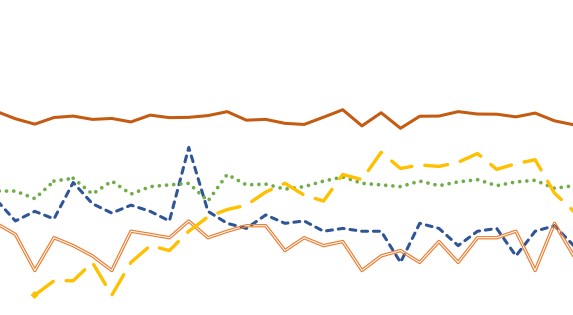 Reportable medical events are documented to monitor, control, and prevent the occurrence and spread of diseases.
12/1/2025
By:
Matthew W.R. Allman, MPH; Anthony R. Marquez, MPH; Katherine S. Kotas, MPH
Reportable Medical Events (RMEs) are documented in the Disease Reporting System internet (DRSi) by health care providers and public health officials throughout the Military Health System (MHS) for monitoring, controlling, and preventing the occurrence and spread of diseases of public health interest or readiness importance. These reports are reviewed by each service’s public health surveillance hub. The DRSi collects reports on over 70 different RMEs, including infectious and non-infectious conditions, outbreak reports, STI risk surveys, and tuberculosis contact investigation reports. A complete list of RMEs is available in the 2022 Armed Forces Reportable Medical Events Guidelines and Case Definitions.1 Data reported in these tables are considered provisional and do not represent conclusive evidence until case reports are fully validated.
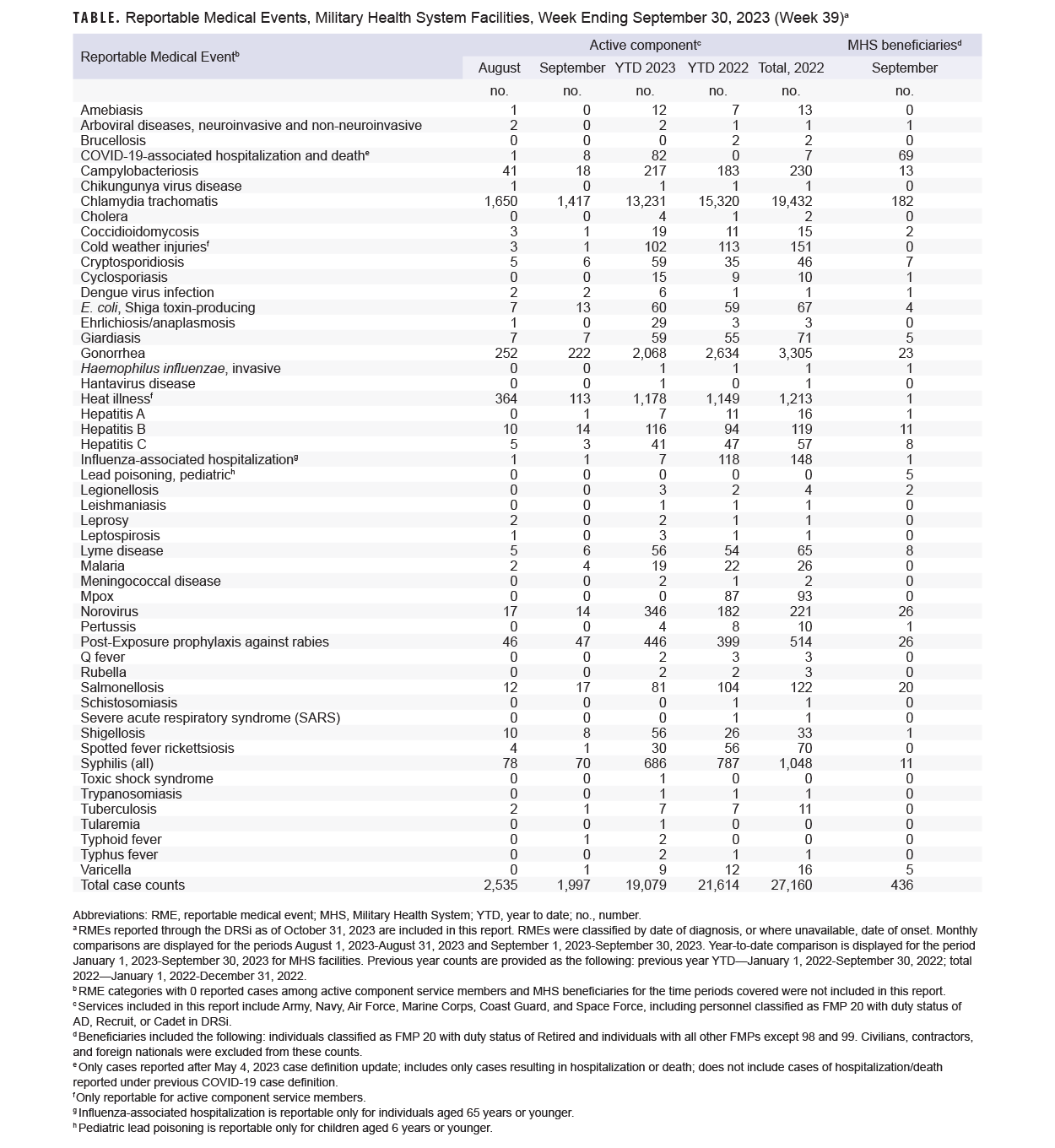
Total active component cases reported per week are displayed for the top 5 RMEs for the previous year. Each month, the graph is updated with the top 5 RMEs, and is presented with the current month’s (August 2025) top 5 RMEs, which may differ from previous months. COVID-19 is excluded from these graphs due to changes in reporting and case definition updates in 2023.
For questions about this report, please contact the Disease Epidemiology Branch at the Defense Centers for Public Health–Aberdeen. Email: dha.apg.pub-health-a.mbx.disease-epidemiologyprogram13@health.mil
Authors’ Affiliation
Defense Health Agency, Disease Epidemiology Branch, Defense Centers for Public Health–Aberdeen
References
- Armed Forces Health Surveillance Division. Armed Forces Reportable Medical Events. Accessed Feb. 28, 2024. https://health.mil/reference-center/publications/2022/11/01/armed-forces-reportable-medical-events-guidelines
- Defense Manpower Data Center. Department of Defense Active Duty Military Personnel by Rank/Grade of Service. Accessed Feb. 28, 2024. https://dwp.dmdc.osd.mil/dwp/app/dod-data-reports/workforce-reports
- Defense Manpower Data Center. Armed Forces Strength Figures for January 31, 2023. Accessed Feb. 28, 2024. https://dwp.dmdc.osd.mil/dwp/app/dod-data-reports/workforce-reports
- Navy Medicine. Surveillance and Reporting Tools–DRSI: Disease Reporting System Internet. Accessed Feb. 28, 2024. https://www.med.navy.mil/navy-marine-corps-public-health-center/preventive-medicine/program-and-policy-support/disease-surveillance/drsi
You also may be interested in...
Report
Aug. 1, 2026
 .PDF |
3.15 MB
.PDF |
3.15 MB
The August 2026 issue of MSMR presents the annual report on diagnoses of mental health disorders among U.S. active component service members (ACSMs), 2021-2025; with a related report on trends in postpartum depression and anxiety diagnoses among U.S. active component service women, 2010-2024; complemented by a report on chronic insomnia and military ...
Report
July 1, 2026
.PDF |
3.23 MB
The June-July 2026 MSMR presents the annual burden of morbidity issue, with data and analysis of absolute and relative morbidity burdens due to illnesses and injuries in 2025 among U.S. active component and reserve service members, as well as Military Health System beneficiaries.
Report
May 1, 2026
.PDF |
2.07 MB
The May 2026 MSMR features four full reports and a brief report, beginning with the annual update of heat exhaustion and heat stroke among U.S. active component service members, 2021–2025; complemented by the annual updates on exertional rhabdomyolysis and exertional hyponatremia among active component service members, 2021–2025; followed by the ...
Report
April 1, 2026
.PDF |
1.30 MB
The April 2026 MSMR features two full reports and a brief report, beginning with a study of tobacco and nicotine use indicators from two data sources for U.S. active component service members in 2023; followed by a report on head and neck cancer among active component service members from 2010 to 2024; with brief report on the incidence of ...
Report
March 1, 2026
.PDF |
1.74 MB
The March 2026 MSMR features two full reports and a Surveillance Snapshot, beginning with a report on mortality rates among U.S. service members, from 2010 to 2020; followed by a report on the incidence and burden of endometriosis among U.S. active component service women, 2017 to 2024; with a Surveillance Snapshot on mid-year populations by sex, age, ...
Report
Feb. 1, 2026
.PDF |
1.29 MB
The February 2026 MSMR features a report on the number of tuberculosis tests and diagnoses of latent tuberculosis infection in the U.S. Army; a historical review on post-infection symptoms in U.S. soldiers with malaria during World War II and its major limitation to return to duty; a Surveillance Snapshot on adherence to disease and injury ...
Report
Jan. 1, 2026
.PDF |
3.43 MB
The January 2026 MSMR features a full report on Guillain-Barré syndrome among U.S. active component service members, 2014–2022; and a report on distinct approaches to racial and ethnic classification to the surveillance of obstetric and neonatal outcomes in the U.S. military, 2010–2021; followed by a case report an atypical Ross River virus infection ...
Report
Dec. 1, 2025
.PDF |
2.86 MB
The December 2025 issue of MSMR features four full reports: the annual update on cold weather injuries among the active and reserve components; a report on trends in the prevalence of obesity among U.S. active component service members and civilians; the annual update on diagnoses of mental health disorders among active component service members; a ...
Report
Nov. 1, 2025
.PDF |
3.56 MB
The November 2025 MSMR presents four full reports on sexually transmitted infections (STIs), led by the annual update on STIs among active component service members, 2016–2024; followed by a report on follow up testing for chlamydia or gonorrhea among male Air Force basic trainees, 2017–2023; accompanied by a report on sexual networks of service ...
Report
Oct. 1, 2025
.PDF |
2.90 MB
The October 2025 MSMR presents five full reports: measles, mumps, rubella and varicella within the Military Health System; seasonal influenza hospitalization among service members; BMI, physical fitness, and COVID-19 hospitalization in the Army; adverse pregnancy outcomes in female service members after COVID-19 infection or vaccination; long COVID ...
Report
Sept. 1, 2025
.PDF |
4.01 MB
The September 2025 MSMR presents the annual burden of morbidity issue, with data and analysis of absolute and relative morbidity burdens due to illnesses and injuries among U.S. active component service members in 2024.
Report
Aug. 1, 2025
.PDF |
2.71 MB
The August 2025 MSMR presents four articles: a report on venomous animal bites and stings in U.S. active component service members, 2008–2023; a report on potential high arbovirus exposure in INDOPACOM during U.S. deployment or exercises in Papua New Guinea; a Historical Perspective on early U.S. military immunization against tetanus and diphtheria; ...
Report
July 1, 2025
.PDF |
2.01 MB
The July 2025 MSMR features four articles, with a report on a vaccine-preventable outbreak of acute respiratory illness and pneumonia associated with adenovirus at a U.S. Marine Corps training center; followed by a brief report on longitudinal associations between health-related quality of life and female service member readiness; a case report on a ...
Report
June 1, 2025
.PDF |
2.20 MB
Section 508-compliant PDF of MSMR Vol 32 No 6 June 2025
Report
May 1, 2025
.PDF |
3.62 MB
Section 508-compliant May 2025 MSMR, volume 32 number 5
You are leaving Health.mil
The appearance of hyperlinks does not constitute endorsement by the Department of Defense of non-U.S. Government sites or the information, products, or services contained therein. Although the Defense Health Agency may or may not use these sites as additional distribution channels for Department of Defense information, it does not exercise editorial control over all of the information that you may find at these locations. Such links are provided consistent with the stated purpose of this website.
You are leaving Health.mil
View the external links disclaimer.
Last Updated: February 03, 2026