A History of the Combat Helmet and the Quest to Prevent Injuries
Image of A History of the Combat Helmet and the Quest to Prevent Injuries. A History of the Combat Helmet and the Quest to Prevent Injuries

As a critical piece of a warfighter's protective gear, the combat helmet has vastly improved over the years as new technology and better designs have reduced the risk of fatal blows and traumatic brain injuries.

The earliest combat helmets were made from bronze and used to protect soldiers from swords and arrows. They were heavy, crudely designed and did not fit well.

During World War I and World War II, standard helmets were made from thin steel. They provided protection mainly against shrapnel rather than shock waves. They were lighter and provided better protection than helmets from previous eras.

But at that time, soldiers were often reluctant to use their chin strap because they believed that "it was better for [the helmet] to be knocked off rather than injure the soldier's neck," said Alan Hawk, a collections manager for the National Museum of Health and Medicine, a branch of the Research Support Division in the Research & Engineering Directorate of the Defense Health Agency.

Technology and safety protocols have evolved in recent years, resulting in helmets that provide more protection from both projectiles and shock waves.
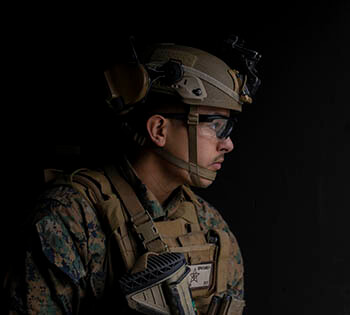
Modern combat helmets, like the one worn by this Marine, offer protection from both projectiles and blast waves. They are also designed to incorporate the use of communications equipment and other devices that can improve warfighter performance and capability. (Photo: Lance Cpl. Manuel Alvarado, U.S. Marine Corps)

Modern Helmets

Modern helmets became lighter as steel was replaced with composite materials like Kevlar. They now have padding and fitted chinstraps, allowing the helmet to stay attached during a blast. Inside, they include an energy-absorbing liner. Modern helmets are designed and tested to meet consistent standards to protect soldiers from concussions and other injuries.

Visibility is also now a key factor to helmet design.

"The best helmet in the world is not effective if a soldier walks into an ambush due to hampered vision," Hawk said.

In recent years, U.S. Special Operations Command helped develop a new helmet designed to integrate modern communications devices. The Army adopted a version of that helmet in 2002 and named it the Advanced Combat Helmet.

Modern helmets are also customized for specific jobs beyond the traditional infantry. Aircrew helmets protect from impact and noise. Helicopter aircrew have helmets that help protect against ricochets from the ground. Both helmets typically have built-in communications headsets and visors as well.

Modern helmet designers optimize protection using test standards and methods measuring the probability of neck injuries, concussions, and other injuries for specific conditions like ejection, said Benjamin Steinhauer, an engineer for the Air Force Research Laboratory's 711th Human Performance Wing.

The Future of Helmets

New helmets focus on suspension technology, which uses shock absorbing webbing, and lightweight and crack resistant materials.

While experts agree there will never be a perfect helmet, the military continues to make significant gains in protecting service members from TBI and other injuries.

"We do find ways to make helmets lighter without sacrificing the mission," Steinhauer said.

You also may be interested in...

Video
Mar 23, 2023

Military Traumatic Brain Injury: The History, Impact, and Future

Military Traumatic Brain Injury: The History, Impact, and Future

Megan Lindberg, Pathway of Care Manager for the Traumatic Brain Injury Center of Excellence, gives a presentation on the history, impact, and future of TBI in the military during the National Museum of Health and Medicine's Science Cafe series, March 23, 2023. The museum's Science Cafe is a regular speaker series that explores topics within military ...

Video
Feb 21, 2023

Brain Injury Awareness with the 19th Sgt. Maj. of the Marine Corps

Thumbnail image of the Picking Your Brain podcast episode with Sgt. Maj. Troy Black

In this episode of Picking Your Brain, TBICoE Branch Chief, Capt. Scott Cota and clinical moderator Amanda Gano interview the 19th Sgt. Maj. of the Marine Corps, Sergeant Major Troy Black. The interview covers topics such as the DOD's Warfighter Brain Health Initiative, the commandant of the Marine Corps' Force Design 2030 efforts, and how warfighter ...

Video
Feb 21, 2023

Optimizing Warfighter Brain Health and Performance

Thumbnail image of TBICoE's Dr. Sloley video.

Traumatic Brain Injury Center of Excellence research support cell chief, Dr. Stephanie Sloley, discusses her role in the organization and the importance of collaborative efforts in examining traumatic brain injuries. Dr. Sloley discusses the mission and vision of TBICoE and the importance of optimizing warfighter brain health and performance.

Video
Jul 18, 2022

Interview with the SEAC: TBI from a Joint Perspective

Picking Your Brian Podcast. Interview with the SEAC: TBI from a Joint Staff Perspective

In this episode of Picking Your Brain, Traumatic Brain Injury Center of Excellence Branch Chief Capt. Scott Cota and clinical moderator Amanda Gano interview the Senior Enlisted Advisor to the Chairman of the Joint Chiefs of Staff (SEAC), Ramón Colón-López. The discussion covers the health impacts of TBI and blast-related concussion stemming from the ...

Video
Jul 11, 2022

What is Performance Nutrition

Dr, Jonathan Scott

Learn more about Performance Nutrition and healthy eating habits at the Consortium for Health & Military Performance. https://champ.usuhs.edu/. For more information about the Dietician Approved Fueling stations at your local commissary, go to https://www.commissaries.com/fueling_stations

Video
Jul 22, 2021

PRA Training Video 2: Six Major Changes

Thumbnail image of PRA Training Video 2, Six Major Changes

In this lesson we review the six major changes in the TBICoE's revised 2021 Progressive Return to Activity (PRA) Clinical Recommendation that differ from the original recommendation. The changes reflect the latest TBI research, and will make it easier for providers to manage the recovery process and return service members with concussion to full ...

Video
Jul 22, 2021

PRA Training Video 5: The Six Stages of the PRA

Thumbnail image for PRA training video 5, the six stages of the PRA

In this lesson, we cover the key activity objectives for each of the six stages of the Progressive Return to Activity (PRA) Clinical Recommendation and provide activity examples for each stage. Each stage is designed to gradually increase the intensity and duration of a service member's physical and cognitive activity as they advance in the PRA ...

Video
Jul 22, 2021

PRA Training Video 3: Understanding Relative Rest

Thumbnail image for PRA Training video 3, understanding relative rest

In this lesson we explain the differences between complete rest and relative rest in a staged concussion recovery process, and provide examples of activities that promote relative rest. The revised Progressive Return to Activity (PRA) Clinical Recommendation uses the term 'relative rest' to emphasize the importance of early introduction of physical ...

Video
Jul 22, 2021

PRA Training Video 7: Symptom-Guided Management and Specialty Referral Guidance Tables

Thumbnail image of PRA training video 7, the symptom-guided management and specialty referral guidance tables.

This lesson covers how to use the Progressive Return to Activity, or PRA's Symptom-Guided Management and Specialty Referral Guidance tables. This lesson also details primary care management strategies for service members who are not progressing as expected in the PRA. Each video in the Progressive Return to Activity training series is designed to ...

Video
Jul 22, 2021

PRA Training Video 6: The Return to Duty Screening

Thumbnail image of PRA training video 6, the return to duty screening

In this lesson, we cover how to perform the Return to Duty, or RTD screening, which now includes both vestibular/physical and neurocognitive examinations. The purpose of the RTD screening is to objectively measure whether a service member is ready for return to full duty. Each video in the Progressive Return to Activity training series is designed ...

Refine your search