Chikungunya is a mosquito-borne viral disease that can cause severe joint pain, fever, and other short- or long-term symptoms.1 Chikungunya is endemic to tropical and subtropical regions, with cases and outbreaks recorded in more than 100 countries.2 The U.S. Food and Drug Administration (FDA) recently approved 2 chikungunya vaccines: a live-attenuated vaccine called IXCHIQ in November 2023, and a virus-like particle vaccine called VIMKUNYA in February 2025.3 These vaccines are recommended for those traveling to high-risk areas. The FDA recently suspended the U.S. license for IXCHIQ in August 2025, however, citing vaccine safety concerns.4
This analysis was conducted to answer questions from military health leadership about the risk of chikungunya infection to service members and their families. The analysis employed data published in prior MSMR articles5-7 to provide case counts for all Military Health System (MHS) beneficiaries from 2020 through 2024. Data were drawn from the Defense Health Agency’s Disease Reporting System internet (DRSi), and were confirmed via medical chart review.
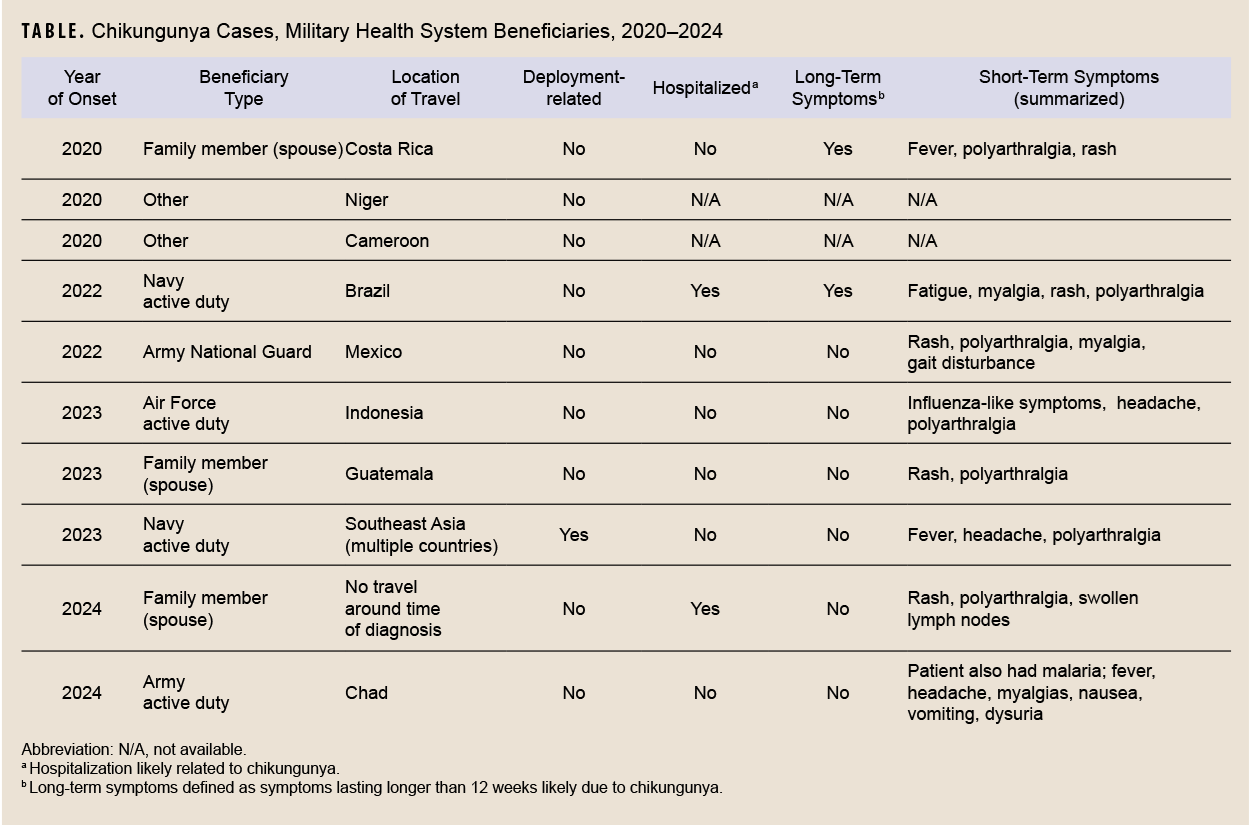
Ten cases of chikungunya virus disease among MHS beneficiaries were documented from 2020 through 2024 (Table). Five cases were recorded in service members, 3 among family members (all spouses), and 2 in other beneficiary types (i.e., not service members or dependents). One case was acquired while on deployment to multiple locations in Southeast Asia; no other cases were related to official travel or deployment. Most cases were related to unofficial travel.
Polyarthralgia, or pain in multiple joints, was the most documented symptom (n=7). Other commonly reported symptoms included fever, rash, and myalgia. Two cases had long-term symptoms (i.e., lasting longer than 12 weeks), and 2 cases were hospitalized. No cases had evidence of prior chikungunya vaccination in their medical records.
The small number of cases, hospitalizations, and evidence of long-term symptoms reported in the past 5 years suggest that risk of chikungunya virus disease to MHS beneficiaries is small. Use of standard preventive measures including personal protective equipment and vaccination should, however, continue to be encouraged when indicated for service members and other beneficiaries traveling to high-risk areas.
References
- U.S. Centers for Disease Control and Prevention. Chikungunya Virus. U.S. Dept. of Health and Human Services. Accessed Oct. 3, 2025. https://www.cdc.gov/chikungunya/index.html
- U.S. Centers for Disease Control and Prevention. Areas at Risk for Chikungunya. U.S. Dept. of Health and Human Services. Accessed Oct. 3, 2025. https://www.cdc.gov/chikungunya/data-maps/index.html
- U.S. Centers for Disease Control and Prevention. Chikungunya Vaccine Information for Healthcare Providers. U.S. Dept. of Health and Human Services. Accessed Oct. 3, 2025. https://www.cdc.gov/chikungunya/hcp/vaccines/index.html
- U.S. Food and Drug Administration. FDA Update on the Safety of Ixchiq (Chikungunya Vaccine, Live), August 2022, 2025. U.S. Dept. of Health and Human Services. Accessed Oct. 3, 2025. https://www.fda.gov/vaccines-blood-biologics/safety-availability-biologics/fda-update-safety-ixchiq-chikungunya-vaccine-live
- O’Donnell FL, Fan M, Stahlman S. Surveillance for vector-borne diseases among active and reserve component service members, U.S. Armed Forces, 2016-2020. MSMR. 2021;28(2):11-15. Accessed Nov. 18, 2025. https://www.health.mil/reference-center/reports/2021/02/01/medical-surveillance-monthly-report-volume-28-number-02
- O’Donnell FL, Stahlman S, Fan M. Surveillance for vector-borne diseases among active and reserve component service members, U.S. Armed Forces, 2010–2016. MSMR. 2018;25(2):8-15. Accessed Nov. 18, 2025. https://www.health.mil/reference-center/reports/2018/01/01/medical-surveillance-monthly-report-volume-25-number-2
- Stahlman SL, Langton RS. Surveillance snapshot: chikungunya in service members of the U.S. Armed Forces, 2016–2022. MSMR. 2023;30(12):11. Accessed Nov. 18, 2025. https://www.health.mil/news/articles/2023/12/01/msmr-chikungunya
Authors’ Affiliation
Defense Health Agency, Public Health Directorate, Armed Forces Health Surveillance Division, Epidemiology and Analysis Branch, Silver Spring, MD: Dr. Stahlman; Defense Health Agency, Defense Centers for Public Health–Aberdeen, MD: Ms. Scatliffe-Carrion, Dr. McCannon