Plasmodium vivax malaria was eliminated in the Republic of Korea (ROK) in 1979 but re-emerged in 1993 and remains endemic.1-3 Although malaria incidence in the ROK is relatively low overall, transmission is geographically concentrated in areas near the demilitarized zone (DMZ), where U.S. military personnel may conduct training and field operations.4 Recognition of malaria may also be complicated by the prolonged latency of P. vivax, as clinical illness can occur months after exposure.5-7 This report describes a case of delayed onset P. vivax malaria in a service member who presented approximately 5 months after returning from the ROK. His non-specific symptoms initially prompted an extensive neurological and infectious disease evaluation before a detailed operational history identified field exposure near the DMZ. This case demonstrates the diagnostic value of geographically-specific operational exposure histories when evaluating returning service members.
Case Presentation
An active duty male service member aged 23 years presented to a continental U.S. military medical facility with 5 days of subjective fever, headache, and non-bloody diarrhea, followed by 1 day of neck stiffness (Table). His headache progressively worsened and was accompanied by intermittent fevers and chills. Initial history was negative for chronic medical conditions, recent domestic travel, sick contacts, intravenous drug use, wildlife exposure, or recent airborne operations. Sexual history was notable for inconsistent condom use.
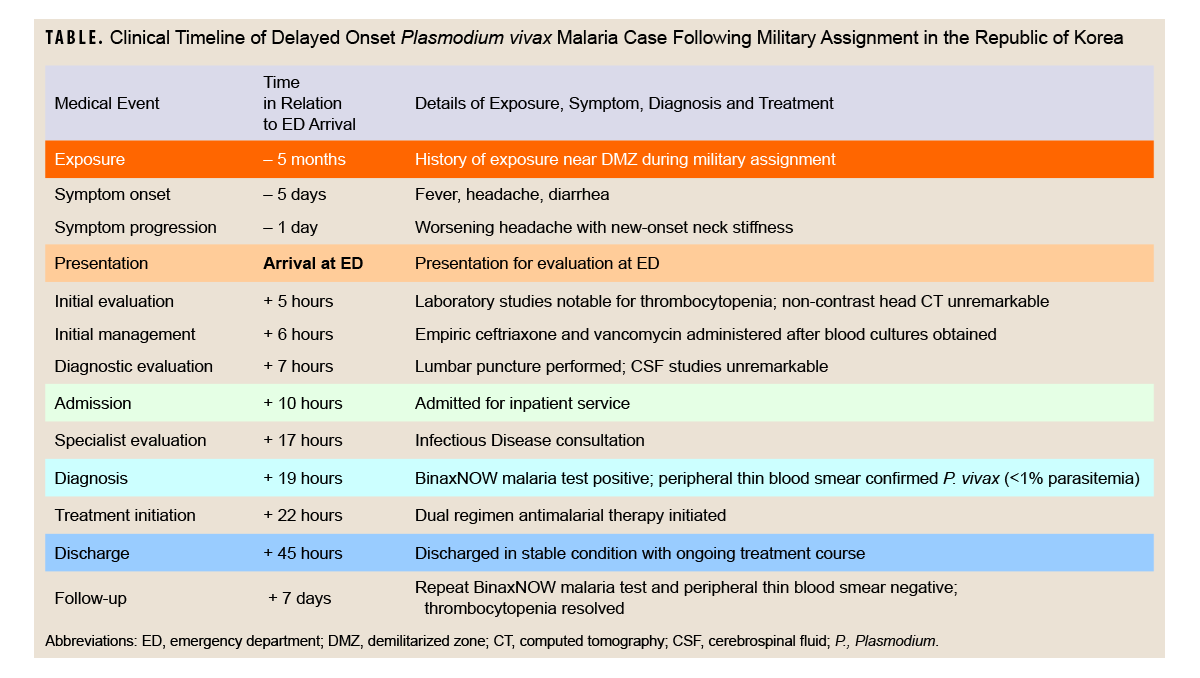
Upon admission, the service member was febrile to 39.5°C. Physical examination was otherwise largely unremarkable, including negative Kernig and Brudzinski signs. Meningitis, however, remained a concern, given his worsening headache and newly reported neck stiffness. Initial laboratory studies demonstrated thrombocytopenia (87 x 10³/μL), mild hyperbilirubinemia, and elevated procalcitonin (2.55 ng/mL) without leukocytosis or anemia. Respiratory pathogen polymerase chain reaction testing, HIV testing, syphilis screening, heterophile antibody testing, and hepatitis serologies were negative. Non-contrast head computed tomography was normal. After blood cultures were obtained, empiric ceftriaxone and vancomycin were initiated. Lumbar puncture was subsequently performed and demonstrated unremarkable cerebrospinal fluid findings. The patient met systemic inflammatory response syndrome criteria and was admitted for further evaluation of worsening headache in the context of an undifferentiated febrile illness.
Additional history obtained after admission revealed leisure travel to Puerto Rico and a 6-month deployment to the ROK and Japan, with return to the U.S. approximately 5 months before presentation. Infectious disease consultation further identified field exposure near the DMZ without malaria chemoprophylaxis. BinaxNOW malaria testing was positive, and peripheral thin blood smear confirmed uncomplicated P. vivax malaria with parasitemia less than 1%.
The patient was treated with atovaquone-proguanil (250 mg/100 mg, 4 tablets daily) for 3 days and a concurrent 14-day course of primaquine 30 mg daily for anti-relapse therapy following confirmation of normal glucose-6-phosphate dehydrogenase activity. At follow-up, thrombocytopenia had resolved, repeat BinaxNOW malaria testing and peripheral thin blood smear were negative, and the patient recovered fully without complication.
Discussion
Both geographic specificity and time since exposure complicated recognition of P. vivax malaria in this returning service member. Although the patient had returned from the ROK approximately 5 months before presentation, his field exposure near the DMZ remained clinically relevant because malaria transmission in the ROK is geographically concentrated, and P. vivax may present after prolonged latency. His initial symptoms prompted evaluation for neurological and infectious causes before a detailed operational history identified the relevant exposure. The case emphasizes the value of determining not only where a service member was stationed or deployed but also where specific training and field activities occurred.
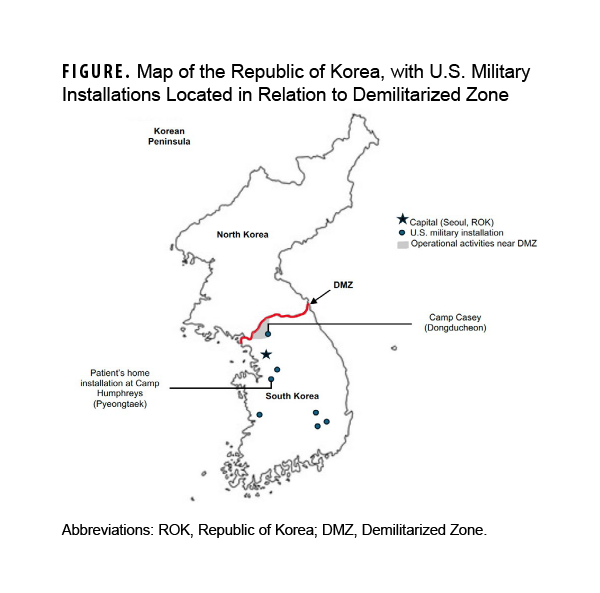 Malaria risk is not uniform within the ROK. P. vivax transmission is concentrated near the DMZ and is substantially lower in most urban areas and at established U.S. military installations.8 Personnel conducting training in northern areas closer to the DMZ, including near Camp Casey in Dongducheon-si, may therefore experience greater vector exposure than those stationed at southern installations, such as U.S. Army Garrison Humphreys in Pyeongtaek (Figure).9 A 2018 cluster of P. vivax malaria among U.S. soldiers training near the DMZ further demonstrates this geographically concentrated risk.10 More recent data show that 80% of P. vivax malaria cases among U.S. service members in 2025 were acquired in Korea.11
The prolonged latency of P. vivax can further obscure the relationship between exposure and clinical presentation. A Korean study of 897 individuals with P. vivax malaria reported mean short- and long-incubation periods of 25.5 and 329.4 days, respectively.5 Among the U.S. soldiers in the 2018 cluster described earlier, 9 of 11 cases (82%) were diagnosed 8–11 months after return to the U.S.10 In temperate regions such as the ROK, P. vivax may exhibit a bimodal pattern of primary presentation, with some infections becoming symptomatic within approximately 1 month and others presenting many months after infection.5 This delayed presentation is associated with dormant hepatic hypnozoites that persist during latent liver-stage infection.7
U.S. Forces Korea Instruction 4200.02 generally does not require malaria chemoprophylaxis for deployments or field operations in the ROK because of low overall malaria attack rates. Chemoprophylaxis may be recommended, however, when increased malaria risk exists, particularly for operations in close proximity to the Military Demarcation Line or within northern boundary training areas.12 Although this patient reported field exposure near the DMZ, he did not receive malaria chemoprophylaxis. Available information does not establish whether chemoprophylaxis was considered or recommended as part of a mission-specific risk assessment. The absence of chemoprophylaxis in this patient cannot therefore be attributed to individual non-adherence, an operational decision based on assessed risk, or a gap in implementation of existing guidance.
Malaria risk is also influenced by seasonality, making timing as well as location of field exposure relevant to operational risk assessment.11 Force health protection measures should continue to emphasize adherence to theater-specific chemoprophylaxis guidance and Department of War Insect Repellent System implementation, including use of permethrin-treated uniforms and DEET (diethyltoluamide)- or picaridin-based repellents, along with appropriate environmental vector control measures.13,14 The effectiveness of these preventive measures may also be influenced by insecticide resistance among local mosquito populations.15
This case has important implications for both force health protection and clinical practice. Commanders, operational planners, and medical personnel should ensure that malaria risk assessments account for specific training and operational locations and are translated into appropriate preventive measures, including chemoprophylaxis when indicated by theater guidance. Clinicians evaluating service members after return from the ROK should likewise obtain detailed operational and geographic exposure histories. Recognition of prior exposure near the DMZ may facilitate timely diagnosis of P. vivax malaria even months after return to the U.S.
References
- Chai JY. History and current status of malaria in Korea. Infect Chemother. 2020;52(3):441-452. doi:10.3947/ic.2020.52.3.441
- Bahk YY, Lee HW, Na BK, et al. Epidemiological characteristics of re-emerging vivax malaria in the Republic of Korea (1993–2017). Korean J Parasitol. 2018;56(6):531-543. doi:10.3347/kjp.2018.56.6.531
- Kim JH, Lim AY, Cheong HK. Malaria incidence of the regions adjacent to the Demilitarized Zone in the Democratic People’s Republic of Korea, 2004–2016. J Korean Med Sci. 2019;34(36):e227. doi:10.3346/jkms.2019.34.e227
- Kim B, Kim JH, Lee J, Yeom JS. A regionstructured model for early warning of Plasmodium vivax malaria transmission risk in the Republic of Korea. J Infect Public Health. 2025;18(3):102665. doi:10.1016/j.jiph.2025.102665
- Kim Sun-Ja, Kim Si-Heon, Jo S, et al. The long and short incubation periods of Plasmodium vivax malaria in Korea: the characteristics and relating factors. Infect Chemother. 2013;45(2):184-193. doi:10.3947/ic.2013.45.2.184
- Fikadu M, Ashenafi E. Malaria: an overview. Infect Drug Resist. 2023;16:3339-3347. doi:10.2147/idr.s405668
- Flannery EL, Kangwanrangsan N, Chuenchob V, et al. Plasmodium vivax latent liver infection is characterized by persistent hypnozoites, hypnozoite-derived schizonts, and time-dependent efficacy of primaquine. Mol Ther Methods Clin Dev. 2022;26:427-440. doi:10.1016/j.omtm.2022.07.016
- Yeom JS. To eradicate malaria on the Korean Peninsula, accurate Democratic People’s Republic of Korea malaria statistics are needed. J Korean Med Sci. 2019;34(36):e249. doi:10.3346/jkms.2019.34.e249
- HyunJung K, Lee S, Shin N, et al. Status of malaria and diagnosis rate in the Republic of Korea, 2018–2022. Public Health Wkly Rep. 2023;16(26):852-866. doi:10.56786/phwr.2023.16.26.3
- Klein TA, Seyoum B, Forshey BM, et al. Cluster of vivax malaria in U.S. soldiers training near the demilitarized zone, Republic of Korea during 2015. MSMR. 2018;25(11):4-9. Accessed Sep. 14, 2026. https://www.health.mil/reference-center/reports/2018/01/01/medical-surveillance-monthly-report-volume-25-number-11
- Armed Forces Health Surveillance Division. Malaria among members of the U.S. Armed Forces, 2025. MSMR. 2026;33(5):22-28. Accessed Sep. 14, 2026. https://www.health.mil/news/articles/2026/05/01/msmr-malaria-2026
- U.S. Forces Korea Headquarters. U.S. Forces Korea Regulation 40-9: Force Health Protection (FHP) Requirements for the Korean Theater. Feb. 8, 2018. Accessed Jun. 12, 2026. https://www.usfk.mil/portals/105/documents/publications/regulations/usfk-reg-40-9-fhp-requirements-kn.pdf
- Agudelo Higuita NI, White BP, Franco-Paredes C, McGhee MA. An update on prevention of malaria in travelers. Ther Adv Infect Dis. 2021;8:20499361211040690. doi:10.1177/20499361211040690
- U.S. Forces Korea Headquarters. U.S. Forces Korea Regulation 40-9: Force Health Protection (FHP) Requirements for the Korean Theater. Feb. 8, 2018. Accessed Jun. 12, 2026. https://www.usfk.mil/portals/105/documents/publications/regulations/usfk-reg-40-9-fhp-requirements-kn.pdf
- Jeon J, Kim HC, Klein TA, Jun H, Choi KS. Insecticide resistance mutations of Anopheles species in the Republic of Korea. PLoS Negl Trop Dis. 2025;19(1):e0012748. doi:10.1371/journal.pntd.0012748
Author Affiliations
Department of Preventive Medicine, Madigan Army Medical Center, Joint Base Lewis-McChord, WA: CPT Skellington, COL Mease; Department of Family Medicine, Madigan Army Medical Center: CPT Joseph; 210th Field Artillery Brigade, Camp Casey, Dongducheon-si, Gyeonggi-do, Republic of Korea: CPT Faldas
Acknowledgment
The authors acknowledge the inpatient care team involved in this case.
Disclaimers
The clinical aspects of this case were presented as an oral poster at the 2026 Uniformed Services Academy of Family Physicians (USAFP) Annual Meeting and Exposition, March 10-11, 2026, San Diego, CA.
The contents of this article are the sole responsibility of the authors and do not necessarily reflect the views, opinions, nor policies of the U.S. Government, Department of War, U.S. Army Medical Department, U.S. Army Office of the Surgeon General, Madigan Army Medical Center, or Camp Casey.
Mention of trade names, commercial products, or organizations does not imply endorsement by the U.S. Government. Investigators followed human subject protection 45CFR46 policies.