Reportable medical events at Military Health System facilities, second quarter, 2026

Image of MSMR 202610 Photo4. In the second quarter of 2026, norovirus, campylobacteriosis, and giardiasis were the most frequently reported gastrointestinal illnesses among U.S. active component service members.

Reportable Medical Events (RMEs) are documented in the Disease Reporting System internet (DRSi) by health care providers and public health officials throughout the Military Health System (MHS) for monitoring, controlling, and preventing the occurrence and spread of diseases of public health interest or readiness importance. These reports are reviewed by a team of validators from Defense Centers for Public Health (DCPH). The DRSi collects reports on over 70 different RMEs, including infectious and non-infectious conditions, outbreak reports, sexually transmitted infection (STI) risk surveys, and tuberculosis contact investigation reports. A complete list of RMEs is available in the 2022 Armed Forces Reportable Medical Events Guidelines and Case Definitions.1 Data reported in these tables are considered provisional and do not represent conclusive evidence until case reports are fully validated.
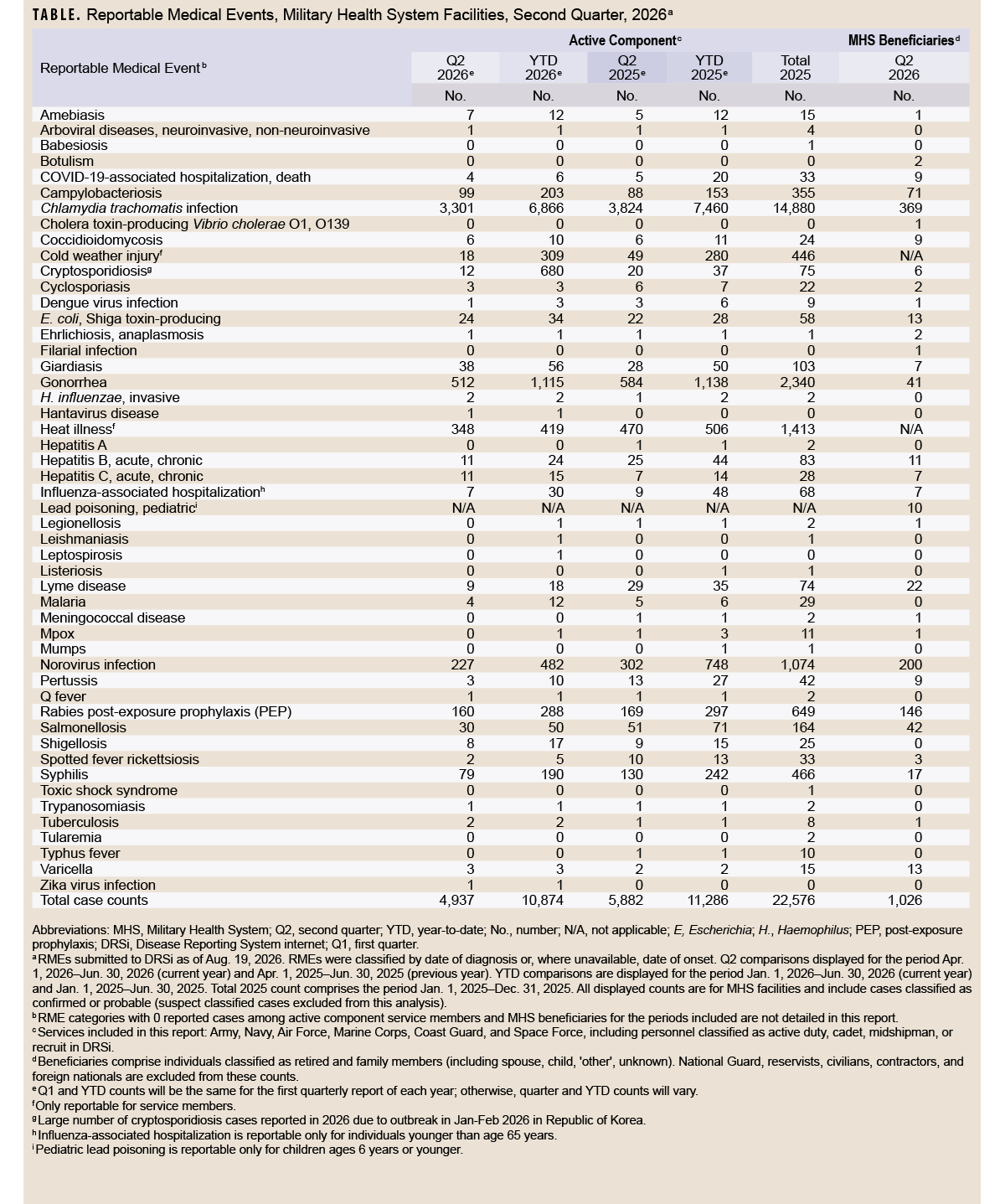
Total cases among active component service members (ACSMs) reported per week are displayed in the graph for the 5 RMEs for the prior year, or preceding 52 weeks. Each quarter, the graph is updated and presented with the quarter’s (Q2, 2026) 5 most frequently reported RMEs, which may differ from previous quarters.
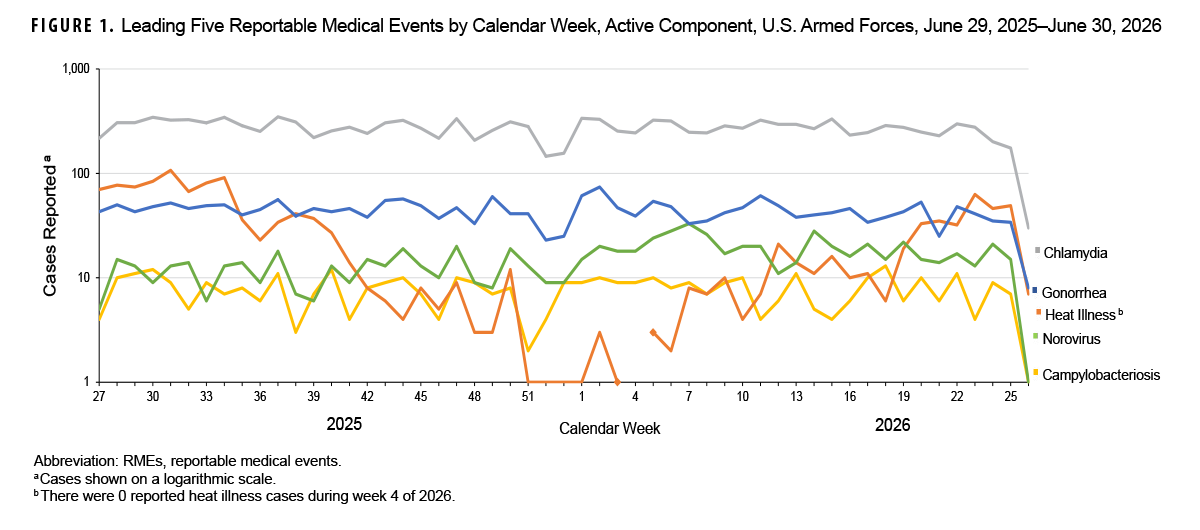
FIGURE 1. Leading Five Reportable Medical Events by Calendar Week, Active Component, U.S. Armed Forces, June 29, 2025–June 30, 2026 This line graph, plotted on a logarithmic vertical axis ranging from 1 to 1,000 cases, displays the weekly incidence of the five most frequent reportable medical events among active duty service members over a 52-week period, from late June 2025 to late June 2026. The purpose of this chart is to monitor and compare the ongoing weekly surveillance trends of high-volume military health events. The data show that Chlamydia trachomatis infection is consistently the most frequently reported event, fluctuating between approximately 100 and 200 cases per week throughout the year. Gonorrhea represents the second-highest event, generally stable, between 20 and 50 cases weekly. Heat illness demonstrates a highly seasonal trend, peaking at nearly 100 cases per week during the summer months of 2025, dropping to near zero (including zero cases in week 4 of 2026) during the winter, and rising again as summer 2026 approaches. Norovirus and campylobacteriosis exhibit much lower and stable weekly baselines, typically remaining below 20 cases per week.

The DRSi requires the reporting of numerous gastrointestinal (GI) illnesses.1 In Q2 2026, the most frequently reported GI illnesses among U.S. ACSMs were norovirus, campylobacteriosis, and giardiasis. This is a change from the previous quarter, which involved a large cryptosporidiosis outbreak.
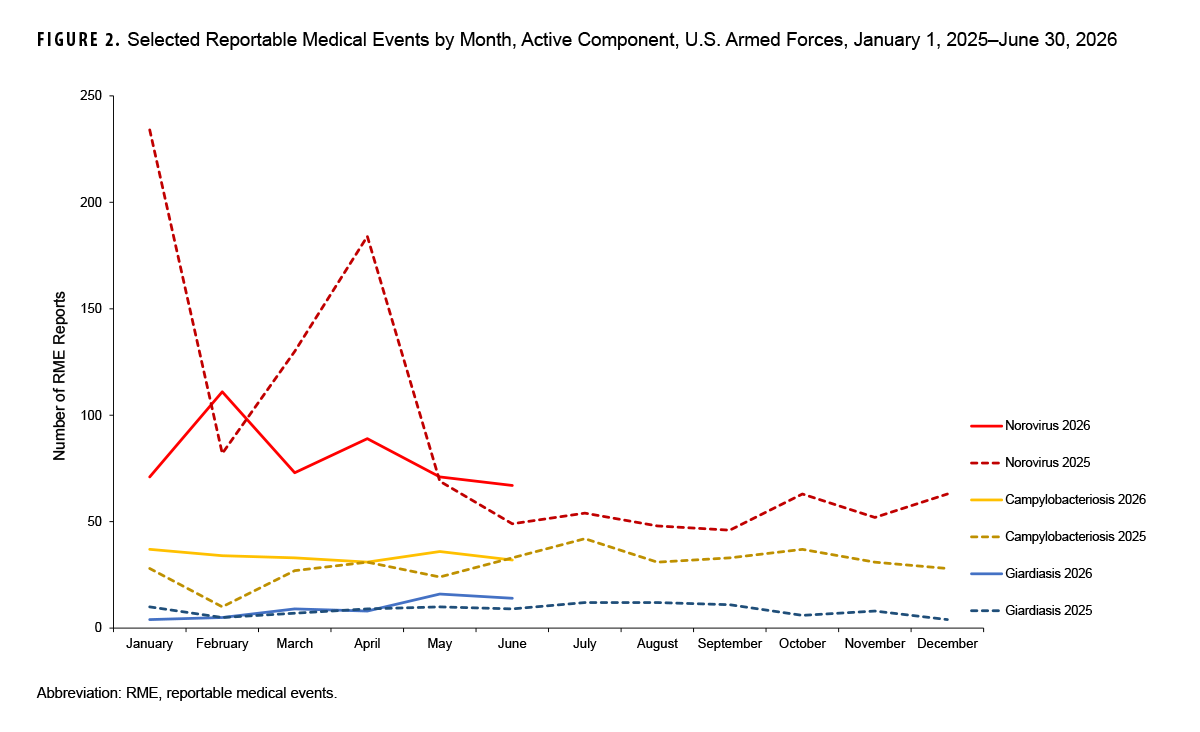
FIGURE 2. Selected Reportable Medical Events by Month, Active Component, U.S. Armed Forces, January 1, 2025–June 30, 2026 This multi-line comparative graph tracks monthly case reports of selected gastrointestinal illnesses—specifically norovirus, campylobacteriosis, and giardiasis—comparing monthly counts across the calendar years of 2025 and 2026. The purpose of the figure is to identify seasonal outbreaks and annual differences in gastrointestinal infections. The data demonstrate that Norovirus is the most common of these gastrointestinal events, exhibiting clear seasonal peaks in the winter and spring. In 2025, Norovirus reports peaked in January, at over 230 cases, and experienced a secondary peak in April at nearly 180 cases. In comparison, norovirus reports in 2026 were lower in April and May than the previous year, but rose slightly higher in June 2026, to around 60 cases. in contrast to norovirus, both campylobacteriosis and giardiasis maintain low, stable reporting levels throughout both years, consistently remaining below 50 cases per month, with campylobacteriosis showing only a minor increase during the summer months of 2025.

The number of reports for norovirus in DRSi were lower during April and May of 2026 than in their respective months in 2025, while the number of norovirus reports in June 2026 was slightly higher than June 2025. One norovirus outbreak report was submitted in June 2026 that included ACSMs. Additionally, campylobacteriosis and giardiasis reports in DRSi during Q2 2026 remained similar to the numbers of reports in the months of Q2 2025. One outbreak of campylobacteriosis was reported in May 2026 that affected ACSMs.

DCPH-A developed the Communicable Disease Toolkit to provide guidance for reporting RME cases and outbreaks to DRSi.2 Tools like investigation worksheets and case definition flowcharts are available in the Communicable Disease Toolkit for all RMEs, including reportable GI illnesses.

For questions about this report, please contact the Disease Epidemiology Branch at DCPH–Aberdeen. Email: dha.apg.pub-health-a.mbx.disease-epidemiologyprogram13@health.mil

References

  1. Armed Forces Health Surveillance Division. Armed Forces Reportable Medical Events. Accessed Aug. 26, 2026. https://health.mil/reference-center/publications/2022/11/01/armed-forces-reportable-medical-events-guidelines 
  2. Defense Health Agency-Public Health. Communicable Disease Toolkit. Accessed Aug. 26, 2026. https://ph.health.mil/topics/healthsurv/de/Pages/cdt.aspx

You also may be interested in...

Article
March 1, 2025

Correlation Between Mean Temperature and Incidence of Tick-borne Diseases Among Active Duty Service Members in the Contiguous U.S., 2000–2023

This study identifies the incidence of the two tick-borne diseases, Lyme disease and Rocky Mountain spotted fever, that are most frequently diagnosed within the Military Health System among active component U.S. service members and evaluates the correlation between temperature and incidence of each tick-borne disease.

Article
March 1, 2025

Non-Medical Risk Factors Influencing Health and Association with Suicidal Ideation or Attempt, U.S. Active Component, 2018–2022

This study reports the prevalence of non-medical risk factors, also known as social determinants of health, among active component U.S. service members and assesses the relationship between these factors and suicide ideation or attempts between 2018 and 2022. This study documents, for the first time, the frequency of diagnosis for non-medical risk ...

Article
Feb. 1, 2025

Development of a New Fleet Disease and Injury Surveillance Capability Using ESSENCE

This report details the steps taken to develop a timely, accurate, and comprehensive Navy fleet disease and injury surveillance capability, utilizing ESSENCE (Electronic Surveillance System for the Early Notification of Community-based Epidemics), including the successes and challenges that will guide further refinement and expansion of this tool.

Article
Feb. 1, 2025

Surveillance Snapshot: Non-Hodgkin Lymphoma Incidence in Active Component U.S. Service Members, 2017–2023

This analysis utilizes an updated case definition for non-Hodgkin lymphoma developed by the Armed Forces Health Surveillance Division, based on consultation with subject matter experts and previous literature, to establish non-Hodgkin lymphoma incidence within the U.S. Armed Forces active component, from 2017 through 2023.

Article
Feb. 1, 2025

External Cause Coding of Injury Encounters in the Military Health System Among Active Component U.S. Service Members, 2016–2019

Knowledge of injury causes is essential for prevention. This article describes causes of injury for all U.S. service members, from 2016 through 2019, and identifies variations in injury cause coding over time, and by branch of military service, type of health care visit and facility, and diagnosis category.

Refine your search