Abstract
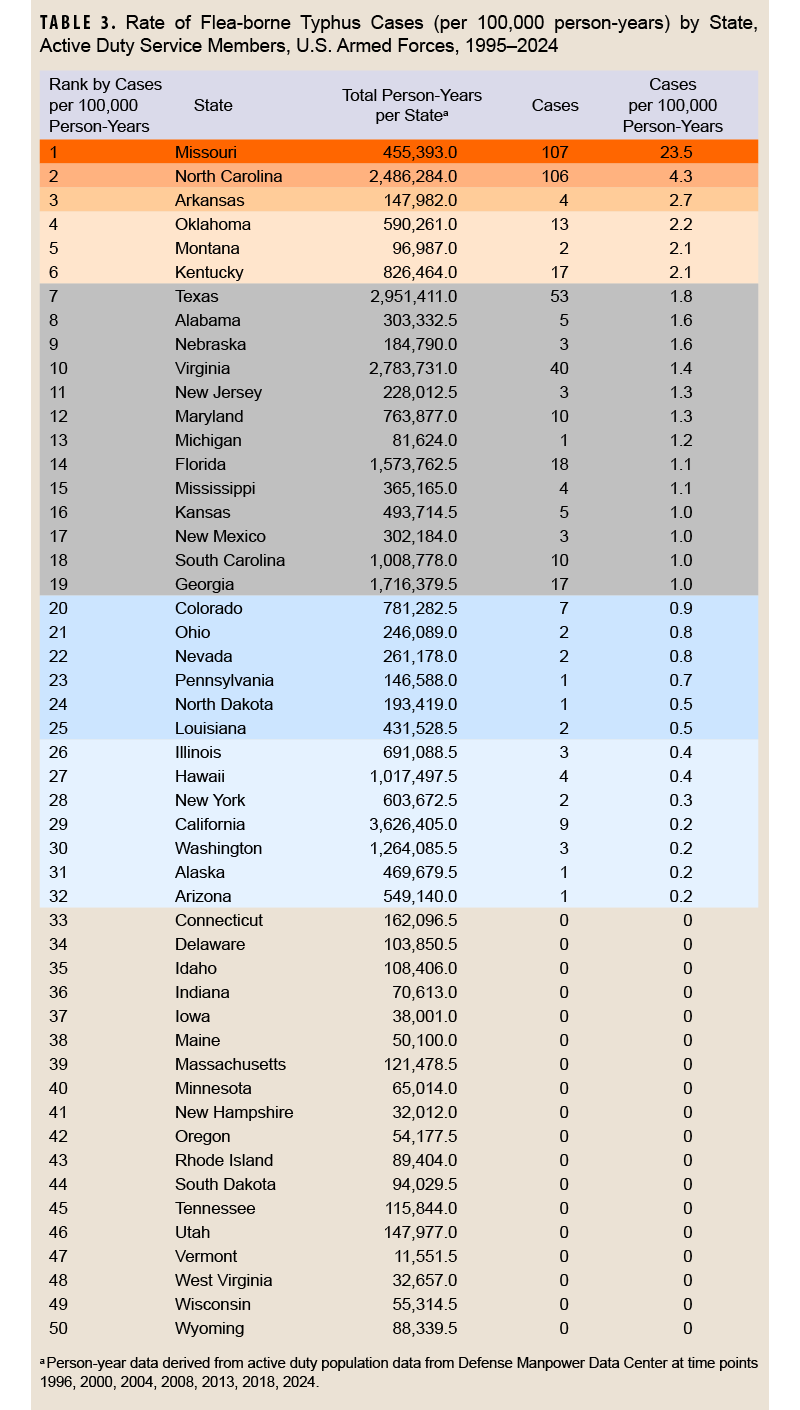
Flea-borne, or endemic, typhus is a re-emerging disease in the U.S. that is only reported by selected states. Due to these limited surveillance efforts, the true burden of the disease has not been adequately assessed, and risk of infection for groups likely to be exposed to the vector, such as military personnel during field training, remains unclear. To better understand the geographic distribution of flea-borne typhus in the U.S. military, Defense Medical Surveillance System (DMSS) data from 1995 through 2024 were retrospectively analyzed, with laboratory data available from 2007 and afterwards. A total of 605 cases of ‘typhus fever’ were identified among service members of the U.S. military; flea-borne typhus cases were identified through International Classification of Diseases code filtering limited to a specified U.S. geographic area to exclude non-endemic typhus disease. The identification of cases was ultimately limited by reporting definitions stipulated in the Armed Forces Reportable Medical Events Guidelines and Case Definitions, constraints for stored variables within the DMSS, and potential concurrence between flea-based typhus and other rickettsioses. All possible screening was employed, however, to reduce this risk. Most cases occurred in men (82.0%), with a median age of 28 years, a reflection of military demographics. Almost half (46.8%) of cases were in a subset of military occupational categories with elevated field exposures, such as infantry and engineers. Among identified cases, pooled incidence in active duty personnel by person-years (p-yrs) increased to 3.5 from 2.1 cases per 100,000 p-yrs when comparing the 2018-2024 period with 2008-2013. Notable case clusters were observed in Missouri and North Carolina, with cases in active duty members per 100,000 p-yrs in those states exceeding 23.5 and 4.3, respectively. These findings may reveal a growing and under-recognized burden of flea-borne typhus within the U.S. military and highlight the need for enhanced arthropod control as well as reconsideration of national reporting strategies.
What are the new findings?
This study identified an increase in the pooled incidence rate of flea-borne typhus in U.S. military service members when comparing the 2008-2013 and 2018-2024 surveillance periods. Normalizing identified typhus cases against active duty strength in each U.S. state revealed previously unrecognized clusters of elevated disease activity in states without civilian reporting mandates, particularly Missouri and North Carolina, concentrated heavily among personnel in occupations with trainings requiring high field exposure.
What is the impact on readiness and force health protection?
Military personnel are exposed to a unique array of austere field conditions that put them at high risk for tick- and flea-borne diseases, including flea-borne typhus. Many military installations in the U.S. are located in regions with increasingly high incidences of these infections. It is unknown how geographic factors influence likelihood of exposure.
Background
The burden of emerging tick- and flea-borne disease in the U.S. is increasing, but the true prevalence, including flea-borne typhus, remains undefined.1 Until 1987, flea-borne, or endemic, typhus was a nationally reportable disease, but following the success of national pest control and sanitation programs, cases plummeted, and it was removed from the list of nationally reportable diseases.2-4 Within the U.S. Department of War (DOW), flea-borne typhus has remained a reportable disease. To date, only a few state governments, including Texas, California, and Hawai’i, mandate reporting of this infection, and as a result of limited data sources, those 3 states are often considered endemic epicenters of this disease.3,5
Because flea-borne typhus has variable clinical penetrance, the number of asymptomatic human cases is unknown, making true seroprevalence challenging to establish. This uncertainty makes prevention of flea bites a key public health measure. Direct exposure to a mammalian host is not required for transmission, and many cases often lack documented contact with a known amplifying host or reservoir.3 In urban settings, rats and rat fleas play a significant role in transmission, whereas in suburban environments, cat fleas and opossums are thought to be the primary drivers of the transmission cycle.3,6
Due to the military’s frequent requirements for field training, these infections present potential threats to force readiness. Military personnel (especially combat, infantry, artillery, and armor operators) are exposed to a unique array of austere conditions, during both training and deployment, placing them at high risk for arthropod exposure and subsequent disease acquisition. Similarly, many military installations within the continental U.S. are in regions—the South, Midwest, and Northeast—with known high transmission rates of many of these diseases.7,8
Studies evaluating the geographic range of flea-borne typhus beyond currently reporting states remain limited, largely due to inconsistent state reporting requirements and a deficiency of centralized public health reporting.5,6,9 The Defense Medical Surveillance System (DMSS) is a centrally maintained medical database of the DOW that contains current and historical data on diseases and medical events (e.g., hospitalizations, ambulatory care visits, reportable medical events), including flea-borne typhus, in addition to longitudinal data on personnel and deployment.10 In this study, the DMSS was employed to evaluate the incidence and characteristics of flea-borne typhus diagnoses from 1995 through 2024 within the Military Health System (MHS) among U.S. military service members, as well as the geographic prevalence of flea-borne typhus in different periods.
Methods
This report details a retrospective, descriptive study of epidemiological data on flea-borne typhus in the DMSS. The DMSS was queried for all confirmed and suspected cases of typhus fever from 1995 through 2024 in the U.S. active duty, Guard, and reserve component military populations in all 50 states. Disease definitions and reportable medical events (RMEs) are specified in the Defense Health Agency’s Armed Forces Reportable Medical Events Guidelines and Case Definitions (AFRME), which is periodically updated, most recently in 2022.11
Confirmed cases were defined as 1 record of an RME confirmed for typhus fever or a laboratory test (polymerase chain reaction [PCR] or serology testing) positive for typhus fever. Suspected cases were defined as 1 inpatient or 2 outpatient encounters within 60 days of each other with a diagnosis of typhus fever indicated by International Classification of Diseases, 9th and 10th revisions (ICD-9/ICD-10) codes in any diagnostic position (ICD-9: 080, 081, 081.0, 081.1, 081.2, 081.9; ICD-10: A75, A75.0, A75.1, A75.2, A75.3, A75.9); ICD-9 codes were utilized due to the older case data. Laboratory data were only available starting in 2007 and do not reliably specify laboratory test type (e.g., serology, PCR, etc.) or titers. For confirmed cases, the earliest date of the RME or laboratory test was used as the incident date. For suspected cases, the earliest date of the inpatient stay or outpatient encounter was used as the incident date. An individual could be an incident case once during the surveillance period. Cases were classified according to the state and military installation where diagnosed, unless otherwise specified.
The ‘typhus fever’ reporting category in the DMSS includes 3 distinct clinical syndromes caused by Rickettsia typhi, Rickettsia prowazekii, and Orientia tsutsugamushi; AFRME defines these 3 pathogens as having distinct clinical syndromes and assigns specific clinical descriptions and epidemiological risk factors.11 Because included cases were exclusively from the 50 states, it was assumed that DMSS records for this study most likely represented cases of R. typhi, given the near-absence of R. prowazekii and O. tsutsugamushi in the U.S.12,13 Sporadic case reports of “sylvatic typhus” caused by R. prowazekii have occurred in those with flying squirrel exposure, but it is of rare occurrence, with rare exposure.14 To further ensure the reliability of this R. typhi assumption, the data were filtered to remove any cases with ICD-9/ICD-10 codes specific to either epidemic (i.e., louse-borne, ICD-9 080 or ICD-10 A75.0) typhus or scrub (i.e., mite-borne, ICD-9 081.2 or ICD-10 A75.3) typhus.
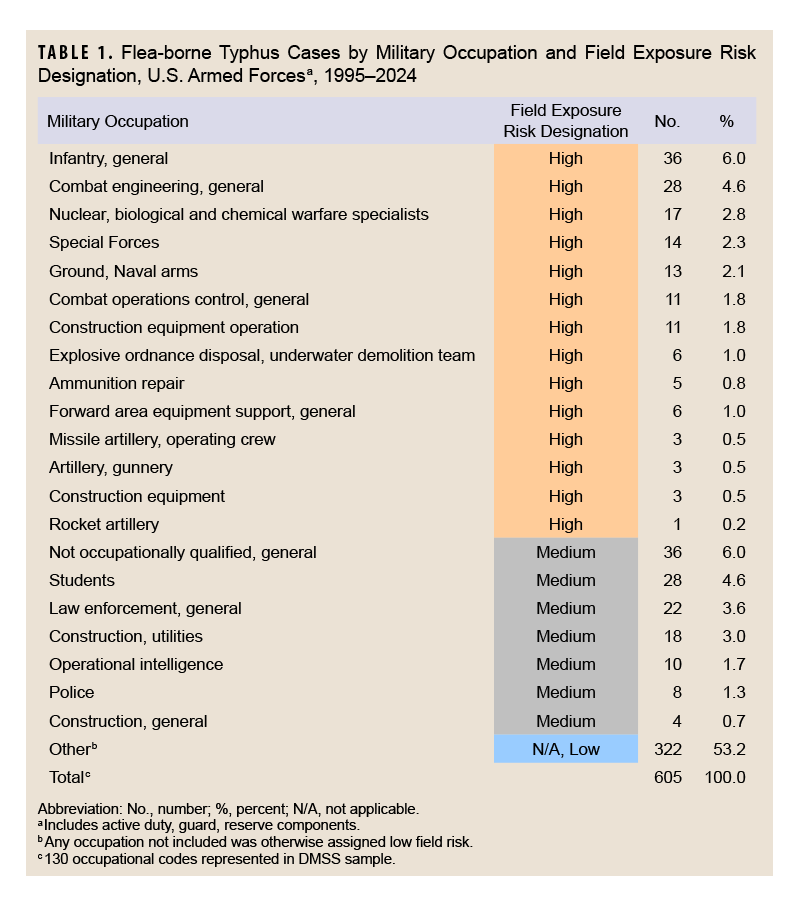 Epidemiological characteristics, including prior deployment, time before and since last deployment, home of record, military occupation, age, sex, and race or ethnicity, were also documented and analyzed. Incidence analysis of cases was performed in 10-year increments. Occupational field or outdoor exposure risk was determined by agreement of 3 separate military officers reviewing occupational codes, considering expected time outdoors to accomplish daily occupational responsibilities, degree of manual labor required in daily activities, and expected likelihood and frequency of outdoor exercises or training. Table 1 details which occupations were designated as incurring high, moderate, or low field risk exposure.
To calculate overall incidence in U.S. states among active duty service members by person-years, the active duty population from each state was extracted from the Defense Manpower Data Center (DMDC) historical database in 4-6-year intervals, from 1996 through 2024: in 1996, 2000, 2004, 2008, 2013, 2018, 2024.15 Active duty census was determined based on DMDC service member records, in which the number of assigned personnel to each state is recorded at each data collection interval. The total number of person-years was tabulated using trapezoidal integration of each state’s total active duty population over time, divided into the total number of active duty cases per state for the same period. Due to potential under-reporting before laboratory data availability in 2007, only pooled incidence changes between 2008-2013 and 2018-2024 were calculated; data prior to 2007 were excluded from changing incidence rate (IR) calculations.
Results
In total, 610 cases of typhus fever were identified in U.S. active duty service members from 1995 through 2024. After filtering cases with codes for epidemic (louse-borne, ICD-9 080 or ICD-10 A75.0) typhus or scrub (mite-borne, ICD-9 081.2 or ICD-10 A75.3) typhus, 605 cases of flea-borne typhus were identified. Of those 605 flea-borne cases, 87.1% (n=527) met the criteria for confirmed disease via laboratory positivity (n=507, 83.8%) or RME (n=20, 3.3%), while the remainder (n=78, 12.9%) met suspected case definition criteria (Table 2).
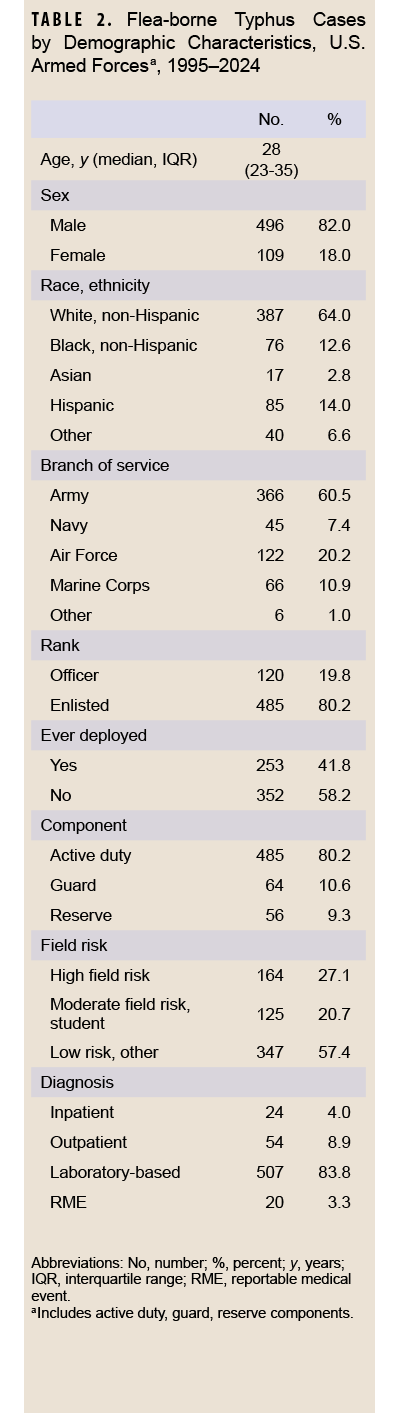
Between 2007-2014 and 2015-2024, cases of flea-borne typhus among U.S. ACSMs increased from 24.8 cases per year to 39.5 cases per year (Figure 1). Utilizing laboratory data, from the initial (2008-2013) period when available and the later (2018-2024) period, pooled IRs for active duty-only individuals were calculated: 2.1 cases per 100,000 person-years (p-yrs) in 2008-2013 to 3.5 cases per 100,000 p-yrs in 2018-2024, with an absolute positive incidence change of 1.4 cases per 100,000 per p-yrs.
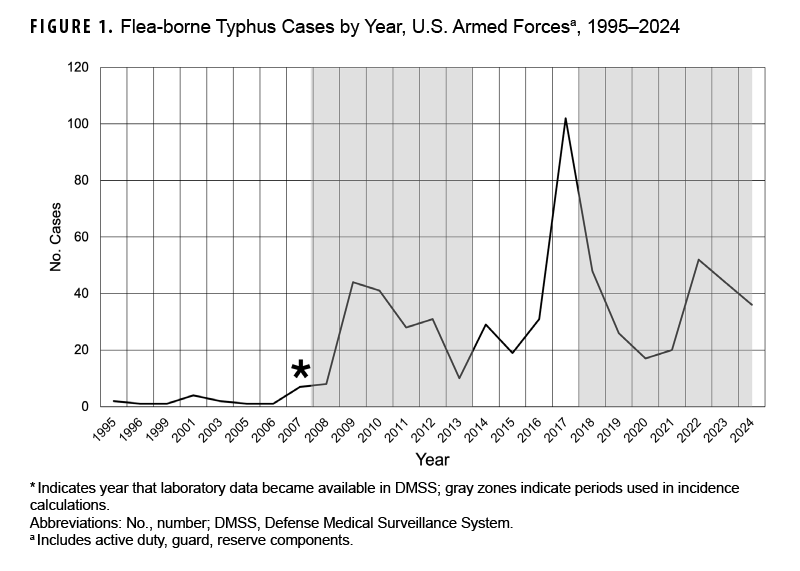
Table 2 shows that most cases were among young (median age 28 years, interquartile range [IQR] 23-35), non-Hispanic White, male, Army service members. A majority (n=352, 58.2%) of individuals with flea-borne typhus had never deployed (Table 2), and most cases in those with a history of deployment occurred at a median of 1,298 (IQR 585-2,628) days before any deployment start or end date (data not shown).
The greatest numbers of cases were in infantry members, those with a “general, not occupationally qualified” occupation signifier, combat engineers, and students. In addition, 25.9% (n=157) of cases occurred in occupations designated with high field activity requirements, and another 20.8% (n=126) occurred in occupations with moderate-to-potentially-high field activity requirements (e.g., students, construction, police) (Table 1).
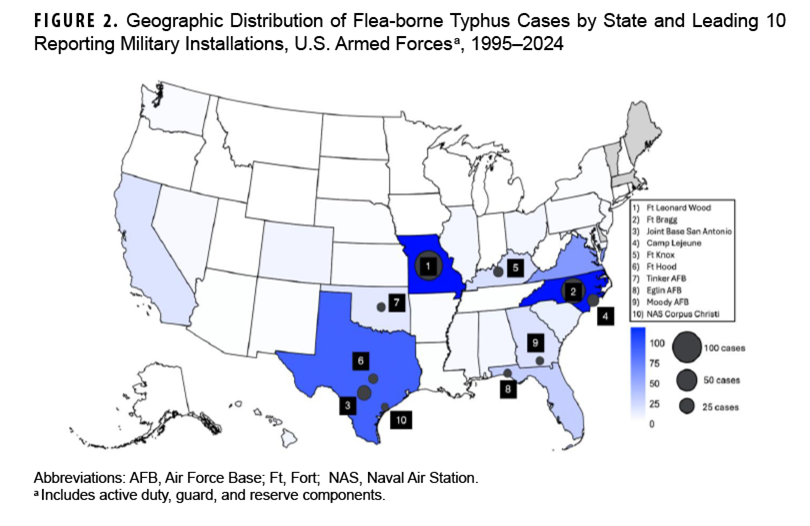
The 5 states with the highest total case numbers together represented 62% (n=375) of all cases reported in the DMSS; Missouri, North Carolina, and Texas combined reported 49.6% (n=299) of all flea-borne typhus infections. Figure 2 details the geographic distribution of DMSS-reported flea-borne typhus cases and the leading 10 reporting bases, led by Fort Leonard Wood (Missouri), Fort Bragg (North Carolina), and Joint Base San Antonio (Texas). Table 3 demonstrates that the overall highest IRs, when normalizing against total active duty person-years remain in Missouri and North Carolina, with Missouri’s IR (23.5 cases per 100,000 p-yrs) about 6 times higher than the state with the next highest IR, North Carolina.
 Discussion
The DMSS data described in this study suggest an under-recognized and increasing burden of flea-borne typhus within the U.S. military population. These findings also imply under-appreciated exposure risks in U.S. states not typically associated with the disease, with greater than expected burdens evidenced in states such as North Carolina or Missouri. These data further corroborate trends observed in the U.S. states with flea-borne typhus reporting criteria: Incidence of flea-borne typhus appears to be increasing annually.5 These findings must be interpreted with caution, however, as they rely heavily on pre-defined classifications in the AFRME guidance, which carries significant assumptions regarding diagnostic specificity.
While incidence of flea-borne typhus between the initial period (2008-2013) after laboratory data availability and the more recent period (2018-2024) demonstrates a modest upward trend consistent with typhus reporting from states such as Texas and California, 5 annual fluctuations remain difficult to interpret. The cause of the 2017 spike in cases is unclear; however, it mirrors similar trends in above-average arthropod (i.e., tick bite) exposures reported to the U.S. Centers for Disease Control and Prevention that year.16 The subsequent decline in reported cases in 2020-2021 likely reflects national patterns in arthropod-borne disease surveillance observed during the COVID-19 pandemic.17-19
While Texas is often considered an epicenter of flea-borne typhus infections,1,3,5 the data in DMSS provide potential evidence of a high degree of exposure among military members stationed in other states, most prominently Missouri. The cases in Missouri occurred almost exclusively at Fort Leonard Wood, a training site for Army infantry, engineers, military police, along with chemical, biological, radiological and nuclear units. These teams typically spend extended durations in the field and outdoors, which may predispose individuals to increased arthropod exposures in rural and peri-urban settings. This predominance of cases was not explained by size-biased sampling from an area of high military personnel concentration, as demonstrated by the IRs per 100,000 p-yrs. States such as Missouri, North Carolina, and Texas continue to have higher rates despite normalization by active duty census.
One major limitation of this study is that the details of tests indicating positive cases are not available within the DMSS: Whether the disease was confirmed via PCR, or serology (e.g., IFA or ELISA), cycle thresholds, and titers were not available reliably in the DMSS. Furthermore, information on what constituted a positive test, and whether a positive titer was taken during acute infection or convalesce, are unknown. This limitation is compounded by the fact that many of the rickettsia serological laboratory specimens are known to cross-react, notably with the spotted fever group rickettsiae.20,21 The possibility of cross-reactivity is impossible to discount without knowledge of the titers of any additional paired tests, which was not available. Cross-reactivity is especially relevant in states such as North Carolina, where an elevated number of flea-borne typhus cases were observed, but where a strong association with Rocky Mountain Spotted Fever (RMSF) exists.22,23
This study assumed that cases entered in the DMSS under the established surveillance definitions represent true infections of flea-borne typhus, even though diagnosis ultimately relies on provider clinical judgment. Notably, the AFRME guidelines specify that when serologies are positive for both the spotted fever and typhus groups, the event must be classified under the disease most consistent with the patient’s clinical presentation, exposure history, and travel history.11 The emergence of novel conditions, such as flea-borne spotted fever, may further confound case counts due to diagnostic overlap and low assay specificity.24
An additional limitation is the inability to account for temporary duty (TDY) status at time of diagnosis. Cases are attributed to the location where a diagnosis is made, so personnel who become ill while temporarily assigned elsewhere—such as for training—are recorded at the TDY rather than permanent duty station. Because denominator data are based on permanently assigned active duty personnel, this misclassification may distort state incidence estimates. Despite this constraint, these findings continue to suggest an elevated exposure risk in certain states, including Missouri.
DMSS data provide a centralized database for exploring the increasing burden of flea-borne typhus. Collectively, these data suggest the possibility of a nationally under-reported burden, due to states that do not currently report this infection publicly—such as Missouri—but with high numbers of infections recorded in the DMSS. These data indicate that increased surveillance with strict diagnostic parameters and heightened clinical suspicion of this disease may be useful in determining the true burden. DMSS data suggest that individuals stationed in certain areas may benefit from stricter arthropod protection and flea control measures based on potential increased exposure risk. This is especially relevant due to the historical ban against re-application of permethrin to field uniforms.25
Given that standard serology cannot reliably distinguish R. typhi from other rickettsioses, it is possible that a proportion of coded typhus cases represent misclassified rickettsial infections. Attributing observed trends exclusively to R. typhi without confirmatory, pathogen-specific diagnostics risks misdirecting surveillance and management efforts. These data argue for more intensive review of local incidence patterns and underscore the need for greater rickettsiosis-focused laboratory diagnostic specificity within the MHS, as well as targeted vector and reservoir biosurveillance, to better characterize the true etiology and epidemiology of typhus-coded cases in the military population.
References
- Blanton LS. Murine typhus: a review of a re-emerging flea-borne rickettsiosis with potential for neurologic manifestations and sequalae. Infect Dis Rep. 2023;15(6):6. doi:10.3390/idr15060063
- Blanton LS, Vohra RF, Bouyer DH, Walker DH. Reemergence of murine typhus in Galveston, Texas, USA, 2013. Emerg Infect Dis. 2015;21(3):484-486. doi:10.3201/eid2103.140716
- Anstead GM. A one health perspective on the resurgence of flea-borne typhus in Texas in the 21st century: part 1: the bacteria, the cat flea, urbanization, and climate change. Pathogens. 2025;14(2):2. doi:10.3390/pathogens14020154
- Anstead GM. History, rats, fleas, and opossums. ii. the decline and resurgence of flea-borne typhus in the United States, 1945–2019. Trop Med Infect Dis. 2020;6(1):2. doi:10.3390/tropicalmed6010002
- Salzer J, Blanton LS, Paddock CD. CDC Clinical Outreach Call: Murine Typhus: A Re-emerging Threat in the United States. Mar. 27, 2025. Accessed Apr. 13, 2025. https://www.cdc.gov/coca/hcp/trainings/murine-typhus.html
- Civen R, Ngo V. Murine typhus: an unrecognized suburban vectorborne disease. Clin Infect Dis Off Publ Infect Dis Soc Am. 2008;46(6):913-918. doi:10.1086/527443
- Madison-Antenucci S, Kramer LD, Gebhardt LL, Kauffman E. Emerging tick-borne diseases. Clin Microbiol Rev. 2020;33(2):10.1128/cmr.00083-18. doi:10.1128/cmr.00083-18
- Marx GE, Spillane M, Beck A, et al. Emergency department visits for tick bites: United States, January 2017–December 2019. MMWR Morb Mortal Wkly Rep. 2021;70(17):612-616. doi:10.15585/mmwr.mm7017a2
- Afzal Z, Kallumadanda S, Wang F, Hemmige V, Musher D. Acute febrile illness and complications due to murine typhus, Texas, USA. Emerg Infect Dis. 2017;23(8):1268-1273. doi:10.3201/eid2308.161861
- Rubertone MV, Brundage JF. The Defense Medical Surveillance System and the Department of Defense Serum Repository: glimpses of the future of public health surveillance. Am J Public Health. 2002;92(12):1900-1904. doi:10.2105/ajph.92.12.1900
- Armed Forces Health Surveillance Branch. Armed Forces Reportable Medical Events: Guidelines and Case Definitions. Defense Health Agency, U.S. Dept. of War. 2022. Accessed Sep. 8, 2026. https://www.health.mil/reference-center/publications/2022/11/01/armed-forces-reportable-medical-events-guidelines
- Cherry CC, Binder AM. Trends in clinical diagnoses of typhus group rickettsioses among a large U.S. insurance claims database. Zoonoses Public Health. 2020;67(3):291-299. doi:10.1111/zph.12687
- Wang Q, Ma T, Ding F, et al. Global and regional seroprevalence, incidence, mortality of, and risk factors for scrub typhus: a systematic review and meta-analysis. Int J Infect Dis. 2024;146. doi:10.1016/j.ijid.2024.107151
- Chapman AS, Swerdlow DL, Dato VM, et al. Cluster of sylvatic epidemic typhus cases associated with flying squirrels, 2004–2006. Emerg Infect Dis. 2009;15(7):1005-1011. doi:10.3201/eid1507.081305
- Defense Manpower Data Center. DoD Personnel, Workforce Reports & Publications: Military and Civilian Personnel by Service/Agency by State/Country. U.S. Dept. of War. Accessed Jun. 22, 2026. https://dwp.dmdc.osd.mil/dwp/app/dod-data-reports/workforce-reports
- Centers for Disease Control and Prevention. Tick Bite Data Tracker. Ticks. U.S. Dept. of Health and Human Services. Jul. 11, 2024. Accessed Jun. 23, 2026. https://www.cdc.gov/ticks/data-research/facts-stats/tick-bite-data-tracker.html
- Centers for Disease Control and Prevention. Ehrlichiosis Epidemiology and Statistics. Ehrlichiosis. U.S. Dept. of Health and Human Services. Jun. 25, 2025. Accessed Jun. 23, 2026. https://www.cdc.gov/ehrlichiosis/data-research/facts-stats/index.html
- Centers for Disease Control and Prevention. Clinical Overview of Transmission and Epidemiology. Rocky Mountain Spotted Fever (RMSF). U.S. Dept. of Health and Human Services. May 20, 2024. Accessed Sept. 18, 2024. https://www.cdc.gov/rocky-mountain-spotted-fever/hcp/clinical-overview/index.html
- McCormick DW, Kugeler KJ, Marx GE, et al. Effects of COVID-19 pandemic on reported Lyme disease, United States, 2020. Emerg Infect Dis. 2021;27(10):2715-2717. doi:10.3201/eid2710.210903
- Aita T, Sando E, Katoh S, et al. Serological cross-reactivity between spotted fever and typhus groups of rickettsia infection in Japan. Int J Infect Dis. 2023;130:178-181. doi:10.1016/j.ijid.2023.03.012
- La Scola B, Rydkina L, Ndihokubwayo JB, Vene S, Raoult D. Serological differentiation of murine typhus and epidemic typhus using cross-adsorption and western blotting. Clin Diagn Lab Immunol. 2000;7(4):612-616. doi:10.1128/cdli.7.4.612-616.2000
- Brown Marusiak A, Giandomenico DA, Hollingsworth BD, et al. Spatial and clinical epidemiology of spotted fever rickettsioses and ehrlichiosis, North Carolina, 2010–2019. PLoS Negl Trop Dis. 2025;19(8):e0013406. doi:10.1371/journal.pntd.0013406
- Ursery L, Mansour O, Abernathy H, et al. Enhanced surveillance for tick-borne rickettsiosis and ehrlichiosis in North Carolina: protocol and preliminary results. PloS One. 2025;20(5):e0320361. doi:10.1371/journal.pone.0320361
- Stidham RA, Lenhart PA, Roachell W, et al. Rickettsia felis case cluster in a military family. Mil Med. 2025;190(11-12):e2643-e2647. doi:10.1093/milmed/usaf104
- Armed Forces Pest Management Board. Re-Treatment of Uniforms with Permethrin: New Guidance. Acquisition and Sustainment, U.S. Dept. of War. Apr. 17, 2020. Accessed Sep. 8, 2026. https://www.acq.osd.mil/eie/afpmb/docs/contingency/Re-treatment_of_uniforms_with_permethrin_New_Guidance.pdf
Author Affiliations
Infectious Diseases Service, Department of Medicine, Brooke Army Medical Center, Fort Sam Houston, TX: Maj Sweet, LTC Kiley, Capt Crouch; Uniformed Services University, Department of Medicine, Bethesda, MD: Maj Sweet, LTC Kiley, Capt Crouch
Acknowledgment
The authors thank Dr. Angelia Eick-Cost, who assisted with DMSS data capture.
Disclaimers
The views expressed in this report reflect the results of research conducted by the authors and do not necessarily reflect official policy nor position of the Defense Health Agency, Department of War, or the U.S. Government. The authors are military service members. This work was prepared as part of official duties. Title 17, U.S. Code Section 105 provides that copyright protection under this title is not available for any work of the U.S. Government.
Title 17, U.S. Code Section 101 defines a U.S. Government work as a work prepared by a military service member or employee of the U.S. Government as part of that person’s official duties.