Al Jubayl, Saudi Arabia

Many veterans of the Gulf War have been experiencing a variety of physical symptoms, collectively called Gulf War illnesses. In response to veterans’ concerns, the Department of Defense established a task force in June 1995 to investigate all possible causes. On November 12, 1996, responsibility for these investigations was assumed by the Investigation and Analysis Directorate, Office of the Special Assistant for Gulf War Illnesses which has continued to investigate the events that occurred at Al Jubayl, Saudi Arabia. Its interim report is contained here.

As part of the effort to inform the public about the progress of this effort, DOD is publishing on the Internet and elsewhere accounts related to possible causes of Gulf War illnesses, along with whatever documentary evidence or personal testimony was used in compiling these accounts.

I. Methodology

During and after the Gulf War, people reported that they had been exposed to chemical warfare agents. To investigate these incidents and to determine if chemical weapons were used, the DOD developed a methodology for investigation and validation based on work done by the United Nations and the international community where the criteria include:

  • A detailed written record of the conditions at the site.
  • Physical evidence from the site such as weapons fragments, soil, water, vegetation or human/animal tissue samples.
  • A record of the chain of custody during transportation of the evidence.
  • Testimony of eyewitnesses.
  • Multiple analyses.
  • Review of the evidence by experts.

While the DOD methodology (Tab D) for investigating chemical incidents is based on these protocols, the passage of time since the Gulf War makes it difficult to obtain certain types of documentary evidence, and physical evidence was often not collected at the time of an event. Accordingly, our methodology is designed to provide a thorough, investigative process to define the circumstances of each incident and determine what happened. Alarms alone are not considered to be certain evidence of chemical agent presence, nor is a single individual’s observation sufficient to validate a chemical agent presence.

By following our methodology and accumulating anecdotal, documentary, and physical evidence, and by interviewing eyewitnesses and key personnel, and analyzing the results, the investigator can assess the validity of the presence of chemical warfare agents on the battlefield. Because information from various sources may be contradictory, we have developed an assessment scale (Figure 1) ranging from "Definitely" to "Definitely Not" with intermediate assessments of "Likely," "Unlikely," and "Indeterminate." This assessment is tentative, based on facts available as of the date of the report publication; each case is reassessed over time based on new information and feedback.

Figure 1. Assessment of Chemical Warfare Agent Presence

Figure 1. Assessment of Chemical Warfare Agent Presence

The standard for making the assessment is based on common sense: do the available facts lead a reasonable person to conclude that chemical warfare agents were or were not present? When insufficient information is available, the assessment is "Indeterminate" until more evidence can be fo found.

II. Executive Summary

This Case Narrative provides information concerning significant events that occurred in and around the greater Al Jubayl[1] area during Operation Desert Shield/Desert Storm. The narrative contains a discussion of each of the three significant events that occurred: "Loud Noise," "SCUD Impact," and "Purple T-Shirt." Included is a short history of the area and a discussion of the environment in which the units stationed in the Al Jubayl area existed.

The "loud noise" event occurred in the early morning hours (0332 local time) of January 19, 1991. A very loud noise was heard throughout the entire Al Jubayl area. General Quarters was sounded and Mission Orientated Protective Posture level four was implemented throughout the area. The loud noise has been described as a single explosion, as two explosions, and as a sonic boom. Some people also reported seeing what appeared as a flash of light or fireball in the sky. As part of the response, NBC teams began testing for the presence of biological and chemical munitions. Although some locations reported an initial positive test for nerve agent and blister agent, all subsequent tests were negative.

Two coalition aircraft have been identified as the most likely source for the loud noise. Electronic data from Airborne Warning and Control System aircraft was analyzed by personnel of the 552d Computer Group located at Tinker AFB, OK. This data shows that two coalition aircraft were exceeding the speed of sound, causing a sonic boom as they flew over the city of Al Jubayl at approximately the same time the "loud noise" was heard and reported. A second incident of loud explosions was reported on January 20-21, 1991. As on the previous day, units in the Al Jubayl area sounded General Quarters and went to MOPP level 4. NBC teams checked for the presence of biological and chemical agents with negative results. However, these explosions were probably caused by a SCUD missile. The time of this event corresponds approximately to the time that a SCUD missile was launched towards Dhahran and was most likely intercepted by a Patriot air defense missile at very high altitude. Although there is no record of a reported impact site, this event is confirmed by numerous command log entries and the SCUD launch database. Based on the information that is available to date, our assessment is that the presence of a chemical or biological warfare agent in the Al Jubayl area during SCUD IMPACT the time period in question (January 19-21, 1991) is judged to be "Unlikely."

On February 16, 1991, the 66th SCUD missile launched during the war was against Al Jubayl. The missile was an Al Hussein variant of the SCUD missile. It impacted in the waters of Al Jubayl harbor and broke up at approximately 0200 hours on February 16, 1991. There was no damage or injury to coalition personnel or equipment. Eyewitnesses to the event report seeing an explosion that looked as if the SCUD was intercepted by a Patriot missile. There was a Patriot Missile Battery located near the harbor. However, during this time period, the battery was not operational and could not have engaged and shot down the SCUD missile. Salvage operations of the missile began on February 22, 1991. During the operation, EOD personnel used an M18 chemical detection kit to check for the presence of chemical warfare agents. The operation ended on the March 2nd with the recovery of the warhead. During the recovery and render safe operations, EOD members found no evidence of chemical or biological agents. Based on the information that is available to date, our assessment is that the SCUD was "Definitely Not" armed with a chemical or biological warfare agent.

On March 19, 1991, seven personnel from Naval Mobile Construction Battalion 24 required medical attention after becoming exposed to unidentified airborne noxious fumes. These fumes resulted in acute symptoms, such as burning throats, eyes and noses, and difficulty in breathing. In addition, portions of their brown T-shirts turned purple. It was also reported that portions of some of these same individuals' combat boots also turned purple. The NMCB-24 personnel who were involved in the incident said they experienced a choking sensation when a "noxious" cloud enveloped them. None of those who were affected saw the origin of the gas cloud but all believed the cloud came from an industrial plant that was located near Camp 13. One individual, a Master Chief Equipment Operator (EQCM) (E-9) is the only eyewitness positively identifying the source of the noxious cloud as a fertilizer plant located near the camp. The majority of those who were exposed immediately sought medical attention and, after removal of contaminated clothing and showering, returned to work with no further symptoms.

Three analyses have been done to determine what could have caused the T-shirts to change color. The first study was supposedly conducted in Saudi Arabia shortly after the incident occurred; but no record of the analysis exists -- only the recollections of NMCB-24 medical personnel. They claimed they bagged the T-shirts and turned them over to a group of Marines and Saudi officials. The second analysis was conducted by the U.S. Army Materiel Test Directorate, White Sands Missile Range, in July 1993. They tested a T-shirt with small holes on its front and back. The origin of the T-shirt is unknown but it is not believed to be one of the T- shirts that turned purple. They could not definitely determine what caused these particular holes, but they surmised from a previous study that the holes were caused by some type of an acid. The third analysis was conducted by Natick Laboratories in May 1994. The report is quite specific, and states that ammonia (a suspected cause) would not change the color of the T-shirts. The color change could only occur in response to a strong oxidizer such as nitric or sulfuric oxides -- by products of industrial area operations. Although studies were conducted on T-shirts, no testing was done on combat boots. Based on the information that is available to date, our assessment is that the presence of a chemical or biological warfare agent at Camp 13 and the surrounding area on March 19, 1991 is judged to be "Definitely Not."

The Purple T-shirt event illustrates the heavily industrialized environment of Al Jubayl. The heavy concentration of industries there meant personnel who lived and worked in Al Jubayl could possibly have been exposed to a variety of industrial chemicals. During interviews of personnel who were stationed in Al Jubayl, investigators asked for each person's impression of Al Jubayl's environment. As might be expected, investigators received both positive and negative comments. To provide as clear a picture as possible of Al Jubayl and the surrounding area, the last section of this case narrative is devoted to discussing Al Jubayl's environment.

During the pre-deployment phase of Operation Desert Shield/Desert Storm, military planners became aware of the heavy concentration of industry in Al Jubayl. The large number of industrial complexes located within a relatively small geographic area was of special concern. Many of these facilities used, produced, or stored industrial chemicals that could pose a serious health risk to military personnel, if they were exposed. The large number of personnel and equipment that were scheduled to deploy and redeploy through Al Jubayl compounded the problem. Because of the concern, several studies were done to determine what hazards existed in Al Jubayl.

Despite Al Jubayl's heavy industrialization, studies have confirmed that the Saudi Arabian Government had stringent environmental standards in place long before the commencement of ODS/DS. The city of Al Jubayl, together with Yanbu, "are believed to be among the most environmentally clean of any comparable urban concentrations in the world."[2] It has been reported that the Saudi environmental standards parallel those of the U.S. Environmental Protection Agency.

III. Narrative

Al Jubayl, Saudi Arabia is the largest of eight "planned" industrial cities, designed to take advantage of Saudi Arabia’s vast oil resources. The city is located on the Persian Gulf coast, approximately 250 kilometers (km) south of the Saudi Arabian-Kuwaiti border (Figure 2).

Figure 2. Map of Saudi Arabia

Figure 2. Map of Saudi Arabia

The Al Jubayl area was developed as an industrial city in the early 1980s. Prior to that time, the landscape of what now comprises Al Jubayl was essentially an uninhabited and unused desert coastline.

Al Jubayl City consists of an industrial zone and port facilities, (Figure 3). The city also contains a residential area and other non-commercial areas. The industrial zone of Al Jubayl is a nine kilometer by nine kilometer area, located approximately five kilometers inland from the Persian Gulf coast. Jubayl Naval Air Facility lies northwest of the city and is approximately 20 km inland. King Abdul Aziz Naval Base is a Naval Station and airfield complex located on the coast, 20 km southeast of the city.

Figure 3. King Fahd Industrial Port and Jubayl Industrial City Al Jubayl, Saudi Arabia

Figure 3. King Fahd Industrial Port and Jubayl Industrial City
Al Jubayl, Saudi Arabia

Housing camps were located throughout the industrial zone to house the hired work force. Several of these camps were used as billeting and administrative spaces for U.S. forces deployed to Al Jubayl. Two Naval Mobile Construction Battalions NMCB-40 and NMCB-24 occupied one of these camps (Camp 13) throughout ODS/DS. Camp 13, which was temporarily renamed Camp Rohrbach,[3] was located in the north central part of the industrial area (Figure 4). NMCB-40 and NMCB-24 were the first tenants of Camp 13. The camp was built some years before ODS/DS but never used. During the Gulf War, Camp 13 was a fenced, two-kilometers-square compound and was surrounded by various industrial plants, including a fertilizer plant, petrochemical plants, and a steel company. An adjacent area, located directly across the street from the main camp, was used as the motor pool. Units of other coalition forces were located near Camp 13. One such unit was British -- probably the British 1st (UK) Armored Division, 7th Armored Brigade "Desert Rats." And, there may also have been a Saudi Arabian military unit located in the area of Camp 13.

Figure 4. Location of Housing Camps and Military Hospitals in Al Jubayl

Figure 4. Location of Housing Camps and Military Hospitals in Al Jubayl

Al Jubayl played a crucial role during ODS/DS. Almost all Marine Corps personnel deployed through the port city, as well as many Army units. The Navy positioned several Fleet hospitals in the area and the Air Force had units on the ground to support airlift missions and medical evacuation missions. The following section describes two units that are crucial to the significant events reported in this case narrative.

During ODS/DS, Al Jubayl was occupied primarily by U.S. Navy and Marine Corps units (see Tab C). The U.S. Marine Corps First Marine Expeditionary Force and 3rd Marine Air Wing were located in Al Jubayl during ODS/DS. Other units, such as the Army’s 702nd Transportation Battalion and a Patriot Missile Battery were also located in Al Jubayl. Units were located in the immediate harbor area, at local airfields, and in the industrial areas throughout the city (such as Camps 5, 13 and 15). Although many units were positioned in Al Jubayl before the ground war, most combat and combat support units deployed northward during the ground war. Two units, NMCB-24 and the Coast Guard’s Port Security Unit 301, are the focus of this narrative because they are central to the major events that occurred at Al Jubayl.

Documentation from other units located in the Al Jubayl area was also reviewed. Interviews of personnel assigned to these units were conducted to develop additional information. A listing of units that passed through or remained in Al Jubayl is available for review. These lists are not complete and do not cover the entire Gulf War deployment period, but will be updated as information becomes available.

1. Naval Mobile Construction Battalion-24

NMCB-24, a reserve unit headquartered in Huntsville, AL, was activated in November 1990. NMCB-24 arrived in Saudi Arabia in December 1990 and reported to the 3rd Naval Construction Regiment. NMCB-24’s mission was to support IMEF and other coalition force engineering and construction requirements. NMCB-24 was stationed at Camp 13 with NMCB-40, an active duty Seabee unit that arrived at Camp 13 in September 1990. The Commanding Officer of NMCB-40 was also the Commandant of Camp 13. NMCB-24 was divided into five companies: Headquarters, Alpha, Bravo, Charlie, and Delta. The Headquarters, Alpha, Bravo, and Charlie Companies were stationed at Camp 13. Delta Company (referred to as the "Air Det") was located 20 kilometers away at KAANB. In addition to personnel normally assigned as reservists, NMCB-24 was augmented with approximately 100 personnel from other U.S.--based reserve Seabee units. NMCB-24’s assigned personnel strength totaled 724 enlisted personnel and 24 officers.

NMCB-24 conducted construction operations in and around Al Jubayl, and deployed forces to Al Khanjar (referred to as Camp Smith or Lonesome Dove) and Al Jabar airfield in Kuwait. NMCB-24 returned to the U.S. on April 26, 1991.

2. U.S. Coast Guard Port Security Unit 301

PSU 301 was an activated U.S. Coast Guard Reserve unit and was manned by personnel coming from various USCG Reserve units throughout the U.S. PSU 301 was manned in two deployment phases, referred to as PSU 301-A and 301-B. PSU 301-A was relieved by 301-B in early March 1991. The PSU was attached to the Port Security and Harbor Defense Command, Group Two. Its primary mission was to conduct harbor patrol and surveillance. The PSU was responsible for interception, search, and apprehension of all suspicious or unidentified water craft in the areas of the port and harbor. PSU 301 was stationed at the port area of Al Jubayl and performed port security operations using "raider" gunboats.

A third unit that had an important role in Al Jubayl was the U.S. Navy’s Explosive Ordinance Disposal Team Detachment 33. Members of Detachment 33 recovered components of a SCUD missile after it impacted into the waters of Al Jubayl harbor and sank.

Members of NMCB-24 testified before the U.S. Senate’s Banking, Housing, and Urban Affairs Committee (known as the Riegle Committee). Their testimony underscored the need to fully explain the unexplained or under-explained events which did occur at Al Jubayl. Our investigation has identified three separate events that are discussed in the following section.

1. Loud Noise

Early reports tended to associate the "loud noise" event[4] with a second incident commonly referred to as the "purple T-shirt" event. But investigators have determined that these two events are unrelated and occurred approximately two months apart.[5] The "loud noise" event occurred during the period of January 19-21, 1991, and the "purple T-shirt" event occurred on March 19, 1991. Consequently, the "purple T-shirt" event is discussed separately in this report.

The investigation has also revealed that the events referred to as the "loud noise" of January 19-21, 1991, were actually two separate events -- the first, occurring in the early morning hours of January 19, 1991, and the second during the late evening-early morning of January 20-21, 1991. The events of January 19 and 20-21, 1991 involved air-raid sirens, loud noises, and unit alerts. The M-8 chemical detectors issued to NMCB-24 did not detect any chemical agents at Camp 13 during January 19-21, 1991, or at any time during ODS/DS.[6]

Sixty-seven NMCB-24 personnel were interviewed, including the command staff, NBC team members, medical personnel, and unit personnel. Seven of these individuals also testified before Congress. Their recollections differed. Some recalled a mist in the air, which would have indicated the presence of a significant concentration of an airborne substance,[7] while others recalled a wind blowing and no mist.[8] Some recalled immediate symptoms (burning eyes and skin) while others did not experience any symptoms. The symptoms that were described are not consistent with symptoms associated with exposure to chemical warfare agents.

January 19, 1991 Chronology

At approximately 0332 hours local time on January 19, 1991, a very loud noise was heard at Camp 13 and in the entire Al Jubayl area. General Quarters was sounded.[9] At 0325 hours, Security Post 5 reported that two blasts had occurred west of Camp 13. A second security post reported that a white cloud was moving towards Camp 13 from the south.[10] At 0407 hours, the NMCB-24 NBC Warfare officer had an NBC team member check for the presence of chemical/biological agents at Camp 13 using a M-256A1 detection kit (see glossary). The results of these tests were negative.[11] A second check using the M256A1 kit was conducted at 0459 hours (local).[12] This test was also negative for chemical agents. At 0501 hours (local), a log entry notes that a test for chemical agents in the port area was conducted with negative results.[13] At 0541, Camp 13 returned to MOPP level 0+ and secured from General Quarters at 0545 hours.[14] The NMCB-24 "Air Det" log at KAANB contains entries denoting a sonic boom at 0330 hours, an air raid at 0400 hours, and at 0500 hours the detachment was secured from the air raid. There is no record of any chemical detection tests being run by NMCB-24 Air Detachment personnel.[15]

However, a member of NMCB-24’s Air Detachment reported during congressional testimony and in interviews conducted by investigators that he conducted several M256A1 tests which were positive for mustard/blister agent two out of three times. He also claimed that one individual, a member of the Air Detachment, developed a blister on his wrist under his wristwatch.[16] These detections were not recorded in either the NMCB-24 Command log or "Air Det" logs, nor are there any records of such an event being reported to higher headquarters. This individual testified that he informed the air detachment leaders of the positive results of his M256A1 tests. An officer who was the assistant Officer in Charge of the Air Detachment stated he was in a position to receive such a report and was never informed of these positive tests.[17] In an interview with investigators, the NMCB-24 Air Detachment OIC stated that the person who reported the positive tests had been detailed by the Air Detachment to the Marine Chemical Biological Radiological element at KAANB. The Air Det OIC stated that during attack alerts, this individual was under the control and direction of the Marine’s Defense Operations. The Air Det OIC emphasized that he and his personnel (the Air Detachment) were under the control of the KAANB Commander who was a Marine Colonel. Any CBR monitoring, surveying, reporting, or decontamination operations took place under the direction and control of the KAANB Commander. He further stated that the Marines (MAG-13) ran a "tight ship" and were very sensitive to the timely flow of information up and down the chain of command. The Air Det OIC does not remember anyone reporting to him that blister agent had been detected. He stated that he "would have remembered such a report. The talk about a chemical detection during the early morning hours was exactly that, talk." He stated that he and all the rest of the tenant unit commanders were "out and about" during the loud noise event and that there were no reports from any unit or the MAG-13 CBR team that any agent had been detected or that there were any injuries suffered or treated.[18] No one in the Air Det was a sick bay casualty during or after the 19th of January as a result of the attack alert. During an interview, a Hospital Corpsman Senior Chief, who was the senior medical corpsman for NMCB-40 and Camp 13, stated that he does not remember the individual from the Air Detachment who developed a blister, but added that he treated a lot of similar cases at Camp 13. He said the blister was most likely caused by ringworm or other fungus that grew under a person’s wristwatch. He explained that if a watch was worn too tightly, heat and humidity built up under the watch, allowing the fungus to grow.[19]

During this time period, a Central Command NBC log entry at 0430 hours noted that there was an earlier report of a chemical attack at Al Jubayl. A British unit (not identified in the log) had a "slight" Chemical Agent Monitor reading for mustard. British NBC control sent an NBC team to the site of the reading to conduct further tests. They did not receive a positive indication for a chemical agent and reported "All Clear" to CENTCOM NBC. At 0440 hours, the British reported that another one of their units was getting a positive reading for mustard using M9 detection paper (see glossary) and that a propeller driven aircraft was heard in the area. At 0510 hours, CENTCOM NBC contacted the British NBC team that was sent out to verify the earlier report and found they were at MOPP 0 and did not have any positive M9 paper readings. Because of the conflicting reports, CENTCOM NBC teams were dispatched at 0518 hours to the sites where the British detections occurred (near Camp 5 in the industrial zone) to recheck the area. At 0615 hours, a CENTCOM NBC team lead by a Chief Warrant Officer Three performed a reconnaissance of the area between the two British detections. At 0748 hours, log entries report that no positive readings were taken and that two separate sweeps found no chemicals or debris in the area. This entry does make note of a large diesel fuel spill in the middle of the suspect area.[20]

Eyewitnesses at Camp 13 describe a large fireball that illuminated the sky, a concussion wave, and a mist in the air.[21] Interview quotes include: "I remember getting woke up by this huge explosion -- it almost knocked us out of our bunks."[22] "I am a Viet Nam War Vet, and my thoughts were that it was a rocket."[23] "I initially thought it was incoming artillery rounds."[24] Several personnel experienced acute symptoms such as runny noses, numbness and burning sensations on their lips, eyes, and skin following this explosion. "Right after I got into the bunker, my lips started turning numb and the numbness lasted for several days." "Nobody believed it was a sonic boom -- nobody. I’ve been in the military most of my life and I know that a sonic boom doesn’t leave a flash of red light in the damn sky." "We washed down and that seemed to help, but people started coming up with blisters."[25] Eyewitnesses also stated that those experiencing symptoms reported for medical attention within the next few days. Investigators interviewed the NMCB-24 commander, medical personnel, and senior non-commissioned officers assigned to Camp 13 and reviewed the unit’s sick-call logs. Investigators found no record indicating that any individual sought medical attention on January 19th or the following few days for the types of symptoms that were reported.[26]

Several eyewitnesses, who were located at Camp 13, stated that they smelled an ammonia-like odor, while others do not recall any significant odor or smell. NMCB-24 (for Camp 13) logs do not mention the presence of any odor during the time of the loud noise. Some personnel have stated that they were unprotected during that time and exhibited no symptoms that would have indicated exposure to a chemical agent. A Builder 2nd Class assigned to NMCB-24 stated that during the alert he volunteered to leave the bunker, located at Camp 13, to conduct a M256A1 chemical test. Once outside, he became aware that he had forgotten his MOPP gloves in the bunker. He elected not to return to the bunker for his gloves and continued to test for the presence of chemical agents. He stated that he did not develop any symptom related to an exposure to a chemical agent.[27]

Records of other units stationed in Al Jubayl describe a series of loud explosions occurring on January 19, 1991. For example, the NMCB-24 Air Detachment Log contains an entry reporting the sonic boom at 0330 hours.[28] The command history of Critical Facility Force describes the British positive blister agent reading.[29] The IMEF journals also contain entries that discuss the British detections.[30] The Logistics Operations Center’s daily update states that the reported mustard gas attack at Al Jubayl was actually an ammonia plant setting off alarms and that the booms were from aircraft.[31] The KAANB Commander (a Marine aviator) has also stated the loud noise was caused by two aircraft. He said it was the loudest sonic boom he had ever heard. He said that he immediately called the command center and was told by the duty watch that the Marine Tactical Air Control Center had informed them that the source of the loud noise was two Tornadoes heading towards the north.[32] Finally, what is believed to be a radio station log from an unknown Marine unit gives some insight into the level of confusion that existed in Al Jubayl from the loud noise and initial reports of positive test results for chemical agents.[33] 

January 20-21, 1991 Chronology

Late in the evening of January 20th (between 2140-2150 hours), a SCUD alert was issued and air raid sirens sounded throughout Al Jubayl. As a result, units in the area went to MOPP 4. At 2230 hours, units secured from General Quarters and went to MOPP 0. At 0046 hours on January 21, 1991, the air raid sirens were activated once again.[34] NMCB-24 security logs note two explosions occurring at 15-20 second intervals southeast of Camp 13 at 0054 hours. At 0115, units secured from the alert. NMCB-24 security logs also note that Saudi sirens sounded at 0142 hours.[35] The NMCB-24 "Air Det" log notes SCUD alerts occurring at 2200 hours on January 20th, and also at 0330 hours and 0445 hours on January 21, 1991. Approximately twenty minutes after each alert, the "All Clear" was given.

CENTCOM NBC logs for January 20-21, 1991 note that at 2147 hours two SCUD missiles were fired towards Jubayl-Dhahran and four Patriot missiles were fired -- destroying the SCUDs in the air. Additionally, CENTCOM logs contain no entries to indicate the presence of chemical or biological agents in the Al Jubayl area during January 20-21, 1991. At 2200 local, a third SCUD was fired and was also destroyed in the air. [36]

Finding of the Loud Noise Event (January 19, 1991)

Thus far we have discussed information obtained from unit logs and personal interviews. Certainly there can be no doubt that a loud noise was heard during the early morning hours of January 19, 1991. What is debated, however, is the source of the loud noise. Many people who were interviewed believe the loud noise was caused by an incoming SCUD missile. Others believe the loud noise was caused by aircraft.

Based upon the information that has been reviewed to date, investigators have determined the loud noise was a sonic boom caused by coalition aircraft. Records reviewed to date show that no SCUDs were launched towards the vicinity of Al Jubayl on January 19, 1991.[37] However, as this was the third day of the air war, the skies were full of aircraft either flying to their assigned targets or on their way back to their home station. Many aircraft had to be refueled while airborne in order to complete their mission. To maintain a steady flow of aircraft and fuel, as well as prevent a mid-air disaster, refueling aircraft (both tankers and the aircraft to be refueled) were required to fly assigned routes or orbits. The sheer size of the air campaign required many refueling routes over Saudi Arabia, including over the port city of Al Jubayl.

To identify aircraft as the source for the loud noise, investigators reviewed the Air Force Central Command (CENTAF) Air Tasking Order for the air campaign. The ATO shows that several sorties were scheduled during the early morning hours of January 19, 1991, which would have overflown Al Jubayl.[38] To further isolate and identify the aircraft most likely to have caused the sonic boom, data recorded by Airborne Warning and Control System aircraft was analyzed by the Department of the Air Force’s 552d Computer Group (ACC) located at Tinker AFB, Oklahoma.[39] This data shows that two coalition aircraft (aircraft "A" and "B" shown in Figure 5) were exceeding the speed of sound[40] as they flew over Al Jubayl at approximately the same time the "loud noise" was heard and reported (approximately 0332 hours local time). Aircraft "A" flew the closest to Camp 13 and was accelerating through 638 knots (733.7 mph) to 652 knots (749.8 mph) while flying over the city at 0327 hours plus nine seconds local time. Aircraft "A" continued to accelerate out over the gulf achieving a top speed of 924 knots (1062 mph) at 0333 hours local time. Aircraft "B" flew a course that led it over the outskirts, south of Al Jubayl. Aircraft "B" approached Al Jubayl at 0327 hours and 16 seconds local time at a speed of 700 knots (805 mph). Aircraft "B" accelerated as it passed by the city and achieved a top speed of 873 knots (1003.95 mph) at 0327 hours and 57 seconds local time.
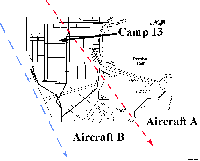
Figure 5. Flight Paths of Aircraft Suspected of Causing the

Figure 5. Flight Paths of Aircraft Suspected of Causing the "Sonic Boom"

Assessment of the Loud Noise Event (January 19, 1991)

Based on the information that is available to date, the presence of a chemical or biological warfare agent in the Al Jubayl area during the Loud Noise Event is judged to be "Unlikely." This assessment is based upon the following information:

  • knowledge that there were no SCUD missiles launched in the direction of Saudi Arabia on January 19, 1991.
  • there were no verifiable tests conducted in the Al Jubayl area that tested positive for chemical warfare agents.
  • no records have been found of any individual receiving medical treatment of symptoms associated with exposure to chemical or biological warfare agents.

Findings of Events That Occurred on January 20-21, 1991

The January 20-21, 1991, incident involved air raid sirens and a reference to "two explosions southeast of camp." Available records indicate that chemical detection tests were negative. The time of this event corresponds approximately to the time that a SCUD missile was launched towards Dhahran and was most likely intercepted by a Patriot air defense missile at very high altitude. Although there is no record of a reported impact site, this event is confirmed by numerous command log entries and the SCUD launch database.

Assessment of Events That Occurred on January 20-21, 1991

Based on the information that is available to date, the presence of a chemical or biological warfare agent in the Al Jubayl area during the events of January 20-21, 1991 is judged to be "Unlikely." This assessment is based upon the following information:

  • that events recorded in numerous command log entries and the SCUD launch database show that a SCUD missile was launched and intercepted at approximately the same time as the events recorded in logs of units located in Al Jubayl.
  • that there is no record of an impact site in the Al Jubayl area.
  • no records have been found of any individual receiving medical treatment of symptoms associated with exposure to chemical or biological warfare agents.

Through the early stages of the war, Al Jubayl was spared from direct missile attack. This did not keep units within the Al Jubayl area from having to respond to air raid warnings and increase the MOPP level each and every time a SCUD alert was issued. The SCUD missiles that could be seen from Al Jubayl were those flying over the city -- apparently targeted against Dhahran or other targets located south of the city. This all changed on February 16, 1991, when a SCUD impacted in Al Jubayl harbor.

2. SCUD Impact

During the Gulf War, the Iraqis fired a total of 88 SCUD missiles. A brief discussion of SCUD history and characteristics is contained at Tab D. The attack against Al Jubayl occurred a little over a month into the war and was the 66th missile the Iraqis launched.[41]

The Iraqis launched the 66th missile at approximately 0200 hours local on February 16, 1991. U.S. National sensors detected the missile early in flight and provided prompt warning of the launch. The incoming missile was the Al Hussein variant of the SCUD. It impacted in the harbor, approximately 150 meters from the commercial pier where an ammunition storage area was located and approximately 1000 meters from the USS Tarawa. Other ships that were in the harbor at the time of the SCUD impact included the USS Button, the USS Cleveland, and a Merchant Marine vessel--the Santa Adele.[42] The missile’s warhead did not explode and it caused no damage. The U.S. Navy’s Explosive Ordnance Disposal Detachment 33 recovered most of the missile, including the warhead, from the harbor floor.

Marine vessel--the Santa Adele.[42] The missile’s warhead did not explode and it caused no damage. The U.S. Navy’s Explosive Ordnance Disposal Detachment 33 recovered most of the missile, including the warhead, from the harbor floor.

A Patriot missile battery was defending Al Jubayl. Although it received the launch warning, the Patriot battery was not-operational for maintenance reasons and was not able to engage the incoming missile.

According to excerpts from the U.S. Navy’s EOD Detachment 33 log, air raid sirens sounded in the city; the Harbor Defense Command went to condition "Red", and the Rear Area Operations Center went to condition "Yellow."[43] The PSU 301 Command Duty Officer heard an explosion outside of the command tent -- "something in the air and to the west." He recalls seeing "white hot luminescent objects still in the air." He then alerted the unit to General Quarters and contacted Harbor Defense Command.[44] Standard Operating Procedures required 3 Raider boats underway at all times. When General Quarters was sounded, PSU 301’s three remaining Raiders got underway.[45] Other eyewitness accounts from PSU 301 personnel indicate that there may have been an airborne explosion; some accounts indicate two explosions.

PSU 301 and EOD boat crews responded rapidly to the SCUD impact. By 0230 hours, an EOD boat and a PSU 301 Raider had arrived at the scene of the SCUD impact. However, due to smoke and the strong smell of what was thought to be missile fuel,[46] the accompanying PSU 301 boat backed off. The EOD team surveyed the harbor’s surface near the reported impact and located an area of major bubble activity and a strong smell of fumes. Approximately twenty minutes later, the EOD team marked the area with a surface buoy and returned to base.

At 0720 hours on February 16, 1991, the EOD team returned to the site in order to check the status of the marked area. Bubbles were still rising to the surface and the same smell of missile fuel remained in the area. At approximately 0930 hours an EOD boat equipped with an Underwater Damage Assessment Television System conducted a survey of the harbor bottom. After lowering the UDATS and surveying the area around the buoy, the team located missile debris, including an item which resembled a warhead. At 1450 hours, the EOD team conducted its first dive at the impact site. The divers confirmed the location of an intact SCUD warhead, along with the guidance section, rocket motor, and miscellaneous components. All major components were separated from each other, confirming that the missile had broken apart.[47]

The Recovery Operation

In preparation for recovery operations, EOD personnel spent February 17th in consultation with their technical information center at Indian Head, MD. EOD personnel also made the requisite notifications to their command in Bahrain as well as other command entities located in the immediate port area. As expected, they also spent time responding to numerous requests for more detailed information.

On February 18th , the detachment’s divers continued their survey of the harbor floor, and mapped the site using the UDATS. At 1500 hours, the Operational Commander of the Harbor Defense Command visited the EOD camp and received an update on the situation.

During the period February 19 -21, the EOD team conducted extensive searches of the harbor bottom and recovered smaller SCUD components with the aid of an underwater camera system. Divers also located and marked a fuel tank for retrieval.

The EOD team began salvage operations on February 22, 1991, at 0800 hours. Using lifting balloons, they retrieved three major non-explosive components: the fuel tank (Figure 6), the guidance section, and the rocket motor (Figure 7). The missile pieces were hoisted out of the water using a crane. While the components were suspended, they were sprayed with a fire hose to flush out sea water and any caustic substances that could have remained. The EOD crew flushed out the pieces for a second time once they were on the pier. Later, the components were taken to the EOD base camp for temporary storage.
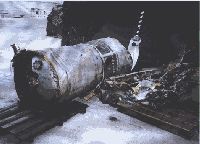
Figure 6. The Recovered SCUD's Fuel Tank
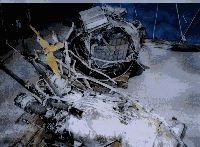
Figure 6. The Recovered SCUD's Fuel Tank

Figure 7. The Recovered SCUD's Guidance Section & Rocket Motor (rocket motor is in the foreground)

Figure 7. The Recovered SCUD's Guidance Section & Rocket Motor (rocket motor is in the foreground)


After the EOD team finished examining the recovered SCUD components, custody was transferred to the Joint Captured Material Exploitation Center on February 23, 1991. JCMEC was a coalition entity responsible for collecting captured foreign military equipment throughout the Kuwait Theater of Operations.

Recovery of the warhead began on March 2, 1991, at 0600 hours. During an interview it was reported that EOD divers collected sediment samples from the area near the warhead prior to its recovery from the harbor.[48] However, investigators found no record that confirms soil samples were taken. By 1320 hours the warhead had been safely removed from the water and operations to render it harmless had begun. During the operation, EOD personnel used an M18 chemical detection kit to check for the presence of chemical warfare agents. The operation ended at 1715 hours. During the entire recovery operation, EOD members found no evidence of chemical or biological agents.

On March 3rd, the disarmed warhead was loaded onto a barge for shipment back to the EOD base camp in Al Jubayl (Figure 8). JCMEC personnel took custody of the warhead on March 8, 1991. JCMEC shipped the missile components to the Army Missile Command in Huntsville, AL.
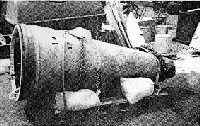
Figure 8. The Recovered SCUD's Warhead

Figure 8. The Recovered SCUD's Warhead

Findings of the SCUD Impact Event

A SCUD missile did impact in the waters of Al Jubayl harbor on February 16, 1991. Eyewitnesses have reported the missile was intercepted and shot down by a Patriot missile. However, the Patriot battery that was located at Al Jubayl was not operational at the time and could not have shot down the SCUD. The SCUD did not detonate upon impact with the water. There were no injuries to personnel or damage to equipment as the result of this incident. This missile was subsequently recovered from the harbor floor by Navy EOD personnel. Testing conducted at the time of recovery for chemical warfare agents were negative.

Assessment of the SCUD Impact Event

Initially, as could be expected, this event received a considerable amount of attention. The opportunity to recover a SCUD nearly intact was not an everyday occurrence. The initial surge of interest diminished over time -- largely because no one was injured and no equipment was damaged at any time from the missile’s impact to its recovery.

Based on the information that is available to date, our assessment is that the SCUD missile was "Definitely Not" armed with chemical warfare agents. This assessment is based upon the following information:

  • that testing conducted for chemical warfare agents during recovery operations were negative. 
  • chemical agents were not found when the warhead was rendered "safe." 

3. Purple T-Shirt Event

On March 19, 1991, following the cease fire, personnel from NMCB-24 required medical attention after becoming exposed to unidentified airborne noxious fumes. These fumes resulted in acute symptoms, such a burning throats, eyes and noses, and difficulty in breathing. In addition, portions of their brown T-shirts turned purple. It was also reported that portions of some of these same individuals’ combat boots also turned purple.[49]

The incident occurred at approximately 1415 hours local and involved three separate groups of NMCB-24 personnel. Five individuals composed the first group, which was working on equipment in the Alpha Yard (a motor pool located adjacent to Camp 13).[50] Group two was two medical personnel, who were emptying sand bags inside Camp 13.[51] A third group was identified through eyewitness interviews and was composed of two other NMCB-24 personnel.[52] This third group experienced the same incident, but did not report it to the safety officer and did not report to the medical department for treatment. Both of these individuals have been interviewed. One individual could not remember the incident. The second individual remembers donning his mask and continuing to work.

The position of each of the three groups was such that if one drew a line connecting their locations, the axis would be oriented roughly North to South as shown in Figure 9. Each group was separated from the adjacent group by about 0.25 km for a total spread of about 0.5 km from North to South. Figure 9 depicts the relative positions of the three "purple T-shirt" groups, the prevailing wind direction, and the location of air monitoring station number 1.[53]
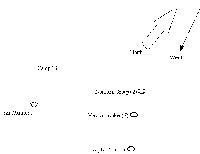
Purple T-Shirt Groups

Figure 9. Purple T-Shirt Groups

The NMCB 24 personnel who were involved in the incident stated they experienced a choking sensation when a "noxious" cloud enveloped them. None of the affected personnel saw the origin of the gas cloud, but all believed the cloud came from one of the industrial plants located near Camp 13 as shown in Figure 10. Although they all agreed that the odor was not ammonia, each person described the odor differently -- chlorine, battery acid, nitric acid, methyl ethyl ketone. All experienced the same symptoms; all had their T-shirts change color. According to one eyewitness, "the areas of our T-shirts that were soaked with sweat slowly began to turn the most beautiful shade of purple I ever saw."[54] All personnel, except for those in group 3, immediately sought medical attention and, after showering and changing clothes, returned to work with no further symptoms.
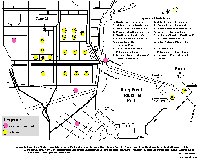
Figure 10. Camp 13 and Surrounding Industries

Figure 10. Camp 13 and Surrounding Industries

As stated earlier, none of individuals who were exposed to the noxious gas cloud saw where it came from. A Master Chief Equipment Operator (EQCM) from NMCB-24 was interviewed by telephone. This individual supervised the construction of Fleet Hospital-15, and worked on earth stabilization projects at KAANB. To date, the Chief is the only eyewitness that has positively identified the source of the noxious cloud. His comments concerning the purple T-shirt incident are summarized as follows:

There was an industrial accident connected with the purple T-shirt incident. The wind blew from the NW to the SE all of the time. It almost never changed. NMCB-24 studied the wind patterns, as they were concerned about gas attacks. The day of the purple T-shirt incident, the Chief was working at a site that was north of Al Jubayl. He returned to Camp 13 to check on equipment that had broken down. Immediately after stepping out of his vehicle at the Alpha yard, he saw purple dust falling everywhere. He could see it coming from a smokestack at the fertilizer plant. The winds changed 180 degrees when it dumped it on him. There were nose bleeds and there was gagging. He had a nose bleed. Although acid was stored in the Alpha yard, he does not recall a battery explosion at any time.[55]

When interviewed, NMCB-24 medical personnel stated that the contaminated clothing was bagged and turned over to the Marines (either 3d NCR or IMEF personnel), and a group of Saudi Arabian officials. Those individuals conducted an environmental/occupational hazard investigation after the incident. NMCB-24 medical personnel stated they were not aware of any official report that was prepared upon completion -- of the investigation. But they were aware that the unit received a telephone report supposedly from the same individuals who conducted the study -- to inform the unit that there were no problems and nothing to worry about. [56] Investigators are attempting to locate any report generated by either U.S. or Saudi Arabian officials relating to the analysis of the purple T-shirts. However, because a chain of custody for the T-shirts cannot be identified, it is unlikely that investigators will be able to determine the identity of the Marines or Saudi officials who took possession of the T-shirts, or to locate any reports that may have been prepared. A request for information concerning this event has been transmitted to the United States Defense Attach� Office, Riyadh, Saudi Arabia.

This incident has been associated with the possible release of fumes from a nearby industry or a localized chemical spill in the Alpha Yard that could have caused the T-shirts to turn purple. The U.S. Navy's Environmental and Preventive Medicine Unit No. 2 conducted an environmental/occupational hazard investigation and site visit of Al Jubayl in 1994. [57] EPMU-2 personnel toured Camp 13 and local industries, as well as meeting with members of the Royal Saudi Arabian Ministry of Health and managers of the local industries. This study noted that the air quality in Al Jubayl was monitored throughout ODS/DS. Records from the Saudi Arabian government indicate that the air quality of Al Jubayl was maintained within acceptable limits throughout ODS/DS. In addition, records from Air Monitoring Station No. 1 for March 19, 1991, do not indicate the detection of any noxious airborne fumes that exceeded normal parameters acceptable for this area (see Tab E).

The EPMU-2 study could not determine the source of the irritant. However, their report did note that the camp was located in a heavily industrialized area. It stated that emissions from a petrochemical plant or from the motor park itself may have been the source of the irritant. Eyewitnesses stated that at the time of this incident, the winds were blowing out of the North, from the direction of the fertilizer plant.

In July 1993, the U.S. Army Material Test Directorate, White Sands Missile Range, conducted tests on a T-shirt in an attempt to identify the cause of damage to the shirt.[58] The rationale for this second test and the requesting agency is not known at this time. The T-shirt was believed to be similar to the ones that turned purple but its actual origin is not known. The T-shirt had numerous small holes on its front and back. A Scanning Electron Microscope was used to analyze damage to the shirt's fibers. The SEM analysis could not determine what specifically caused the damage to the T-shirt in question. However, the cause of the damage appeared to be chemical in nature. The test directorate had conducted a similar study in 1988. During this earlier study, fabric was exposed to various concentrations of sulfuric acid. The damaged fiber ends of the current T-shirt sample exhibit similar damage to those fibers exposed to sulfuric acid in the 1988 study.

A third study was done by Natick Research Development and Engineering Center in Natick, MA, at the request of the Defense Science Board. Natick conducted analyses of T-shirts that were similar to those that had turned purple at Camp 13. The T-shirts were furnished by one of the NMCB-24 members whose T-shirt turned purple. It is not known whether these shirts were actually worn during ODS/DS. These tests showed that brown military T-shirts of the type worn during ODS/DS do turn purple when exposed to acids, such as sulfuric (battery) acid and nitric/nitrous oxides from nitric acid.[59]

Findings of the Purple T-Shirt Event

On March 19, 1991, nine personnel from Naval Mobile Construction Battalion 24 were working at Camp 13 and were exposed to unidentified airborne noxious fumes. Although it has not been verified, the source of the fumes appears to be a fertilizer plant located near Camp 13. This exposure caused acute medical symptoms and caused portions of these individuals' T-Shirts and combat boots to turn purple in color.

At least seven of the nine personnel reported to the medical facility for treatment. After showering and changing their clothes all five returned to duty with no further symptoms. the two individuals who did not report to the medical facility simply continued to work and did experience the acute medical symptoms as the others. The shirts and boots that changed color were given to unnamed U.S. and Saudi officials and have never been recovered. Analyses of T-Shirts that are similar to those worn during the war show that the shirts can change color when exposed to acids, such as sulfuric (battery) acid and nitric/nitrous oxides from nitric acid.

Assessment of the Purple T-Shirt Event

Based on the information that is available to date, our assessment is that chemical warfare agents were "Definitely Not" involved in the Purple T-Shirt event. This assessment is based upon the following information:

  • this event occurred after the cessation of hostilities. 
  • there is no record of hostile attacks occurring during this time period. 
  • the medical problems reported by the individuals involved and their rapid recovery is not consistent with exposure to chemical warfare agents. 

The Purple T-shirt event served to highlight that Al Jubayl was a heavily industrialized city. This heavy concentration of industries meant that personnel who lived and worked in Al Jubayl could possibly have been exposed to a variety of industrial chemicals. During interviews of personnel who were stationed in Al Jubayl, investigators asked for each person’s impression of Al Jubayl’s environment. As might be expected, investigators received both positive and negative comments. To provide as clear a picture as possible of Al Jubayl and the surrounding area, the last section of this case narrative discusses Al Jubayl’s environment.

4. Environmental Factors & Other Related Topics

Eyewitness accounts from numerous personnel, as well as notations in NMCB-24 command logs, relate the presence of ammonia and sulfur odors in the air and give a general impression of Al Jubayl's environment. Some of these accounts are cited below:

A Boatswain’s Mate Third Class assigned to Port Security Unit 301-B said that Al Jubayl was the dirtiest port he had ever seen. He attributed this to smoke from the oil well fires in Kuwait, crude oil floating in the water, and the various industrial plants located in the area.[60]

A Port Security man Second Class, assigned to PSU-301-B, recalls the heavy concentration of black smoke from the oil well fires: "Sometimes the smoke layer was so heavy it would obliterate the sun." When asked about the general conditions of Al Jubayl, he indicated that the port was as clean or cleaner than many ports he has seen in the United States.[61]

A Chief Builder (BUC) assigned to NMCB-24 stated that the "Camp 13 area smelled like a giant Port-O-Let (portable toilet)."[62]

During the pre-deployment phase of ODS/DS, military planners became aware of the heavy concentration of industry in Al Jubayl. The large number of industrial complexes located within a relatively small geographic area was of special concern. Many of these facilities used, produced, or stored industrial chemicals that could pose a serious health risk to military personnel, if they were exposed. The large number of personnel and equipment that were scheduled to deploy and redeploy through Al Jubayl compounded the problem.

Beginning early in the deployment phase of Desert Shield and continuing through the post Gulf War period, the issue of exposure to toxic industrial chemicals in the city of Al Jubayl was an item of concern to the IMEF command element. As a result, several studies (which are cited throughout this section) were conducted to determine the state of day-to-day environmental protective actions taken by the Saudi government; to identify the chemicals involved; and to determine what action(s), if any, could be taken to reduce the likelihood of a large scale chemical exposure.

Despite its heavy industrialization, studies have confirmed that the Saudi Arabian Government had stringent environmental standards in place long before the commencement of ODS/DS. The city of Al Jubayl, together with Yanbu, "are believed to be among the most environmentally clean of any comparable urban concentrations in the world."[63] Within the Kingdom, environmental protection standards were developed by the Saudi Meteorological and Environmental Protection Agency. Enforcement of these standards was the responsibility of a Royal Commission that was established to oversee operations within Al Jubayl and the surrounding area (see Tab F). It has been reported that the Saudi environmental standards parallel those of the U.S. Environmental Protection Agency.[64] A comparison of a small portion of U.S. EPA and Saudi (the Royal Commission) Air Quality Standards are provided in Table 1.[65]

Table 1. Comparison of a Cross-section of U.S. and Saudi Environmental Standards
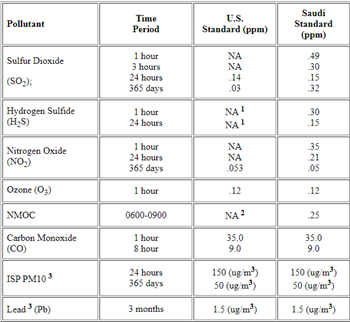
Table 1. Comparison of a Cross-section of U.S. and Saudi Environmental Standards


  1. No Federal Standard has been established. However, the State of California established an individual state standard of .03.
  2. No Federal Standard has been established. However, the State of New York established an individual state standard of .24.
  3. Standards are expressed in micrograms per cubic meter. 

The Saudi Arabian Government strictly monitored and enforced environmental standards and closely controlled the licensing of businesses within the Kingdom. This was done mainly for social and religious reasons, but the Saudis also recognized the need to maintain a strong environmental protection program.

Before any business could establish an industrial operation in Al Jubayl, it had to prove that its facility could adhere to established environmental and pollution control standards. The Saudi government required businesses to submit an Environmental Evaluation Report.
For example, the applications for several paper mills were rejected because the applicants could not demonstrate the ability to comply with environmental and pollution regulations. Obtaining a license did not signify an end to a business’s compliance responsibilities -- it was only the beginning. In order to ensure compliance, businesses that established operations were subject to continuous monitoring.

As a result of their efforts, the United Nations awarded the Saudi Royal Commission for Jubayl and Yanbu the "Sasakawa Award" in 1988 for their "excellent planning and implementation of environmentally sound management of the two industrial complexes."[66]

Analysis of Industries Located in Al Jubayl

Prior to the Gulf War, the Center for Naval Analysis conducted for IMEF a detailed analysis of every industry located in Al Jubayl.[67] The study identified each industrial plant that produced, used, or stored potentially dangerous chemicals, as well as the names of the individual chemicals involved. The location of these industrial plants is shown in Figure 11. This study also included the development of several exposure scenarios simulating the leakage of chemicals due to sabotage or direct destruction. Table 2 identifies the primary industrial complexes and the industrial chemicals they use or produce.[68]
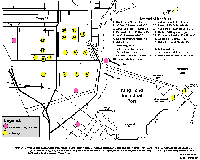
Figure 11. Identification of Industrial Plants Located in Al Jubayl

Figure 11. Identification of Industrial Plants Located in Al Jubayl

Table 2. List of the Primary Industrial Chemicals Found in Al Jubayl
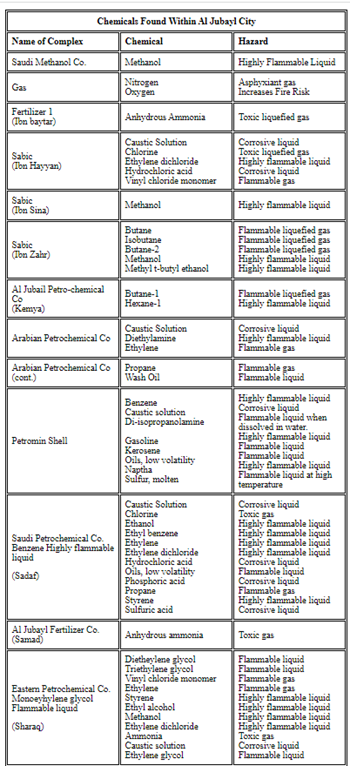
Table 2. List of the Primary Industrial Chemicals Found in Al Jubayl

After the industrial chemicals were identified, they were grouped into three different classifications. Flammable substances, which encompassed the majority of the chemicals identified, were classified as Petrochemicals; ammonia and chlorine were classified as Toxic gases; and the remaining chemicals were classified as Corrosive liquids. Corrosive liquids received no further attention.

Petrochemicals

The petrochemical companies located in Al Jubayl had disaster plans in place, and possessed varying capabilities to deal with explosions, leaks, etc. It was reported, however, that an explosion of a petroleum storage tank would have had serious consequences. Due to the percussion or impact of the explosion itself, extreme heat generated by the ensuing fire, and the rapid consumption of oxygen at ground level by the fireball, anyone within 500 feet of the blast would not have survived. Beyond the 500 foot zone the danger would have come from smoke, sulfur compounds, and airborne acids. In addition to explosion, a second danger would have been direct exposure to the petrochemicals themselves. This hazard would most likely have been the result of a major liquid petrochemical spill. [69]

Toxic Gases

Toxic chemicals (gaseous forms) were the second category of hazardous substances to be studied. As with their petrochemical company counterparts, each company that dealt with toxic chemicals reportedly had disaster preparedness plans. Three toxic substances were studied: ammonia, chlorine, and hydrogen sulfide. Each is discussed separately in the following paragraphs.

Ammonia was stored at facilities located in both the city and at the port. Two companies stored ammonia in the city -- Fertilizer 1 and the Al Jubayl Fertilizer Company. Both companies reportedly reduced their holdings at the beginning of the Gulf crisis. For example, before the crisis Fertilizer 1 normally stored 22,000 metric tons of ammonia but reduced their holdings to 1,000-8,000 MT as the crisis progressed. The Al Jubayl Fertilizer Company stored up to 5,000 MT. When the quantity being stored reached 5,000 MT, the excess would be transferred to Fertilizer 1’s tanks. The largest ammonia storage facility, operated by Fertilizer 1, was located in the port area. Their holdings at the port ranged between 5,000 to 20,000 MT between shipments, which normally occurred every two or three weeks.

Chlorine was located only within the industrial area of the city. The Saudi Petrochemical Company stored most of the chlorine. They voluntarily reduced their holdings to 110,000 MT at the beginning of the crisis.

Hydrogen Sulfide was the third toxic gas that could have been injurious to coalition forces. H2S could have emanated from any one of the numerous oil wells that dotted the area, or any one of the many oil pipelines that crisscrossed the area. If a pipeline or well head developed a leak or burst, H2S could have been released into the environment.

Individual Protection from Petrochemicals and Toxic Gases

Would the M17A1 mask and MOPP suit have protected individuals if they had been exposed to petrochemicals or any of the aforementioned toxic gases? According to the U.S. Army’s Field Manual 3-4, the M17A1 mask, when properly fitted, would have protected individuals against field concentrations of all known chemical and biological agents in vapor or aerosol form. The M17A1 mask would not have protected individuals from ammonia. When the oxygen level in the air is displaced by another gas (e.g., the air becomes saturated with chlorine after a rupture in a chlorine storage tank), the mask would not have protected the wearer. The MOPP suit, more commonly referred to as a Battledress Overgarment, would have protected the wearer against contact with chemical agent vapors, aerosols, and droplets of liquids. It was noted, however, that neither the mask nor MOPP suit could have provided protection if the air became saturated with either gas. Finally, both the mask and MOPP suit would have provided protection from exposure to hydrogen sulfide.[70]

Considering the findings of the original studies, contacts between representatives of IMEF and local officials were made in order to determine what actions could be taken to reduce the risk of exposure. At that time, IMEF representatives learned that businesses in Al Jubayl had voluntarily reduced their holdings of toxic substances at the beginning of ODS/DS. These meetings were also useful because they provided a forum to build a spirit of cooperation among the various parties involved. As a result, plans were developed that ensured proper notification of military authorities in the event of a disaster. These plans also included mutual aid agreements which would have involved military resources should the need arise.

Many Gulf War Veterans deployed in Al Jubayl have expressed concern about the substances they could have been exposed to in such a heavily industrialized environment. The environmental data included in this narrative indicates that Al Jubayl is no worse (or better) than comparable industrialized sites in the United States. Environmental standards were in place in Al Jubayl, but chemical substances could have been inadvertanlty released-- causing the T-Shirts to turn purple and causing the Seabees to seek medical attention. That noxious could reported at Camp 13 could well have been such a release. The release could have come from the fertilizer plant (or some other nearby factory). We continue to search for information that will shed light on its origin.

5. Summary

This case narrative focuses on three major events that took place in Al Jubayl, Saudi Arabia, during Operation Desert Storm and Desert Shield. These events are the "Loud Noise" event, the "SCUD Impact" event, and the "Purple T-shirt" event. A general discussion of Al Jubayl’s environment is also included because some veterans expressed concern over what hazardous materials they could have been exposed to while they were in Al Jubayl.

The information reported in this case narrative and the assessments made by investigators are based upon information that we have been able to uncover. We need to hear from you -- not only about your experiences in the vicinity of Al Jubayl, but also about any health problems you are experiencing which you think may be a result of your service during Operations Desert Shield /Desert Storm. If you have information that you believe would be of immediate value to us about the events at Al Jubayl, please call the DOD Incident Reporting Line at 1-800-472-6719.

If you are experiencing health problems you believe to be a result of your service in Operation Desert Storm/Desert Shield and you are eligible for health benefits through the Department of Defense, please call the COMPREHENSIVE CLINICAL EVALUATION PROGRAM at 1-800-796-9699.

If you are eligible for benefits provided by the Department of Veterans Affairs system, please call the PERSIAN GULF HELPLINE at 1-800-PGW-VETS.

Tab A:

The DOD requires a common framework for our investigations and assessments of chemical warfare agent incident reports, so we turned to the United Nations and the international community which had experience concerning chemical weapons. Because the modern battlefield is complex, the international community developed investigation and validation protocols[71] to provide objective procedures for possible chemical weapons incidents. The standard that we are using is based on these protocols that include:\

  • A detailed written record of the conditions at the site. 
  • Physical evidence from the site such as weapons fragments, soil, water, vegetation, or human or animal tissue samples. 
  • A record of the chain of custody during transportation of the evidence. 
  • Testimony of eye witnesses. 
  • Multiple analyses. 
  • Review of the evidence by an expert panel. 

While the DOD methodology for investigating chemical incidents (Figure 12) is based on these protocols, the passage of time since the Gulf War makes it difficult to obtain certain types of documentary evidence, and physical evidence was often not collected at the time of an event. Accordingly, the methodology is designed to provide a thorough, investigative process to define the circumstances of each incident and determine what happened. The major efforts in this methodology are:

  • Substantiate the incident. 
  • Document the medical reports related to the incident. 
  • Interview appropriate people.
  • Obtain information available to external organizations.
  • Assess the results.

Alarms alone are not considered to be certain evidence of chemical agent presence, nor is a single individual’s observation sufficient to validate a chemical agent presence.

To substantiate the circumstances surrounding an incident, the investigator searches for documentation from operational, intelligence, and environmental logs. This focuses the investigation on a specific time, date, and location, clarifies the conditions under which the incident occurred, and determines whether there is "hard" as well as anecdotal evidence. Additionally, the investigator looks for physical evidence that might indicate that chemical agents were present in the vicinity of the incident, including samples (or the results of analyses of samples) collected at the time of the incident.

The investigator searches the medical records to determine if personnel were injured as a result of the incident. Deaths, injuries, sicknesses, etc. near the time and location of an incident may be telling. Medical experts should provide information about alleged chemical casualties.

Figure 12. Chemical Incident Investigation Methodology

Figure 12. Chemical Incident Investigation Methodology

Interviews of incident victims (or direct observers) are conducted. First-hand witnesses provide valuable insight into the conditions surrounding the incident and the mind-set of the personnel involved, and are particularly important if physical evidence is lacking. NBC officers or personnel trained in chemical and biological testing, confirmation, and reporting are interviewed to identify the unit’s response, the tests that were run, the injuries sustained, and the reports submitted. Commanders are contacted to ascertain what they knew, what decisions they made concerning the events surrounding the incident, and their assessment of the incident. Where appropriate, subject matter experts also provide opinions on the capabilities, limitations, and operation of technical equipment, and submit their evaluations of selected topics of interest.

Additionally, the investigator contacts agencies and organizations that may be able to provide additional clarifying information about the case. These would include, but not be limited to:

  • Intelligence agencies that might be able to provide insight into events leading to the event, imagery of the area of the incident, and assessments of factors affecting the case.
  • The DOD and Veterans’ clinical registries, which may provide data about the medical condition of personnel involved in the incident.

Tab B: Acronym Listing/Glossary

This TAB provides a listing of acronyms found in this report. Additionally, the Glossary section provides definitions for selected technical terms which are not found in common usage. 

AO Area of Operations

ATO Air Tasking Order

AWACS Airborne Warning and Control System

BM3 Boatswain's Mate Third Class

BUC Chief Builder

CAM Chemical Agent Monitor

CBR Chemical Biological Radiological

CENTCOM Central Command

CDO Command Duty Officer

CFF         Critical Facility Force

DAO Defense Attach Office

DOD Department of Defense (U.S.)

EER Environmental Evaluation Report

EOD Explosive Ordnance Disposal

EPMU-2 Environmental and Preventive Medicine Unit Number Two

EQCM Master Chief Equipment Operator

ESG Environmental Support Group

HDC Harbor Defense Command

HMCS Hospital Corpsman Senior Chief

HQ or Hq  Headquarters

IAD Investigation and Analysis Directorate

IMEF First Marine Expeditionary Force

JNAF         Jubayl Naval Air Facility

JCMEC Joint Captured Material Exploitation Center

KAANB King Abdul Aziz Naval Base

KM Kilometers

KTO Kuwaiti Theater of Operations

MAG Marine Air Group

MAW Marine Air Wing

MEPA Meteorological and Environmental Protection Agency

MT Measurement Tons

MOAW         Ministry of Agriculture and Water

MIUW Mobile Inshore Undersea Warfare

MOPP Mission Orientated Protective Posture

NMCB Naval Mobile Construction Battalion

NAF Naval Air Facility

NBC Nuclear, Biological, and Chemical

NCR  Naval Construction Regiment

ODS/DS Operation Desert Shield/Desert Storm

OIC         Officer In Charge

OSAGWI Office of the Special Assistant for Gulf War Illnesses

OSD Office of the Secretary of Defense (U.S)

PPM Parts Per Million

PSHD Port Security and Harbor Defense

PSU         Port Security Unit

PS2 Port Securityman Second Class

RAOC Rear Area Operation Center

RCEG Royal Commission Environmental Guidelines

Security Classification Symbols: (U) Unclassified 

(S) SECRET

(TS) TOP SECRET

SEM Scanning Electron Microscope

TACC Tactical Air Control Center

UIC Unit Identification Code

UK United Kingdom

UN         United Nations

U.S United States

USCG United States Coast Guard

USPACECOM United States Space Command

Detection Paper

Detection paper relies on certain dyes being soluble in chemical warfare agents. Normally, two dyes and one pH indicator are mixed with cellulose fibers in a paper without special coloring (unbleached). When a drop of chemical warfare agent is absorbed by the paper, it dissolves one of the pigments. Mustard agent dissolves a red dye and nerve agent a yellow. In addition, VX (a form of liquid nerve agent) causes the indicator to turn to blue which, together with the yellow, will become green/green-black.

Detection paper can thus be used to distinguish between three different types of chemical warfare agents. A disadvantage with the papers is that many other substances can also dissolve the pigments. Consequently, they should not be located in places where drops of substances such as solvent, fat, oil, or fuel can fall on them. Drops of water produce no reaction.

Depending on the spot diameter and density on the detection paper, it is possible to gauge the original size of the droplets and the degree of contamination.

Reference: Detection of Chemical Weapons: An overview of methods for the detection of chemical warfare agents; homepage: http://www.opcw.nl/chemhaz/detect.htm

Leishmaniasis

Lesishmaniasis is a parasitic disease transmitted by sandflies.

Reference: The Merck Manual, Sixteenth Edition, 1992, page 232.

M256A1 Chemical Agency Detection Kit

The M256A1 kit is a portable, expendable item capable of detecting and identifying hazardous concentrations of chemical agent. The M256 kit is used after a chemical attack to determine if it is safe to unmask. The M256A1 kit has replaced the M256 kit. The only difference between the two kits is that the M256A1 kit will detect lower levels of nerve agent. This improvement was accomplished by using an eel enzyme for the nerve test in the M256A1 kit in place of the horse enzyme used in the M256 kit.

Reference: Worldwide Chemical Detection Equipment Handbook, p. 430.

M8A1 Chemical Alarm

The M8A1 is an automatic chemical agent detection and warning system designed to detect the presence of nerve agent vapors or inhalable aerosols. The M8A1 will automatically signal the presence of the nerve agent in the air by providing troops with both an audible and visible warning. The M8A1 was fielded to replace the wet chemical M8 detector with a dry system -- which eliminated the M229 refill kit, the logistic burden and associated costs. The M8A1 operates in a fixed, portable, or vehicle mounted configuration.

Reference: Worldwide Chemical Detection Equipment Handbook, p. 412.

The wearing of MOPP gear provides soldiers protection against all known chemical agents, live biological agents, and toxins. MOPP gear consists of the following items:\

  • Overgarmet (chemical suit)
  • Overboots
  • Mask (gas mask) with hood
  • Gloves

Mission Oriented Protective Posture 

When a person is wearing MOPP gear, they can not work for very long nor can they work very fast. They may also suffer mental distress as a result of feeling closed in and will also suffer from heat stress and heat exhaustion when working in warm temperatures and at high work rates. The MOPP concept arose from the need to balance individual protection with the threat, temperature, and urgency of the mission.

Commanders can raise or lower the amount of protection through five levels of MOPP. In addition, commanders can exercise a mask-only option.

MOPP Zero: Individuals must carry their protective mask with them at all times. Their remaining MOPP Gear must be readily available (i.e., within the work area, fighting position, living space, etc.).

MOPP Level One: Individuals wear their overgarmet. They must carry the rest of their MOPP gear.

MOPP Level Two: Individuals wear their overgarmet and overboots and carry the mask with hood and gloves.

MOPP Level Three: Individuals wear their overgarmet, overboots, and mask with hood. They carry the gloves.

MOPP Level Four: Individuals wear all their MOPP gear.

Source: U.S. Army Field Manual 3-4, Headquarters Department of the Army, Washington, DC, 21 October 1985

Mustard

Mustard "gas" refers to several manufactured chemicals including sulfur mustard. They do not occur naturally in the environment. The term gas is in quotes because mustard "gas" does not behave as a gas under ordinary conditions. Mustard "gas" is really a liquid and is not likely to change into a gas immediately if it is released at ordinary temperatures. As a pure liquid, it is colorless and odorless, but when mixed with other chemicals, it looks brown and has a garlic-like smell. Mustard was made in large amounts during World Wars I and II and used in World War I. It was reportedly used in the Iran-Iraq war in 1984-1988. It is not presently used in the United States, except for research purposes.

The only way that mustard can enter the environment (other than through use as a weapon) is through an accidental release. Some evaporates from water and soil into air. It does not easily go into water, and the amount that does breaks down quickly. It is more stable in soil than in water but still breaks down within days, depending on the outside temperature (cold weather makes it more stable). It does not go from soil to groundwater. Mustard "gas" does not build up in the tissues of animals because it breaks down so quickly. Mustard "gas" makes your eyes burn, your eyelids swell, and causes you to blink a lot. If you breathe mustard "gas," it can cause coughing, bronchitis, and long-term respiratory disease.

References: Agency for Toxic Substances and Disease Registry 1992. Toxicological profile for mustard "gas." Atlanta, GA: U.S. Department of Health and Human Services, Public Health Service.

Units That Were Located in Al Jubayl or Deployed Through Al Jubayl

The following Air Force Units were located in the Al Jubayl Area:

  • 1683d Airlift Control Squadron (Provisional)
  • 2d Combat Communications Group (Provisional)
  • 162d Combat Communications Group (Provisional)
  • 38th Aerial Port Squadron
  • 62d Aerial Port Squadron
  • 374th Aerial Port Squadron
  • 436th Aerial Port Squadron
  • 164th Mobile Aerial Port Squadron

Source: USAF Guff War Declassification Authority, Maxwell AFB, AL 
 

Julian Date Command UIC Unit Location Name Latitude  Longitude Source
15 Jan 91 101ST AIRBORNE WFJ4AA 0101 AV BN 05   27:03:38 049:31:18  101 ABN MSG DTD 15 JAN 91
 15 Jan 91   22ND SUPCOM   0007 CORPS  AL JUBAYL PORT   26:58:30   049:41:22  LOGSITREP 163 15 JAN 91
 15 Jan 91   22ND SUPCOM   0007 CORPS  AL JUBAYL   27:01:00   049:40:00  LOGSITREP #163 
 15 Jan 91   22ND SUPCOM   WEP0AA 0180 TC HHC BN  AL JUBAYL PORT   27:01:00   049:40:00  FLEXIBILITY - MISSION ESSENT
 15 Jan 91   22ND SUPCOM 100-1   WD0AF0 0007 AD BN 02 F BTY     27:01:04   049:39:48  EAC LOGSTAT 15
 15 Jan 91   3RD ARMY 29-2   WD0AF0 0007 AD BN 02 F BTY     27:01:04   049:39:48  MSG SITUATION RPT 161
15 Jan 91  VII CORPS   0003 AR DIV  AL JUBAYL   27:01:00  049:40:00   C/C ADE 24-28 FEB 91
16 Jan 91   22ND SUPCOM   0007 CORPS   AL JUBAYL PORT  26:58:30  049:41:22  LOGISTREP D-1 16 JAN 91
16 Jan 91   22ND SUPCOM   0007 CORPS   AL JUBAYL   27:01:00  049:40:00  LOGSITREP D+1 (H-4)
16 Jan 91   22ND SUPCOM    0007 CORPS   AL JUBAYL   27:01:00  049:40:00  LOGSITREP D+1 (H-4)
16 Jan 91  22ND SUPCOM  WEP0AA  0180 TC HHC BN   AL JUBAYL   27:01:00    049:40:00  FLEXIBILITY - MISSION ESSENT
16 Jan 91   22ND SUPCOM 100-01  WD0AF0   0007 AD BN 02 F BTY     27:01:04   049:39:48   EAC LOGSTAT 16
16 Jan 91  3RD ARMY 29-2  WD0AF0  0007 AD BN 02 F BTY    27:01:04    049:39:48  MSG SITUATION RPT 161
16 Jan 91   HQ, USAREUR AND 7TH ARMY   0007 CORPS   AL JUBAYL PORT  26:58:30    049:41:22   MSG DTD 16 JAN 91
16 Jan 91   HQ, USAREUR AND 7TH ARMY    0007 CORPS   AL JUBAYL PORT   26:58:30  049:41:22   LOGSTAT 133 91016
16 Jan 91   HQ, USAREUR AND 7TH ARMY   WSX0AA  0318 TC AGY MCC   AL JUBAYL   27:01:00   049:40:00   LOGSTAT 133 DTD 91016
16 Jan 91   MISCELLANEOUS    0298 QM CO   AL JUBAYL   27:01:00   049:40:00   AAR DTD 91124
16 Jan 91  VII CORPS   0003 AR DIV   AL JUBAYL   27:01:00   049:40:00   C/C ADE 24-28 FEB 91
16 Jan 91  XVIII ABN CORPS   WFJ4AA   0101 AV BN 05     27:03:38   049:31:18   UNIT LOCATIONS SEQ #161
 17 Jan 91   101ST AIRBORNE     0101 AV BN 05     27:03:38  049:31:18  101 ABN MSG DTD 17 JAN 91
 17 Jan 91   22ND SUPCOM    0007 CORPS   AL JUBAYL   27:01:00  049:40:00   APOD AIRFLOW
 17 Jan 91   22ND SUPCOM    0007 CORPS   AL JUBAYL   27:01:00  049:40:00   LOGSITREP D-DAY
 17 Jan 91   22ND SUPCOM  WCKYAA   0010 TC HHC TRANS TML BN   AL JUBAYL PORT  26:58:30  049:41:22   PHASE C - DESERT STORM
 17 Jan 91   22ND SUPCOM    0018 AB CORPS   AL JUBAYL   27:01:00  049:40:00   APOD AIRFLOW
 17 Jan 91   22ND SUPCOM   WG4TAA   0041 MD HSP   AL JUBAYL   27:01:00  049:40:00   BED STAT RPT DTD 91017
 17 Jan 91  22ND SUPCOM   WBNWAA   0655 MD CO  AL JUBAYL  27:01:00   049:40:00  BLOOD UNITS DTD 91017
 17 Jan 91  22ND SUPCOM 100-01  WD0AF0   0007 AD BN 02 F BTY    27:01:04   049:39:48  EAC LOGSTAT 17
 17 Jan 91   3RD ARMY    0007 CORPS  AL JUBAYL  27:01:00  049:40:00  LOGSITREP D-DAY
 17 Jan 91   3RD ARMY   WAB1AA   0101 AB DIV MAIN    26:58:30  049:50:22  SITREP 17 JAN 91
 17 Jan 91   3RD ARMY 29-2  WD0AF0  0007 AD BN 02 F BTY    27:01:04  049:39:48  MSG SITUATION RPT 161
 17 Jan 91   CENTER OF MIL HIST    0007 CORPS  AL JUBAYL PORT  26:58:30   049:41:22  LOGSTAT RPT - 134
 17 Jan 91   CENTER OF MIL HIST     0093 MCT  AL JUBAYL   27:01:00   049:40:00  MOVMT DIVISION DS AAR
 17 Jan 91  HQ, USAREUR AND 7TH ARMY    0007 CORPS  AL JUBAYL PORT  26:58:30  049:41:22  MSG DTD 17 JAN 91
 17 Jan 91   VII CORPS     0003 AR DIV  AL JUBAYL  27:01:00  049:40:00  C/C ADE 24-28 FEB 91
 17 Jan 91   XVIII ABN CORPS   WFJ4AA   0101 AV BN 05    27:03:38   049:31:18  UNIT LOCATIONS SEQ #162
 18 Jan 91  22ND SUPCOM     0007 CORPS  AL JUBAYL PORT   26:58:30   049:41:22  LOGSITREP D + 2 DTD 18 JAN
 18 Jan 91  22ND SUPCOM     0007 CORPS  AL JUBAYL   27:01:00   049:40:00  APOD AIRFLOW
 18 Jan 91  22ND SUPCOM     0007 CORPS  AL JUBAYL   27:01:00   049:40:00  LOGSITREP D + 2 91018
 18 Jan 91  22ND SUPCOM     0007 CORPS  AL JUBAYL   27:01:00   049:40:00  LOGSITREP D + 2
 18 Jan 91  22ND SUPCOM     0018 AB CORPS  AL JUBAYL   27:01:00   049:40:00  APOD AIRFLOW
 18 Jan 91  22ND SUPCOM 100-01   WD0AF0   0007 AD BN 02 F BTY     27:01:04 049:39:48   EAC LOGSTAT 18
 18 Jan 91  3RD ARMY 29-2   WD0AF0   0007 AD BN 02 F BTY     27:01:04  049:39:48  MSG SITUATION RPT 161
 18 Jan 91  CENTER OF MIL HIST     0093 MCT  AL JUBAYL   27:01:00  049:39:48  MOVMT DIVISON DS AAR
 18 Jan 91   Gap Fill-in   WCKYAA  0010 TC HHC TRANS TERMNL BN  AL JUBAYL PORT   26:58:30   049:41:22  Gap Fill-in
 18 Jan 91   USCENTCOM     0002 AR DIV  AL JUBAYL  27:01:00  049:40:00  MSG SITREP CINCCENT
 18 Jan 91  VII CORPS    0003 AR DIV  AL JUBAYL  27:01:00  049:40:00  101 ABN MSG DTD 19 JAN 91
 18 Jan 91   XVIII ABN CORPS   WFJ4AA   0101 AV BN 05     27:03:38   049:31:18  UNIT LOCATIONS SEQ #163
 19 Jan 91   101ST AIRBORNE   WFJ4AA   0101 AV BN 05     27:03:38   049:31:18  101 ABN MSG DTD 19 JAN 91
 19 Jan 91  22ND SUPCOM     0002 AR DIV   AL JUBAYL  27:01:00   049:40:00   SITREP 163 91019
 19 Jan 91  22ND SUPCOM     0007 CORPS   AL JUBAYL  27:01:00   049:40:00  LOGSITREP D+4 91020
 19 Jan 91  22ND SUPCOM     0007 CORPS   AL JUBAYL  27:01:00   049:40:00  LOGSITREP D+3
 19 Jan 91  22ND SUPCOM 100-01   WD0AF0   0007 AD BN 02 F BTY    27:01:04   049:39:48  EAC LOGSTAT 19
 19 Jan 91   3RD ARMY 29-2   WD0AF0   0007 AD BN 02 F BTY    27:01:04   049:39:48  MSG SITUATION RPT 161
 19 Jan 91   CENTER OF MIL HIST    0007 CORPS  AL JUBAYL PORT  26:58:30   049:41:22  ARCENT LOGSITREP D+14
 19 Jan 91   CENTER OF MIL HIST    0093 MCT  AL JUBAYL  27:01:00   049:40:00  MOVMT DIVISION DS AAR
 19 Jan 91   Gap Fill-in   WCKYAA   0010 TC HHC TRANS TERMNL BN  AL JUBAYL PORT  26:58:30   049:41:22  Gap Fill-in
 19 Jan 91   HQ, USAREUR AND 7TH ARMY     0007 CORPS  AL JUBAYL PORT  26:58:30   049:41:22  LOGSTAT 136 DTD 91019
 19 Jan 91  VII CORPS    0003 AR DIV  AL JUBAYL  27:01:00   049:40:00  C/C ADE 24-28 FEB 91
 19 Jan 91   XVIII ABN CORPS  WFJ4AA   0101 AV BN 05     27:03:38   049:31:18   UNIT LOCATIONS SEQ #164
 20 Jan 91   101ST AIRBORNE   WFJ4AA   0101 AV BN 05    27:03:38  049:31:18   101 ABN MSG DTD 20 JAN 91
 20 Jan 91  22ND SUPCOM    0007 CORPS  AL JUBAYL   27:01:00   049:40:00  LOGSITREP D+4 91020
 20 Jan 91  22ND SUPCOM    0007 CORPS  AL JUBAYL   27:01:00   049:40:00  LOGSITREP D+4
 20 Jan 91   3RD ARMY   WFAMAA  0001 TC HHC MCA  AL JUBAYL   27:01:00   049:40:00  MSG DTD 91020
 20 Jan 91   3RD ARMY    0007 CORPS  AL JUBAYL   27:01:00   049:40:00  ARCENT LSOC DUTY LOG
 20 Jan 91   3RD ARMY   WCKYAA  0010 TC HHC TRANS TML BN  AL JUBAYL PORT  26:58:30  049:41:22  10 TC BN MOV MSG 91020
 20 Jan 91   3RD ARMY 29-2   WD0AF0   0007 AD BN 02 F BTY     27:01:04   049:39:48  MSG SITUATION RPT 161
 20 Jan 91  CENTER OF MIL HIST   WD0AF0   0007 AD BN 02 F BTY     27:01:04   049:39:48   MSG DTD 20 JAN 91
 20 Jan 91  CENTER OF MIL HIST     0093 MCT  AL JUBAYL   27:01:00  049:40:00  MOVMT DIVISION DS AAR
 20 Jan 91  HQ, USAREUR AND 7TH ARMY     0007 CORPS  AL JUBAYL PORT  26:58:30  049:41:22   MSG DTD 20 JAN 91
 20 Jan 91   VII CORPS     0003 AR DIV  AL JUBAYL  27:01:00   049:40:00  C/C ADE 24-28 FEB 91
 20 Jan 91  XVIII ABN CORPS   WFJ4AA   0101 AV BN 05    27:03:38  049:31:18  UNIT LOCATIONS SEQ #165
 21 Jan 91  22ND SUPCOM     0007 CORPS   AL JUBAYL  27:01:00  049:40:00   LOGSITREP D+5 91021
 21 Jan 91  22ND SUPCOM     0007 CORPS   AL JUBAYL  27:01:00  049:40:00   LOGSITREP D+5
 21 Jan 91   24TH INF DIV   WD0AF0  0007 AD BN 02 F BTY   AL JUBAYL  27:01:00   049:33:45  UNIT LOCATIONS FOR 11 ADA BDE
 21 Jan 91  3RD ARMY    0001 AR DIV   AL JUBAYL  27:01:00  049:40:00  SITREP/166/91022
 21 Jan 91  3RD ARMY     0007 CORPS   AL JUBAYL  27:01:00  049:40:00  CONVOY MVMTS FOR 91021
 21 Jan 91  3RD ARMY    0007 CORPS   AL JUBAYL  27:01:00  049:40:00  ARCENT LSOC DUTY LOG
 21 Jan 91  3RD ARMY  WH60AA   0011 MI CO 2   AL JUBAYL  27:02:00  049:38:00  22SUP CDRSITREP 91021
 21 Jan 91  3RD ARMY    0130 CS CTR RAOC   AL JUBAYL  27:01:00  049:40:00   DAILY STAFF JOURNAL
 21 Jan 91   3RD ARMY 29-2  WD0AF0 0007 AD BN 02 F BTY    27:01:04  049:39:48  MSG SITUATION RPT 161
 21 Jan 91  CENTER OF MIL HIST     0007 CORPS  AL JUBAYL PORT  26:58:30   049:41:22  ARCENT LOGSITREP D+14
 21 Jan 91  CENTER OF MIL HIST     0093 MCT  AL JUBAYL   27:01:00  049:40:00   MOVMT DIVISION DS AAR
 21 Jan 91   Gap Fill-in  WCKYAA 0010 TC HHC TRANS TERMNL BN  AL JUBAYL PORT  26:58:30   049:41:22  Gap Fill-in
 21 Jan 91   HQ, USAREUR AND 7TH ARMY     0007 CORPS  AL JUBAYL PORT  26:58:30   049:41:22   LOGSTAT 137 DTD 91021
 21 Jan 91   VII CORPS    0003 AR DIV  AL JUBAYL   27:01:00   049:40:00   C/C ADE 24-28 FEB 91
 22 Jan 91   22ND SUPCOM      0007 CORPS    27:01:00  049:40:00  LOGSITREP D+6 91022
 22 Jan 91   24TH INF DIV  WD0AF0 0007 AD BN 02 F BTY   AL JUBAYL   27:01:04  049:39:48  11 AD SITREP #151 22 JAN 91
 22 Jan 91  3RD ARMY      0007 CORPS   AL JUBAYL   27:01:00   049:40:00  ARCENT LSOC DUTY LOG
 22 Jan 91  3RD ARMY  WCYPAA  0012 AV BDE HHC   AL JUBAYL   27:01:00   049:40:00   ARCENT LSOC DUTY LOG
 22 Jan 91  3RD ARMY 109-3   WS46AA  0411 EN HHC BDE   AL JUBAYL   27:01:00   049:40:00  HQ 411 EN PROJ LOG 3/91
 22 Jan 91  3RD ARMY  29-2   WD0AF0     0007 AD BN 02 F BTY   AL JUBAYL   27:01:04  049:39:48   MSG SITUATION RPT 161
 22 Jan 91  3RD ARMY 74-2   WCW4AA   0864 EN BN   AL JUBAYL   27:01:00   049:40:00   411 EN BDE PROJECT LOG
 22 Jan 91  CENTER OF MIL HIST     0001 AR DIV   AL JUBAYL   27:01:00  049:40:00  SITREP
 22 Jan 91  CENTER OF MIL HIST    0093 MCT   AL JUBAYL   27:01:00   049:40:00  MOVMT DIVISION DS AAR
 22 Jan 91  Gap Fill-in  WCKYAA   0010 TC HHC TRANS TERMNL BN   AL JUBAYL PORT  26:58:30  049:41:22   Gap Fill-in
 22 Jan 91   HQ, USAREUR AND 7TH ARMY     0007 CORPS   AL JUBAYL PORT  26:58:30   049:41:22  MSG DTD 22 JAN 91
 22 Jan 91  USCENTCOM     0001 AR DIV   AL JUBAYL  27:01:00   049:40:00  MSG SITREP CINCCENT
 22 Jan 91   VII CORPS     0003 AR DIV   AL JUBAYL  27:01:00   049:40:00  C/C ADE 24-28 FEB 91
 23 Jan 91  22ND SUPCOM     0007 CORPS   AL JUBAYL   27:01:00   049:40:00  LOGSITREP D+7 23 Ja n 91
 23 Jan 91   22ND SUPCOM    0007 CORPS   AL JUBAYL  27:01:00  049:40:00  LOGSITREP D+7
 23 Jan 91   3RD ARMY 29-2   WD0AF0   0007 AD BN 02 F BTY     27:01:04  049:39:48   MSG SITUATION RPT 161
 23 Jan 91  CENTER OF MIL HIST   WD0AF0   0007 AD BN 02 F BTY     27:01:04  049:39:48  PATRIOT LOC DTD 23 JAN
 23 Jan 91   CENTER OF MIL HIST     0007 CORPS  AL JUBAYL PORT   26:58:30   049:41:22   LOGSTAT RPT - 140
 23 Jan 91   CENTER OF MIL HIST     0093 MCT  AL JUBAYL    27:01:00  049:40:00   MOVMT DIVISION DS AAR
 23 Jan 91  Gap Fill-in   WCKYAA  0010 TC HHC TRANS TERMNL BN  AL JUBAYL PORT   26:58:30  049:41:22   Gap Fill-in
 23 Jan 91   HQ, USAREUR AND 7TH ARMY     0007 CORPS   AL JUBAYL PORT   26:58:30   049:41:22  MSG DTD 23 JAN 91
 23 Jan 91   VII CORPS    0003 AR DIV   AL JUBAYL  27:01:00  049:40:00  C/C ADE 24-28 FEB 91
 24 Jan 91  22ND SUPCOM   WBG2AA  0004 COSCOM  AL JUBAYL  27:01:00  049:40:00  LOGSITREP D+8 91024
 24 Jan 91  22ND SUPCOM     0007 CORPS   AL JUBAYL  27:01:00   049:40:00  LOGSITREP D+8 91024
 24 Jan 91   24TH INF DIV   WD0AF0  0007 AD BN 02 F BTY     27:01:04   049:39:48  11 AD SITREP #153 24 JAN 91
 24 Jan 91  3RD ARMY     0007 CORPS      27:01:00   049:40:00   ARCENT LSOC DUTY LOG
 24 Jan 91  3RD ARMY   WH60AA   0011 MI CO 2   AL JUBAYL  27:01:00   049:38:00  22SUP CDR SITREP 91025
 24 Jan 91  3RD ARMY 29-2  WD0AF0  0007 AD BN 02 F BTY  AL JUBAYL  27:01:04  049:39:48  MSG SITUATION RPT 161
 24 Jan 91  CENTER OF MIL HIST    >0007 CORPS  AL JUBAYL  26:58:30  049:41:22  LOGSTAT RPT - 141
 24 Jan 91  CENTER OF MIL HIST    0093 MCT  AL JUBAYL  27:01:00  :40:00 MOVMT DIVISION DS AAR 
 24 Jan 91  Gap Fill-in  WCKYAA  0010 TC HHC TRANS TERMNL BN  AL JUBAYL PORT  26:58:30  049:41:22  Gap Fill-in
 24 Jan 91  HQ MTMC<     0001 AR DIV  AL JUBAYL  27:01:00  049:40:00  MTMC MEMO 24JAN91
 24 Jan 91  HQ, USAREUR AND 7TH ARMY    0007 CORPS  AL JUBAYL PORT  26:58:30  049:41:22  MSG DTD 24 JAN 91
 24 Jan 91  VII CORPS    0003 AR DIV  AL JUBAYL PORT  27:01:00  049:40:00  >C/C ADE 24-28 FEB 91
 25 Jan 91  22ND SUPCOM    0007 CORPS  AL JUBAYL  27:01:00  049:40:00  LOGSITREP D+9
 25 Jan 91  22ND SUPCOM    0007 CORPS  AL JUBAYL  27:01:00  049:40:00  LOGSITREP D+9 91025
 25 Jan 91  22ND SUPCOM    0007 CORPS  AL JUBAYL  27:01:00  049:40:00  LOGSITREP D+9
 25 Jan 91  22ND SUPCOM  WHK1AA  0022 QM DET  AL JUBAYL   27:01:53  049:27:28  EAC ORGANIZATIONS PG 3
 25 Jan 91  22ND SUPCOM  WHK1AA  0022 QM DET     27:01:53  049:27:28  EAC ORGANIZATIONS PG 3
 25 Jan 91  22ND SUPCOM  WEV2AA  0267 QM CO  AL JUBAYL   27:01:53  049:27:28  EAC ORGANIZATIONS PG 3
 25 Jan 91  22ND SUPCOM  WEV2AA  0267 QM CO  AL JUBAYL   27:01:53  049:27:28  EAC ORGANIZATIONS PG 3
 25 Jan 91  24TH INF DIV  WD0AF0  0007 AD BN 02 F BTY     27:01:04  049:39:48  11 ADA SITREP #153 25 JAN 91
 25 Jan 91  3RD ARMY  WBHZAA  0002 MD HSP MASH  AL JUBAYL   27:01:00  049:40:00  91025 CONVOY LISTING
 25 Jan 91  3RD ARMY  WGGHAA  0003 AD BN 06  AL JUBAYL   27:01:00  049:40:00  91025 ACTUAL DEP
 25 Jan 91 3RD ARMY  WH9WAA  0003 FA BN 04  AL JUBAYL  27:01:00  049:40:00  91025 ACTUAL DEP
 25 Jan 91 3RD ARMY  WH9WAA  0003 FA BN 04  AL JUBAYL  27:01:00  049:40:00  91025 ACTUAL DEP
 25 Jan 91 3RD ARMY  WADDA0  0006 IN BN 07  AL JUBAYL  27:01:00  049:40:00  91025 ACTUAL DEP
 25 Jan 91 3RD ARMY    0007 CORPS  AL JUBAYL  27:01:00  049:40:00  ARCENT LSOC DUTY LOG
 25 Jan 91 3RD ARMY  WH60AA  0011 MI CO 2  AL JUBAYL  27:01:00  049:40:00  22SUP SITREP 25 Ja n 91
 25 Jan 91 3RD ARMY  WAC8AA  0016 EN BN  AL JUBAYL  27:01:00  049:40:00  91025 ACTUAL DEP
 25 Jan 91 3RD ARMY  WEQ5AA  0026 QM DET  AL JUBAYL  27:01:00  049:40:00  ARCENT SUPCOM SITREP
 25 Jan 91 3RD ARMY  WAD0AA  0041 IN BN 01  AL JUBAYL  27:01:00  049:40:00  91025 ACTUAL DEP
 25 Jan 91 3RD ARMY  WAD7AA  0066 AR BN 03  AL JUBAYL  27:01:00  049:40:00  91025 ACTUAL DEP
 25 Jan 91 3RD ARMY  WAZKAA  0069 CM CO NBC DEFENSE  AL JUBAYL  27:01:00  049:40:00  91025 ACTUAL DEP
 25 Jan 91 3RD ARMY    0107 IN DIV  AL JUBAYL  27:01:00  049:40:00  91025 ACTUAL DEP
 25 Jan 91 3RD ARMY  WSZ9AA  0298 TC CO  AL JUBAYL  27:01:00  049:40:00  91025 ACTUAL DEP
 25 Jan 91 3RD ARMY  WVDEAA  0403 MD HSP CSH  AL JUBAYL  27:01:00  049:40:00  91025 ACTUAL DEP
 25 Jan 91 3RD ARMY  WVFGAA  0475 MD HSP MASH  AL JUBAYL  27:01:00  049:39:00  91025 ACTUAL DEP
 25 Jan 91 3RD ARMY  WDMUAA  0496 CS CO  AL JUBAYL  27:01:00  049:40:00  91025 ACTUAL DEP
 25 Jan 91 3RD ARMY  WCBK02  0498 CS BN  AL JUBAYL  27:01:00  049:40:00  91025 ACTUAL DEP
 25 Jan 91  3RD ARMY 109-2  WCW4AA  0864 EN BN  AL JUBAYL  27:01:00  049:40:00  MSTR PROJ LIST 4/91
 25 Jan 91  3RD ARMY 109-2  WCW4A0  0864 EN BN A CO  AL JUBAYL  27:01:00  049:40:00  MSTR PROJ LIST 4/91
 25 Jan 91  3RD ARMY 109-2  WCW4C0  0864 EN BN ENGR CO C HVY  AL JUBAYL  27:01:00  049:40:00  MSTR PROJ LIST 4/91
 25 Jan 91  3RD ARMY 29-2  WD0AF0  0007 AD BN 02 F BTY    27:01:04  049:39:48  MSG SITUATION RPT 161
 25 Jan 91  CENTER OF MIL HIST    0093 MCT  AL JUBAYL  27:01:00  049:40:00  MOVMT DIVISION DS AAR
 25 Jan 91  Gap Fill-in  WCKYAA  0010 TC HHC TRANS TERMNL BN  AL JUBAYL PORT  26:58:30  049:41:22  Gap Fill-in
 25 Jan 91 VII CORPS   0003 AR DIV AL JUBAYL 27:01:00 049:40:00  C/C ADE 24-28 FEB 91
 26 Jan 91  22ND SUPCOM    0007 CORPS  AL JUBAYL  27:01:00  049:40:00  LOGSITREP D+10 91026
 26 Jan 91  22ND SUPCOM  WEQ5AA  0026 QM DET  AL JUBAYL  27:01:00  049:40:00  LOGSITREP DTD 91026
 26 Jan 91  24TH INF DIV  WD0AF0  0007 AD BN 02 F BTY    27:01:04  049:39:48  11 AD SITREP #155 26 JAN 91
 26 Jan 91  3RD ARMY   WGGHAA  0003 AD BN 06  AL JUBAYL  27:01:00  049:40:00  CONVOY MVMTS FOR 91026
 26 Jan 91  3RD ARMY   WH9WAA  0003 FA BN 04  AL JUBAYL  27:01:00  049:40:00  CONVOY MVMTS FOR 91026
 26 Jan 91  3RD ARMY   WAJ3AA  0004 IN DIV 01 BDE  AL JUBAYL  27:01:00   049:40:00  CONVOY MVMTS FOR 91026
 26 Jan 91  3RD ARMY     0007 CORPS  AL JUBAYL  27:01:00   049:40:00  ARCENT LSOC DUTY LOG
 26 Jan 91  3RD ARMY   WAMWAA  0007 IN BN 01  AL JUBAYL  27:01:00   049:40:00  CONVOY MVMTS FOR 91026
 26 Jan 91  3RD ARMY  WCMKAA  0024 TC CO  AL JUBAYL  27:01:00   049:40:00  CONVOY DEP FOR 01 FEB 9
 26 Jan 91  3RD ARMY   WH1LAA  0026 CS CO  AL JUBAYL  27:01:00   049:40:00  CONVOY MVMTS FOR 91026
 26 Jan 91  3RD ARMY     0123 MS BN  AL JUBAYL  27:01:00   049:40:00  CONVOY MVMTS FOR 91026
 26 Jan 91  3RD ARMY   WD0GAA  0260 QM HHD BN  AL JUBAYL  27:01:00   049:40:00  CONVOY MVMTS FOR 91026
 26 Jan 91  3RD ARMY   WCBKAA  0498 SUP BN  AL JUBAYL  27:01:00   049:40:00  CONVOY MVMTS FOR 91026
 26 Jan 91  3RD ARMY 109-2  WCW4AA  0864 EN BN  AL JUBAYL  27:01:00   049:40:00  CONVOY MVMTS FOR 91026
 26 Jan 91  3RD ARMY 109-2  WCW4A0  0864 EN BN A CO  AL JUBAYL  27:01:00   049:40:00  CONVOY MVMTS FOR 91026
 26 Jan 91  3RD ARMY     0123 MS BN  AL JUBAYL   27:01:00  049:40:00  CONVOY MVMTS FOR 91026
 26 Jan 91  3RD ARMY   WD0GAA  0260 QM HHD BN  AL JUBAYL  27:01:00   049:40:00  CONVOY MVMTS FOR 91026
 26 Jan 91  3RD ARMY   WCBKAA  0498 SUP BN  AL JUBAYL  27:01:00  049:40:00  CONVOY MVMTS FOR 91026
 26 Jan 91  3RD ARMY 109-2  WCW4AA  0864 EN BN  AL JUBAYL  27:01:00  049:40:00  MSTR PROJ LIST 4/91
 26 Jan 91  3RD ARMY 109-2  WCW4A0  0864 EN BN A CO  AL JUBAYL  27:01:00   049:40:00  MSTR PROJ LIST 4/91
 26 Jan 91  3RD ARMY 109-2  WCW4C0  0864 EN BN ENGR CO C HVY  AL JUBAYL  27:01:00  049:40:00  MSTR PROJ LIST 4/91
 26 Jan 91  3RD ARMY 29-2  WD0AF0  0007 AD BN 02 F BTY    27:01:04  049:39:48  MSG SITUATION RPT 161
 26 Jan 91  CENTER OF MIL HIST    0007 CORPS   AL JUBAYL PORT  26:58:30  049:41:22  LOGSTAT RPT - 143
 26 Jan 91  CENTER OF MIL HIST    0093 MCT  AL JUBAYL   27:01:00   049:40:00  MOVMT DIVISION DS AAR
 26 Jan 91  CENTER OF MIL HIST  WAR4AA  0197 IN BDE    26:48:00  049:37:00  MSG DTD 26 JAN
 26 Jan 91  HQ, USAREUR AND 7TH ARMY    0007 CORPS  AL JUBAYL PORT  26:48:00   049:37:00  MSG DTD 26 JAN 91
 26 Jan 91  VII CORPS    0003 AR DIV  AL JUBAYL  27:01:00  049:40:00  C/C ADE 24-28 FEB 91
 27 Jan 91  22ND SUPCOM    0007 CORPS  AL JUBAYL   27:01:00  049:40:00  LOGSITREP D+12 91028
 27 Jan 91  22ND SUPCOM  WEQ5AA  0026 QM DET  AL JUBAYL   27:01:00  049:40:00  LOGSITREP D+12 91027
 27 Jan 91  24TH INF DIV  WD0AF0  0007 AD BN 02 F BTY    27:01:04   049:39:48  11 AD SITREP #155 27 JAN 91
 27 Jan 91  3RD ARMY    0007 CORPS  AL JUBAYL   27:01:00  049:40:00  ARCENT LSOC DUTY LOG
 27 Jan 91  3RD ARMY  WEQ5AA  0026 QM DET  AL JUBAYL  27:01:00  049:40:00  ARCENT SUPCOM SITREP
 27 Jan 91  3RD ARMY 109-2  WCW4AA  0864 EN BN  AL JUBAYL  27:01:00  049:40:00  MSTR PROJ LIST 4/91
 27 Jan 91  3RD ARMY 109-2  WCW4A0  0864 EN BN A CO  AL JUBAYL  27:01:00  049:40:00  MSTR PROJ LIST 4/91
 27 Jan 91  3RD ARMY 109-2  WCW4C0  0864 EN BN ENGR CO C HVY  AL JUBAYL   27:01:00  049:40:00  MSTR PROJ LIST 4/91
 27 Jan 91  3RD ARMY 29-2  WD0AF0  0007 AD BN 02 F BTY     27:01:04  049:39:48  MSG SITUATION RPT 161
 27 Jan 91  CENTER OF MIL HIST    0007 CORPS   AL JUBAYL PORT  26:58:30  049:41:22  LOGSTAT RPT - 144
 27 Jan 91  CENTER OF MIL HIST    0093 MCT  AL JUBAYL  27:01:00  049:40:00  MOVMT DIVISION DS AAR
 27 Jan 91  HQ, USAREUR AND 7TH ARMY    0007 CORPS  AL JUBAYL PORT  26:58:30  049:41:22  LOGSTAT 144 DTD 91027
 27 Jan 91  VII CORPS    0003 AR DIV  AL JUBAYL  27:01:00  049:40:00  C/C ADE 24-28 FEB 91
 28 Jan 91  22ND SUPCOM  WEQ5AA  0026 QM DET  AL JUBAYL  27:01:00  049:40:00  ARCENT SUPPORT CMD SITREP
 28 Jan 91  22ND SUPCOM  WEUHAA  0471 TC CO  AL JUBAYL  27:01:00  049:40:00  UNIT HIST/LLR 471 TC CO
 28 Jan 91  24TH INF DIV  WD0AF0  0007 AD BN 02 F BTY    27:01:04  049:39:48  11 AD SITREP #156 28 JAN 91
 28 Jan 91  3RD ARMY    0007 CORPS  AL JUBAYL  27:01:00   049:40:00  ARCENT LSOC DUTY LOG
 28 Jan 91  3RD ARMY 109-2  WCW4AA  0864 EN BN  AL JUBAYL  27:01:00  049:40:00  MSTR PROJ LIST 4/91
 28 Jan 91  3RD ARMY 109-2  WCW4A0  0864 EN BN A CO   AL JUBAYL  27:01:00  049:40:00  MSTR PROJ LIST 4/91
 28 Jan 91  3RD ARMY 109-2  WCW4C0  0864 EN BN ENGR CO C HVY  AL JUBAYL  27:01:00  049:40:00  MSTR PROJ LIST 4/91
 28 Jan 91  3RD ARMY 29-2  WD0AF0  0007 AD BN 02 F BTY    27:01:04  049:39:48  MSG SITUATION RPT 161
 28 Jan 91  CENTER OF MIL HIST    0007 CORPS  AL JUBAYL PORT  26:58:30  049:41:22  LOGSTAT RPT - 145
 28 Jan 91  CENTER OF MIL HIST    0093 MCT  AL JUBAYL  27:01:00  049:40:00  MOVMT DIVISION DS AAR
 28 Jan 91  HQ, USAREUR AND 7TH ARMY    0007 CORPS  AL JUBAYL PORT  26:58:30  049:41:22  MSG DTD 28 JAN 91
 28 Jan 91  VII CORPS    0003 AR DIV  AL JUBAYL  27:01:00  049:40:00  C/C ADE 24-28 FEB 91
 29 Jan 91  22ND SUPCOM  WD0AF0  0007 AD BN 02 F BTY    27:01:04  049:39:48  ADA BDE RPT #157 91029
 29 Jan 91  22ND SUPCOM  WEQ5AA  0026 QM DET  AL JUBAYL  27:01:00   049:40:00  LOGSITREP D+13 91029
 29 Jan 91  24TH INF DIV  WBJ8AA  0005 MD HSP GENL  AL JUBAYL  27:01:00  049:40:00  CMD'R READING FILE
 29 Jan 91  3RD ARMY    0007 CORPS  AL JUBAYL  27:01:00  049:40:00  ARCENT LSOC DUTY LOG
 29 Jan 91  3RD ARMY  WEQ5AA  0026 QM DET  AL JUBAYL  27:01:00  049:40:00  ARCENT SUPCOM SITREP
 29 Jan 91  3RD ARMY  WSZ5AA  0180 TC CO   AL JUBAYL  27:01:00  049:40:00  CONVOY MVMTS FOR 91029
 29 Jan 91  3RD ARMY    0702 TC CO   AL JUBAYL  27:01:00  049:40:00  CONVOY MVMTS FOR 91029
 29 Jan 91  3RD ARMY 109-2  WCW4AA  0864 EN BN  AL JUBAYL   27:01:00  049:40:00  MSTR PROJ LIST 4/91
 29 Jan 91  3RD ARMY 109-2  WCW4A0  0864 EN BN A CO  AL JUBAYL   27:01:00  049:40:00  MSTR PROJ LIST 4/91
 29 Jan 91  3RD ARMY 109-2  WCW4C0  0864 EN BN ENGR CO C HVY  AL JUBAYL   27:01:00  049:40:00  MSTR PROJ LIST 4/91
 29 Jan 91  3RD ARMY 29-2  WD0AF0  0007 AD BN 02 F BTY     27:01:04  049:39:48  MSG SITUATION RPT 161
 29 Jan 91  CENTER OF MIL HIST    0093 MCT  AL JUBAYL  27:01:00  049:40:00  MOVMT DIVISION DS AAR
 29 Jan 91  HQ, USAREUR AND 7TH ARMY    0007 CORPS  AL JUBAYL  27:01:00  049:40:00  MSG DTD 29 JAN 91
 29 Jan 91  VII CORPS    0003 AR DIV  AL JUBAYL  27:01:00  049:40:00  C/C ADE 24-28 FEB 91
 30 Jan 91  22ND SUPCOM  WD0AF0  0007 AD BN 02 F BTY    27:01:04  049:39:48  ADA RPT #158 DTD 30 Jan 91
 30 Jan 91  22ND SUPCOM    0007 CORPS  AL JUBAYL PORT  26:58:30  049:41:22  LOGSITREP
 30 Jan 91  22ND SUPCOM  WEQ5AA  0026 QM DET  AL JUBAYL  27:01:00  049:40:00  ARCENT SUPPORT CMD SITREP
 30 Jan 91  22ND SUPCOM  WEQ5AA  0026 QM DET  AL JUBAYL  27:01:00  049:40:00  LOGSITREP D+14 91030
 30 Jan 91  22ND SUPCOM  WEQ5AA  0026 QM DET  AL JUBAYL  27:01:00  049:40:00  LOGSITREP D+14
 30 Jan 91  3RD ARMY  WEQ5AA  0026 QM DET  AL JUBAYL  27:01:00  049:40:00  ARCENT SUPCOM SITREP
 30 Jan 91  3RD ARMY  WSZ5AA  0180 TC CO  AL JUBAYL   27:01:00   049:40:00  CONVOY DEP FOR 91030
 30 Jan 91  3RD ARMY  WD6KAA  0702 MD CO  AL JUBAYL   27:01:00   049:40:00  CONVOY DEP FOR 91030
 30 Jan 91  3RD ARMY 109-2  WCW4AA  0864 EN BN  AL JUBAYL  27:01:00  049:40:00  MSTR PROJ LIST 4/91
 30 Jan 91  3RD ARMY 109-2  WCW4A0  0864 EN BN A CO  AL JUBAYL  27:01:00  049:40:00  MSTR PROJ LIST 4/91
 30 Jan 91  3RD ARMY 109-2  WCW4C0  0864 EN BN ENGR CO C HVY  AL JUBAYL  27:01:00 049:40:00  MSTR PROJ LIST 4/91
 30 Jan 91  3RD ARMY 29-2  WD0AF0  0007 AD BN 02 F BTY    27:01:04  049:39:48  MSG SITUATION RPT 161
 30 Jan 91  CENTER OF MIL HIST    0093 MCT  AL JUBAYL  27:01:00  049:40:00  MOVMT DIVISION DS AAR
 30 Jan 91  VII CORPS    0003 AR DIV  AL JUBAYL  27:01:00  049:40:00  C/C ADE 24-28 FEB 91
 31 Jan 91  22ND SUPCOM    0007 CORPS  AL JUBAYL PORT  26:58:30  049:41:22  LOGSITREP
 31 Jan 91  22ND SUPCOM  WEQ5AA  0026 QM DET  AL JUBAYL  27:01:00  049:40:00  LOGSITREP D+15 91031
 31 Jan 91  22ND SUPCOM  WEQ5AA  0026 QM DET  AL JUBAYL  27:01:00  049:40:00  LOGSITREP D+15
 31 Jan 91  22ND SUPCOM 100-1  WD0AF0  0007 AD BN 02 F BTY    27:01:04  049:39:48  EAC LOGSTAT 31
 31 Jan 91  22ND SUPCOM 100-1  WCKYAA  0010 TC HHC TRANS TML BN  AL JUBAYL PORT  26:58:30  049:41:22  EAC LOGSTAT 31
 31 Jan 91  22ND SUPCOM 100-1  WEP0AA  0180 TC BN HHD  AL JUBAYL PORT  26:58:30  049:41:22  EAC LOGSTAT 31
 31 Jan 91  22ND SUPCOM 100-1  WEV2AA  0267 QM CO   AL JUBAYL  27:00:53  049:27:28  EAC LOGSTAT 31
 31 Jan 91  3RD ARMY   WHK1AA  0022 QM DET  AL JUBAYL  27:00:53  049:27:28  ARCENT LOGSITREP D+16
 31 Jan 91  3RD ARMY   WEQ5AA  0026 QM DET  AL JUBAYL  27:01:00  049:40:00  ARCENT SUPCOM SITREP
 31 Jan 91  3RD ARMY   WSZ5AA  0180 TC CO  AL JUBAYL  27:01:00  049:40:00  CONVOY MVMTS FOR 91031
 31 Jan 91  3RD ARMY     0702 TC CO  AL JUBAYL  27:01:00  049:40:00  CONVOY MVMTS FOR 91031
 31 Jan 91  3RD ARMY 109-2  WCW4AA  0864 EN BN  AL JUBAYL  27:01:00  049:40:00  MSTR PROJ LIST 4/91
 31 Jan 91  3RD ARMY 109-2  WCW4A0  0864 EN BN A CO  AL JUBAYL  27:01:00  049:40:00  MSTR PROJ LIST 4/91
 31 Jan 91  3RD ARMY 109-2  WCW4C0  0864 EN BN ENGR CO C HVY  AL JUBAYL  27:01:00  049:40:00  MSTR PROJ LIST 4/91
 31 Jan 91  3RD ARMY 29-2  WD0AF0  0007 AD BN 02 F BTY    27:01:04  049:39:48  MSG SITUATION RPT 161
 31 Jan 91  CENTER OF MIL HIST    0093 MCT  AL JUBAYL  27:01:00  049:40:00  MOVMT DIVISION DS AAR
 31 Jan 91  VII CORPS    0003 AR DIV  AL JUBAYL  27:01:00  049:40:00  C/C ADE 24-28 FEB 91
 1 Feb 91  22ND SUPCOM  WHK1AA  0022 QM DET  AL JUBAYL  27:01:53  049:27:28  LOGSITREP D+16 91032
 1 Feb 91  22ND SUPCOM  WHK1AA  0022 QM DET  AL JUBAYL  27:01:53  049:27:28  LOGSITREP D+16 91032
 1 Feb 91  22ND SUPCOM  WHK1AA  0022 QM DET  AL JUBAYL  27:01:00  049:40:00  LOGSITREP DTD 1 FEB 91
 1 Feb 91  22ND SUPCOM  WEQ5AA  0022 QM DET  AL JUBAYL  27:01:00  049:40:00  WATER PURIF
 1 Feb 91  22ND SUPCOM  WEQ5AA  0022 QM DET  AL JUBAYL  27:01:00  049:40:00  ARCENT SUPPORT CMD SITREP
 1 Feb 91  22ND SUPCOM  WEQ5AA  0022 QM DET  AL JUBAYL  27:01:00  049:40:00  LOGSITREP D+16 91032
 1 Feb 91  22ND SUPCOM 100-1  WD0AF0  0007 AD BN 02 F BTY    27:01:04  049:39:48  EAC LOGSTAT 32
 1 Feb 91  22ND SUPCOM 100-1  WCKYAA  0010 TC HHC TRANS TML BN  AL JUBAYL PORT  26:58:30  049:41:22  EAC LOGSTAT 32
 1 Feb 91  22ND SUPCOM 100-1  WEV2AA  0267 QM CO  AL JUBAYL  27:00:53  049:27:28  EAC LOGSTAT 32
 1 Feb 91  22ND SUPCOM 100-1  WYGVAA  0541 TC DET  AL JUBAYL  27:01:00  049:40:00  EAC LOGSTAT 32
 1 Feb 91  22ND SUPCOM 100-15  WCKYAA  0010 TC HHC TRANS TML BN  AL JUBAYL PORT  26:58:30  049:41:22  EAC LOGSTAT 131
 1 Feb 91  22ND SUPCOM 100-15  WEP0AA  0180 TC HHC BN  AL JUBAYL  27:01:00  049:40:00  EAC LOGSTAT 131
 1 Feb 91  22ND SUPCOM 100-15  WYGVAA  0541 TC  AL JUBAYL  27:01:00  049:40:00  EAC LOGSTAT 131
 1 Feb 91  22ND SUPCOM 100-15  WA96AA  0593 LG AREA SPT GP HHC  AL JUBAYL  27:01:00  049:40:00  EAC LOGSTAT 131
 1 Feb 91  3RD ARMY  WEQ5AA  0026 QM DET  AL JUBAYL  27:01:00  049:40:00  ARCENT SUPCOM SITREP
 1 Feb 91  3RD ARMY  WSZ5AA  0180 TC CO  AL JUBAYL  27:01:00  049:40:00  CONVOY DEP FOR 01 FEB 91
 1 Feb 91  3RD ARMY  WAJYT0  0702 CS BN  AL JUBAYL  27:01:00  049:40:00  CONVOY DEP FOR 01 FEB 91
 1 Feb 91  3RD ARMY 109-2  WCW4AA  0864 EN BN  AL JUBAYL  27:01:00  049:40:00  MSTR PROJ LIST 4/91
 1 Feb 91  3RD ARMY 109-2  WCW4A0  0864 EN BN A CO AL JUBAYL   27:01:00  049:40:00   MSTR PROJ LIST 4/91
 1 Feb 91  3RD ARMY 109-2  WCW4C0  0864 EN BN ENGR CO C HVY  AL JUBAYL   27:01:00  049:40:00   MSTR PROJ LIST 4/91
 1 Feb 91  3RD ARMY 29-2 WD0AF0  0007 AD BN 02 F BTY    27:01:04  049:39:48  MSG SITUATION RPT 161
 1 Feb 91  CENTER OF MIL HIST    0093 MCT  AL JUBAYL  27:01:00  049:40:00  MOVMT DIVISION DS AAR
 1 Feb 91  VII CORPS    0003 AR DIV  AL JUBAYL  27:01:00  049:40:00  C/C ADE 24-28 FEB 91
 2 Feb 91  22ND SUPCOM  WEQ5AA  0026 QM DET   AL JUBAYL  27:01:00  049:40:00  LOGSITREP D+18 91034
 2 Feb 91  22ND SUPCOM  WEQ5AA  0026 QM DET   AL JUBAYL  27:01:00  049:40:00  LOGSITREP D+17 91033
 2 Feb 91  22ND SUPCOM  WEQ5AA  0026 QM DET   AL JUBAYL  27:01:00  049:40:00  LOGSITREP DTD 2 FEB 91
 2 Feb 91  22ND SUPCOM 100-1  WD0AF0  0007 AD BN 02 F BTY     27:01:04  049:39:48  EAC LOGSTAT 33
 2 Feb 91  22ND SUPCOM 100-1  WCKYAA  0010 TC HHC TRANS TML BN   AL JUBAYL PORT  26:58:30  049:41:22  EAC LOGSTAT 33
 2 Feb 91  22ND SUPCOM 100-1  WEP0AA  0180 TC BN HHD  AL JUBAYL PORT  26:58:30  049:41:22   EAC LOGSTAT 33
 2 Feb 91  22ND SUPCOM 100-1  WEV2AA  0267 QM CO   AL JUBAYL  27:01:00  049:40:00   EAC LOGSTAT 33
 2 Feb 91  22ND SUPCOM 100-1  WYGVAA  0541 TC DET   AL JUBAYL  27:01:00  049:40:00   EAC LOGSTAT 33
 2 Feb 91  3RD ARMY    0007 CORPS  AL JUBAYL  27:01:00  049:40:00  ARCENT LSOC DUTY LOG
 2 Feb 91  3RD ARMY  WBUPAA  0483 MD DET  AL JUBAYL  27:01:00  049:40:00  COMMREP 422D MED DET
 2 Feb 91  3RD ARMY 109-2  WCW4AA  0864 EN BN   AL JUBAYL  27:01:00  049:40:00  MSTR PROJ LIST 4/91
 2 Feb 91  3RD ARMY 109-2  WCW4A0  0864 EN BN A CO   AL JUBAYL  27:01:00  049:40:00  MSTR PROJ LIST 4/91
 2 Feb 91  3RD ARMY 109-2  WCW4C0  0864 EN BN ENGR CO C HVY   AL JUBAYL  27:01:00  049:40:00  MSTR PROJ LIST 4/91
 2 Feb 91  3RD ARMY 29-2  WD0AF0  0007 AD BN 02 F BTY    27:01:04  049:39:48  MSG SITUATION RPT 161
 2 Feb 91  CENTER OF MIL HIST    0093 MCT  AL JUBAYL  27:01:00  049:40:00  MOVMT DIVISION DS AAR
 2 Feb 91  VII CORPS    0003 AR DIV  AL JUBAYL  27:01:00  049:40:00  C/C ADE 24-28 FEB 91
 3 Feb 91  22ND SUPCOM  WHK1AA  0022 QM DET  AL JUBAYL  27:00:53  049:27:28  UNIT LOCATIONS CHT 91034
 3 Feb 91  22ND SUPCOM  WEQ5AA  0026 QM DET  AL JUBAYL  27:01:00  049:40:00  LOGSITREP D+18 91034
 3 Feb 91  22ND SUPCOM  WEQ5AA  0026 QM DET  AL JUBAYL  27:01:00  049:40:00  LOGSITREP DTD 3 FEB 91
 3 Feb 91  22ND SUPCOM  WEV2AA  0267 QM CO  AL JUBAYL  27:00:53  049:27:28  UNIT LOCATIONS CHT 91034
 3 Feb 91  22ND SUPCOM 100-1  WD0AF0  0007 AD BN 02 F BTY    27:01:04  049:39:48  EAC LOGSTAT 34
 3 Feb 91  22ND SUPCOM 100-1  WCKYAA  0010 TC HHC TRANS TML BN  AL JUBAYL PORT  26:58:30  049:41:22  EAC LOGSTAT 34
 3 Feb 91  22ND SUPCOM 100-1  WEP0AA  0180 TC BN HHD  AL JUBAYL PORT  26:58:30  049:41:22  EAC LOGSTAT 34
 3 Feb 91  22ND SUPCOM 100-1  WEV2AA  0267 QM CO   AL JUBAYL  27:00:53  049:27:28  EAC LOGSTAT 34
 3 Feb 91  22ND SUPCOM 100-1  WYGVAA  0541 TC DET   AL JUBAYL  27:01:00  049:40:00  EAC LOGSTAT 34
 3 Feb 91  3RD ARMY  WBPVAA  0022 MD DET  AL JUBAYL  27:00:53  049:27:28  240 QM BN UNIT LOC 91034
 3 Feb 91  3RD ARMY  WEQ5AA  0026 QM DET  AL JUBAYL  27:01:00  049:40:00  ARCENT SUPCOM SITREP
 3 Feb 91  3RD ARMY  WAJYT0  0702 CS BN  AL JUBAYL  27:01:00  049:40:00  CONVOY DEP FOR 3 FEB 91
 3 Feb 91  3RD ARMY 109-2  WCW4AA  0864 EN BN  AL JUBAYL   27:01:00  049:40:00  MSTR PROJ LIST 4/91
 3 Feb 91  3RD ARMY 109-2  WCW4A0  0864 EN BN A CO  AL JUBAYL   27:01:00  049:40:00  MSTR PROJ LIST 4/91
 3 Feb 91  3RD ARMY 109-2  WCW4C0  0864 EN BN ENGR CO C HVY  AL JUBAYL   27:01:00  049:40:00  MSTR PROJ LIST 4/91
 3 Feb 91  CENTER OF MIL HIST    0093 MCT  AL JUBAYL   27:01:00  049:40:00  MOVMT DIVISION DS AAR
 3 Feb 91  VII CORPS    0003 AR DIV  AL JUBAYL   27:01:00  049:40:00  C/C ADE 24-28 FEB 91
 4 Feb 91  22ND SUPCOM  WEQ5AA  0026 QM DET  AL JUBAYL  27:01:00  049:40:00  ARCENT SUPPORT CMD SITREP
 4 Feb 91  22ND SUPCOM  WEQ5AA  0026 QM DET  AL JUBAYL  27:01:00  049:40:00  LOGSITREP D+19 91035
 4 Feb 91  22ND SUPCOM  WEQ5AA  0026 QM DET  AL JUBAYL  27:01:00  049:40:00  LOGSITREP D+19
 4 Feb 91  22ND SUPCOM 100-1  WD0AF0  0007 AD BN 02 F BTY    27:01:04  049:39:48  EAC LOGSTAT 35
 4 Feb 91  22ND SUPCOM 100-1  WCKYAA  0010 TC HHC TRANS TML BN  AL JUBAYL PORT  26:58:30  049:41:22  EAC LOGSTAT 35
 4 Feb 91  22ND SUPCOM 100-1  WEP0AA  0180 TC BN HHD  AL JUBAYL PORT  26:58:30  049:41:22  EAC LOGSTAT 35
 4 Feb 91  22ND SUPCOM 100-1  WEV2AA  0267 QM CO  AL JUBAYL  27:00:53  049:27:28  EAC LOGSTAT 35
 4 Feb 91  22ND SUPCOM 100-1  WYGVAA  0541 TC DET  AL JUBAYL  27:01:00  049:40:00  EAC LOGSTAT 35
 4 Feb 91  3RD ARMY  WEQ5AA 0026 QM DET  AL JUBAYL  27:01:00  049:40:00  ARCENT SUPCOM SITREP
 4 Feb 91  3RD ARMY 109-2  WCW4AA  0864 EN BN  AL JUBAYL  27:01:00  049:40:00  MSTR PROJ LIST 4/91
 4 Feb 91  3RD ARMY 109-2  WCW4A0  0864 EN BN A CO  AL JUBAYL  27:01:00  049:40:00  MSTR PROJ LIST 4/91
 4 Feb 91  3RD ARMY 109-2  WCW4C0  0864 EN BN ENGR CO C HVY  AL JUBAYL   27:01:00  049:40:00  MSTR PROJ LIST 4/91
 4 Feb 91  CENTER OF MIL HIST    0093 MCT  AL JUBAYL   27:01:00  049:40:00  MOVMT DIVISION DS AAR
 4 Feb 91  MISCELLANEOUS WVBKAA   0781 TC CO MDM TRK PET  AL JUBAYL   27:01:00  049:40:00  AAR DTD 91124
 4 Feb 91  VII CORPS    0003 AR DIV  AL JUBAYL   27:01:00  049:40:00  C/C ADE 24-28 FEB 91
 5 Feb 91  22ND SUPCOM  WD0AF0  0007 AD BN 02 F BTY     27:01:04  049:39:48  EAC LOGSTAT 36
 5 Feb 91  22ND SUPCOM  WEQ5AA  0026 QM DET   AL JUBAYL  27:01:00  049:40:00  LOGSITREP D+20 91036
 5 Feb 91  22ND SUPCOM  WEQ5AA  0026 QM DET   AL JUBAYL  27:01:00  049:40:00  LOGSITREP D+20
 5 Feb 91  22ND SUPCOM    0093 TC BN PROV   AL JUBAYL  27:01:00  049:40:00  AMMO CONVOY 91036
 5 Feb 91  22ND SUPCOM  WEP0AA  0180 TC HHC BN   AL JUBAYL  27:01:00  049:40:00  EAC LOGSTAT 36
 5 Feb 91  22ND SUPCOM  WEVZAA  0267 QM CO    27:00:53  049:27:28  EAC LOGSTAT 36
 5 Feb 91  22ND SUPCOM  WC72AA  0398 TC DET   AL JUBAYL  27:01:00  049:40:00  2D COSCOM OPORD 91-1
 5 Feb 91  22ND SUPCOM  WYGVAA  0541 TC DET   AL JUBAYL  27:01:00  049:40:00  EAC LOGSTAT 36
 5 Feb 91  22ND SUPCOM  WRCWAA  0586 TC DET   AL JUBAYL  27:01:00  049:40:00  EAC LOGSTAT 36
 5 Feb 91  22ND SUPCOM    10TH BN (11TH SIG BDE)   AL JUBAYL  27:01:00  049:40:00  EAC LOGSTAT 36
 5 Feb 91  22ND SUPCOM 100-1  WD0AF0  0007 AD BN 02 F BTY    27:01:04  049:39:48  EAC LOGSTAT 36
 5 Feb 91  22ND SUPCOM 100-1  WCKYAA  0010 TC HHC TRANS TML BN  AL JUBAYL PORT  26:58:30  049:41:22  EAC LOGSTAT 36
 5 Feb 91  22ND SUPCOM 100-1  WEP0AA  0180 TC BN HHD  AL JUBAYL PORT  26:58:30  049:41:22  EAC LOGSTAT 36
 5 Feb 91  22ND SUPCOM 100-1  WEV2AA  0267 QM CO  AL JUBAYL  27:00:53  049:27:28  EAC LOGSTAT 36
 5 Feb 91  22ND SUPCOM 100-1  WYGVAA  0541 TC DET  AL JUBAYL  27:01:00   049:40:00  EAC LOGSTAT 36
 5 Feb 91  3RD ARMY  WEQ5AA  0026 QM DET  AL JUBAYL  27:01:00  049:40:00  ARCENT SUPCOM SITREP
 5 Feb 91  3RD ARMY 109-2  WCW4AA  0864 EN BN  AL JUBAYL  27:01:00   049:40:00  MSTR PROJ LIST 4/91
 5 Feb 91  3RD ARMY 109-2  WCW4A0  0864 EN BN A CO  AL JUBAYL  27:01:00   049:40:00  MSTR PROJ LIST 4/91
 5 Feb 91  3RD ARMY 109-2  WCW4C0  0864 EN BN ENGR CO C HVY  AL JUBAYL  27:01:00   049:40:00  MSTR PROJ LIST 4/91
 5 Feb 91  3RD ARMY 29-2  WD0AF0  0007 AD BN 02 F BTY    27:01:04   049:39:48  MSG SITUATION RPT 165
  5 Feb 91  CENTER OF MIL HIST    0093 MCT  AL JUBAYL  27:01:00  049:40:00  MOVMT DIVISION DS AAR
  5 Feb 91  VII CORPS    0003 AR DIV  AL JUBAYL  27:01:00  049:40:00  C/C ADE 24-28 FEB 91
  5 Feb 91  22ND SUPCOM    0007 CORPS  AL JUBAYL PORT  26:58:30   049:41:22  LOGSITREP
 6 Feb 91  22ND SUPCOM  WEQ5AA  0026 QM DET  AL JUBAYL  27:01:00   049:40:00  LOGSITREP D+21 91037
 6 Feb 91  22ND SUPCOM  WEQ5AA  0026 QM DET  AL JUBAYL  27:01:00   049:40:00  LOGSITREP DTD 6 FEB 91
 6 Feb 91  22ND SUPCOM 100-1  WD0AF0  0007 AD BN 02 F BTY    27:01:04 049:39:48   EAC LOGSTAT 37
 6 Feb 91  22ND SUPCOM 100-1  WCKYAA  0010 TC HHC TRANS TML BN  AL JUBAYL PORT  26:58:30  049:41:22  EAC LOGSTAT 37
 6 Feb 91  22ND SUPCOM 100-1  WEP0AA  0180 TC BN HHD  AL JUBAYL PORT  26:58:30  049:41:22  EAC LOGSTAT 37
 6 Feb 91  22ND SUPCOM 100-1  WEV2AA  0267 QM CO  AL JUBAYL  27:00:53  049:27:28  EAC LOGSTAT 37
 6 Feb 91  22ND SUPCOM 100-1  WYGVAA  0541 TC DET  AL JUBAYL  27:01:00  049:40:00  EAC LOGSTAT 37
 6 Feb 91  3RD ARMY    0007 CORPS  AL JUBAYL  27:01:00  049:40:00  ARCENT LSOC DUTY LOG
 6 Feb 91  3RD ARMY  WEQ5AA  0026 QM DET  AL JUBAYL  27:01:00  049:40:00  ARCENT SUPCOM SITREP
 6 Feb 91  3RD ARMY 109-2  WCW4AA  0864 EN BN  AL JUBAYL  27:01:00  049:40:00  MSTR PROJ LIST 4/91
 6 Feb 91  3RD ARMY 109-2  WCW4A0  0864 EN BN A CO  AL JUBAYL  27:01:00 049:40:00   MSTR PROJ LIST 4/91
 6 Feb 91  3RD ARMY 109-2  WCW4C0  0864 EN BN ENGR CO C HVY  AL JUBAYL  27:01:00  049:40:00  MSTR PROJ LIST 4/91
 6 Feb 91  3RD ARMY 29-2  WD0AF0  0007 AD BN 02 F BTY    27:01:04  049:39:48  MSG SITUATION RPT 165
  6 Feb 91  CENTER OF MIL HIST    0093 MCT  AL JUBAYL  27:01:00  049:40:00  MOVMT DIVISION DS AAR
  6 Feb 91  VII CORPS    0003 AR DIV  AL JUBAYL  27:01:00  049:40:00  C/C ADE 24-28 FEB 91
 7 Feb 91  22ND SUPCOM  WEQ5AA  0026 QM DET  AL JUBAYL  27:01:00  049:40:00  SITREP D+22 91038
 7 Feb 91  22ND SUPCOM  WEQ5AA  0026 QM DET  AL JUBAYL  27:01:00  049:40:00  ARCENT SUPPORT CMD SITREP
 7 Feb 91  22ND SUPCOM  WEQ5AA  0026 QM DET  AL JUBAYL  27:01:00  049:40:00  LOGSITREP D+22
 7 Feb 91   22ND SUPCOM 100-1  WD0AF0  0007 AD BN 02 F BTY    27:01:04  049:39:48  EAC LOGSTAT 38
 7 Feb 91  22ND SUPCOM 100-1  WCKYAA  0010 TC HHC TRANS TML BN  AL JUBAYL PORT  26:58:30  049:41:22  EAC LOGSTAT 38
 7 Feb 91   22ND SUPCOM 100-1  WEP0AA  0180 TC BN HHD  AL JUBAYL PORT  26:58:30  049:41:22  EAC LOGSTAT 38
 7 Feb 91   22ND SUPCOM 100-1  WEV2AA  0267 QM CO  AL JUBAYL  27:00:53  049:27:28  EAC LOGSTAT 38
 7 Feb 91   22ND SUPCOM 100-1  WYGVAA  0541 TC DET  AL JUBAYL  27:01:00  049:40:00  EAC LOGSTAT 38
 7 Feb 91  3RD ARMY  WEQ5AA  0026 QM DET  AL JUBAYL  27:01:00  049:40:00  ARCENT SUPCOM SITREP
 7 Feb 91  3RD ARMY 29-2  WD0AF0  0007 AD BN 02 F BTY    27:01:04  049:39:48  MSG SITUATION RPT 166
 7 Feb 91  CENTER OF MIL HIST    0093 MCT  AL JUBAYL  27:01:00  049:40:00  MOVMT DIVISION DS AAR
 7 Feb 91  HQ, USAREUR AND 7TH ARMY    0007 CORPS  AL JUBAYL PORT  26:58:30  049:41:22  COMUSARCENT MAIN MSG 910338
 7 Feb 91  VII CORPS    0003 AR DIV  AL JUBAYL  27:01:00   049:40:00  C/C ADE 24-28 FEB 91
  8 Feb 91  22ND SUPCOM  WEQ5AA  0026 QM DET  AL JUBAYL   27:01:00  049:40:00  ARCENT SUPPORT CMD SITREP
  8 Feb 91  22ND SUPCOM  WEQ5AA  0026 QM DET  AL JUBAYL   27:01:00  049:40:00  LOGSITREP D+23 91039
  8 Feb 91  22ND SUPCOM  WEQ5AA  0026 QM DET  AL JUBAYL   27:01:00  049:40:00  LOGSITREP DTD 8 FEB 91
 8 Feb 91  22ND SUPCOM 100-1  WD0AF0  0007 AD BN 02 F BTY    27:01:04  049:39:48  EAC LOGSTAT 39
 8 Feb 91  22ND SUPCOM 100-1  WCKYAA  0010 TC HHC TRANS TML BN  AL JUBAYL PORT 26:58:30  049:41:22  EAC LOGSTAT 39
 8 Feb 91  22ND SUPCOM 100-1    0022 LAB   27:00:53  049:27:28  EAC LOGSTAT 39
 8 Feb 91  22ND SUPCOM 100-1  WEP0AA  0180 TC BN HHD  AL JUBAYL PORT  26:58:30  049:41:22  EAC LOGSTAT 39
 8 Feb 91  22ND SUPCOM 100-1  WEV2AA  0267 QM CO   AL JUBAYL  27:00:53  049:27:28  EAC LOGSTAT 39
 8 Feb 91  22ND SUPCOM 100-1  WYGVAA  0541 TC DET   AL JUBAYL  27:01:00  049:40:00  EAC LOGSTAT 39
 8 Feb 91  3RD ARMY  WEQ5AA  0026 QM DET   AL JUBAYL   27:01:00   049:40:00  ARCENT SUPCOM SITREP
 8 Feb 91  CENTER OF MIL HIST    0093 MCT   AL JUBAYL   27:01:00   049:40:00  MOVMT DIVISION DS AAR
 9 Feb 91  22ND SUPCOM  WEQ5AA  0026 QM DET  AL JUBAYL  27:01:00   049:40:00  ARCENT SUPPORT CMD SITREP
 9 Feb 91  22ND SUPCOM  WEQ5AA  0026 QM DET  AL JUBAYL  27:01:00   049:40:00  LOGSITREP D+24 91040
 9 Feb 91  22ND SUPCOM  WEQ5AA  0026 QM DET  AL JUBAYL  27:01:00   049:40:00  LOGSITREP D+24
  9 Feb 91  22ND SUPCOM 100-1  WD0AF0  0007 AD BN 02 F BTY    27:01:04  049:39:48  EAC LOGSTAT 40
  9 Feb 91  22ND SUPCOM 100-1  WCKYAA  0010 TC HHC TRANS TML BN  AL JUBAYL PORT  26:58:30  049:41:22  EAC LOGSTAT 40
  9 Feb 91  22ND SUPCOM 100-1    0022 LAB    27:00:53  049:27:28  EAC LOGSTAT 40
  9 Feb 91  22ND SUPCOM 100-1  WEP0AA  0180 TC BN HHD  AL JUBAYL PORT  26:58:30  049:41:22  EAC LOGSTAT 40
  9 Feb 91  22ND SUPCOM 100-1  WEV2AA  0267 QM CO  AL JUBAYL  27:00:53  049:27:28  EAC LOGSTAT 40
  9 Feb 91  22ND SUPCOM 100-1  WYGVAA  0541 TC DET  AL JUBAYL  27:01:00  049:40:00  EAC LOGSTAT 40
  9 Feb 91  3RD ARMY  WEQ5AA  0026 QM DET  AL JUBAYL   27:01:00  049:40:00  ARCENT SUPCOM SITREP
  9 Feb 91  3RD ARMY 29-3  WD0AF0  0007 AD BN 02 F BTY     27:01:04  049:39:48  MSG SITUATION RPT 169
  9 Feb 91  CENTER OF MIL HIST    0093 MCT  AL JUBAYL   27:01:00  049:40:00  MOVMT DIVISION DS AAR
 9 Feb 91  HQ, USAREUR AND 7TH ARMY    0007 CORPS   AL JUBAYL PORT  26:58:30  049:41:22  COMUSARCENT MAIN MSG 91040
 10 Feb 91  22ND SUPCOM  WEQ5AA  0026 QM DET   AL JUBAYL  27:01:00  049:40:00  ARCENT SUPPORT CMD SITREP
 10 Feb 91  22ND SUPCOM  WEQ5AA  0026 QM DET  AL JUBAYL  27:01:00  049:40:00  LOGSITREP D+25 91041
 10 Feb 91  22ND SUPCOM  WEQ5AA  0026 QM DET  AL JUBAYL  27:01:00  049:40:00  LOGSITREP D+25
 10 Feb 91  22ND SUPCOM 100-1  WD0AF0  0007 AD BN 02 F BTY    27:01:04  049:39:48  EAC LOGSTAT 41
 10 Feb 91  22ND SUPCOM 100-1  WCKYAA  0010 TC HHC TRANS TML BN   AL JUBAYL PORT  26:58:30  049:41:22  EAC LOGSTAT 41
 10 Feb 91  22ND SUPCOM 100-1    0022 LAB    27:00:53  049:27:28  EAC LOGSTAT 41
 10 Feb 91  22ND SUPCOM 100-1  WEP0AA  0180 TC BN HHD   AL JUBAYL PORT  26:58:30  049:41:22  EAC LOGSTAT 41
 10 Feb 91  22ND SUPCOM 100-1  WEV2AA  0267 QM CO  AL JUBAYL  27:00:53  049:27:28  EAC LOGSTAT 41
 10 Feb 91  22ND SUPCOM 100-1  WYGVAA  0541 TC DET  AL JUBAYL  27:01:00  049:40:00  EAC LOGSTAT 41
 10 Feb 91  3RD ARMY  WEQ5AA  0026 QM DET  AL JUBAYL  27:01:00  049:40:00  ARCENT SUPCOM SITREP
 10 Feb 91  3RD ARMY 29-3  WD0AF0  0007 AD BN 02 F BTY    27:01:04  049:39:48  MSG SITUATION RPT 169
 10 Feb 91  CENTER OF MIL HIST      AL JUBAYL  27:01:00  049:40:00  MOVMT DIVISION DS AAR
 11 Feb 91  22ND SUPCOM  WEQ5AA  0026 QM DET   AL JUBAYL  27:01:00  049:40:00  LOGSITREP D+26 91042
 11 Feb 91  22ND SUPCOM  WEQ5AA  0026 QM DET   AL JUBAYL  27:01:00  049:40:00  LOGSITREP D+26 91042
 11 Feb 91  22ND SUPCOM  WEQ5AA  0026 QM DET   AL JUBAYL  27:01:00  049:40:00  LOGSITREP D+27
 11 Feb 91  22ND SUPCOM 100-2  WD0AF0  007 AD BN 02 F BTY    27:01:04  049:39:48  EAC LOGSTAT 41
 11 Feb 91   22ND SUPCOM 100-2  WCKYAA  0010 TC HHC TRANS TML BN  AL JUBAYL PORT  26:58:30  049:41:22  EAC LOGSTAT 41
 11 Feb 91   22ND SUPCOM 100-2    0022 LAB        EAC LOGSTAT 41
 11 Feb 91   22ND SUPCOM 100-2  WEP0AA  0180 TC BN HHD  AL JUBAYL PORT  26:58:30  049:41:22  EAC LOGSTAT 41
 11 Feb 91   22ND SUPCOM 100-2  WEV2AA  0267 QM CO  AL JUBAYL  27:00:53  049:27:28  EAC LOGSTAT 41
 11 Feb 91   22ND SUPCOM 100-2  WYGVAA  0541 TC DET  AL JUBAYL  27:01:00  049:40:00  EAC LOGSTAT 41
 11 Feb 91  3RD ARMY  WEQ5AA  0026 QM DET   AL JUBAYL   27:01:00   049:40:00  ARCENT SUPCOM SITREP
 11 Feb 91  3RD ARMY 29-3  WD0AF0  007 AD BN 02 F BTY    27:01:04  049:39:48  MSG SITUATION RPT 170
 11 Feb 91  CENTER OF MIL HIST    0093 MCT   AL JUBAYL   27:01:00   049:40:00  MOVMT DIVISION DS AAR
 12 Feb 91  22ND SUPCOM  WD0AF0  007 AD BN 02 F BTY    27:01:04  049:39:48  EAC LOGSTAT 42 DTD 12FEB
 12 Feb 91  22ND SUPCOM  WCKYAA  0010 TC HHC TRANS TML BN  AL JUBAYL PORT  26:58:30  049:41:22  EAC LOGSTAT 42 DTD 12FEB
 12 Feb 91  22ND SUPCOM  WEQ5AA  0026 QM DET   AL JUBAYL  27:01:00  049:40:00  LOGSITREP D+27 91043
 12 Feb 91  22ND SUPCOM  WEQ5AA  0026 QM DET   AL JUBAYL  27:01:00  049:40:00  ARCENT SUPPORT CMD SITREP
 12 Feb 91  22ND SUPCOM  WEQ5AA  0026 QM DET  AL JUBAYL  27:01:00  049:40:00  LOGSITREP D+27 91043
 12 Feb 91  22ND SUPCOM  WEQ5AA  0026 QM DET  AL JUBAYL  27:01:00  049:40:00  LOGSITREP D+27
 12 Feb 91  22ND SUPCOM  WEP0AA  0180 TC HHC BN  AL JUBAYL PORT  26:58:30  049:41:22  EAC LOGSTAT 42 DTD 12FEB
 12 Feb 91  22ND SUPCOM  WEV2AA  0267 QM CO  AL JUBAYL  27:00:53  049:27:28  EAC LOGSTAT 42 DTD 12FEB
 12 Feb 91  22ND SUPCOM  WYGVAA  0541 TC DET  AL JUBAYL  27:01:00  049:40:00  EAC LOGSTAT 42 DTD 12FEB
 12 Feb 91  CENTER OF MIL HIST    0093 MCT AL JUBAYL 27:01:01 049:40:00 MVMT DIVISION DS AAR
 13 Feb 91 22ND SUPCOM WD0AF0 0007 AD BN 02 F BTY   27:01:04 049:39:48

EAC LOGSTAT 43 DTD 13FEB

 13 Feb 91 22ND SUPCOM WCKYAA 0010 TC HHC TRANS TML BN ALL JUBAYL PORT 26:58:30 049:41:22 EAC LOGSTAT 43 DTD 13FEB
13 Feb 91  22ND SUPCOM WEQ5AA 0026 QM DET AL JUBAYL 27:01:00 049:40:00 ARCENT SUPPORT CMD SITREP
13 Feb 91   22ND SUPCOM  WEQ5AA  0026 QM DET  AL JUBAYL  27:01:00  049:40:00  LOGSITREP D+28 91044
13 Feb 91   22ND SUPCOM  WEP0AA  0180 TC HHC BN  ALL JUBAYL PORT  26:58:30  049:41:22  EAC LOGSTAT 43 DTD 13FEB
13 Feb 91   22ND SUPCOM  WEV2AA  0267 QM CO  AL JUBAYL  27:00:53  049:27:28  EAC LOGSTAT 43 DTD 13FEB
 13 Feb 91  22ND SUPCOM  WRTZAA  0431 CA BN  AL JUBAYL  27:01:00  049:40:00  431ST CHRONOLOGY
 13 Feb 91  22ND SUPCOM  WRT0AA  0432 CA BN  AL JUBAYL  27:01:00  049:40:00  432ND AAR
 13 Feb 91  22ND SUPCOM    0541 TC DET  AL JUBAYL  27:01:00  049:40:00  EAC LOGSTAT 43 DTD 13FEB
 13 Feb 91  24TH INF DIV  WD0AF0  0007 AD BN 02 F BTY    27:01:04  049:39:48  11 AD SITREP #173 13 FEB 91
 13 Feb 91  3RD ARMY  WEQ5AA  0026 QM DET  AL JUBAYL  27:01:00  049:40:00  ARCENT SUPCOM SITREP
 13 Feb 91  3RD ARMY  WEQ6AA  0030 QM DET  AL JUBAYL  27:01:00  049:40:00  SITREP D+28 91044
 13 Feb 91  3RD ARMY  WRTZAA  0431 CA BN  AL JUBAYL  27:01:00  049:40:00  AAR-VOL 8 352D CA BN
 13 Feb 91  3RD ARMY  WRT0AA  0432 CA BN  AL JUBAYL  27:01:00  049:40:00  AAR-VOL 8 352D CA BN
 13 Feb 91  3RD ARMY  WRT0AA  0432 CA BN  AL JUBAYL  27:01:00  049:40:00  432D CA CO MEMO 7APR91
 13 Feb 91  CENTER OF MIL HIST    0093 MCT  AL JUBAYL  27:01:00  049:40:00  MOVMT DIVISION DS AAR
 14 Feb 91  22ND SUPCOM  WEQ5AA  0026 QM DET  AL JUBAYL  27:01:00  049:40:00  ARCENT SUPPORT CMD SITREP
 14 Feb 91  22ND SUPCOM  WEQ5AA  0026 QM DET  AL JUBAYL  27:01:00  049:40:00  LOGSITREP D+29 91045