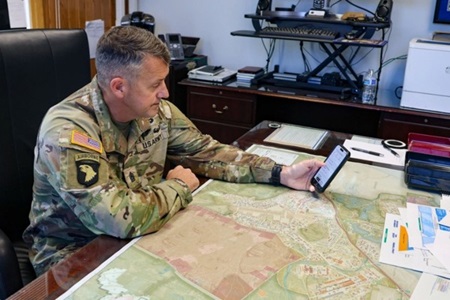
U.S. Army photo by Spc. Elsi Delgado
Republic of Korea Air Force Lt Col Eunjeung Sung and Marie Manteuffel
November 6, 2026
Your patients may already have access to thousands of digital resources that can support emotion regulation, sleep hygiene, and coping skills—without realizing it.
Smartphone apps can provide on-demand tools to monitor symptoms, support treatment, and help individuals manage concerns before they escalate.1 There are over 20,000 mental health apps on the market, many of which are free or low cost. Some of the most popular apps have attracted millions of users.2 However, these tools come from a wide range of sources, and quality, evidence base, usability, security, and functionality can vary considerably.
Researchers and subject matter experts at the Defense Health Agency’s Psychological Health Center of Excellence (PHCoE) support content for five free mental health mobile apps: Virtual Hope Box,3-4 Breathe2Relax,5 Mood Tracker,6 Dream EZ,7 and Provider Resilience.8 These apps are designed for patients and mental health providers to use for general well-being or as an adjunct to treatment. Built on evidence-informed practices, including cognitive behavioral therapy and imagery rehearsal therapy, they can offer accessible support for service members and providers.
In a study of 998 adults aged 18–83 with lived experience of mental health concerns, participants across all age groups generally viewed digital mental health tools positively. Younger adults (ages 18–34) and middle-aged adults (ages 35–59) were more accepting of these tools than older adults (ages 60 and older).9 Given the potential relevance of digital tools for military-connected populations, providers can help patients navigate available resources by:
- Discussing when self-care or online resources may be appropriate versus when to connect with a provider
- Reviewing high quality, evidence-informed app options, their capabilities, and their limitations
- Maintaining current print or digital information to provide patients
- Anticipating questions on evidence, use, and privacy and helping patients assess what options might be right for them
Despite the widespread availability of smartphones and mental health applications, use of these resources remains relatively low. One systematic review found that, although approximately 88% of individuals with mental disorders own smartphones, only 23% use them for mental health purposes.10 This gap represents an opportunity for providers to increase awareness of evidence-informed digital tools and help patients identify resources that may complement their care.
Apps can complement care but do not replace clinical assessment, treatment, or crisis support. While next generation apps, including those using conversational artificial intelligence, have the potential to expand access and support even further, their development and use may also raise a range of concerns, including safety in managing suicide risk and responding to crises, the potential for harmful advice, overreliance on AI tools, accountability, and privacy protection.11 Patients with immediate safety concerns, suicidal risk, or rapidly worsening symptoms should promptly contact a health care provider or appropriate crisis support service.
By increasing awareness of reliable digital resources, providers, leaders, and peers can help service members build practical skills in emotion regulation, sleep hygiene, stress management, and coping. Expanding awareness of these tools can support individual well-being and contribute to medical readiness.
Resource
DHA App Library: mobile.health.mil
References
- Almuqrin, A., Hammoud, R., Terbagou, I., Tognin, S., & Mechelli, A. (2025). Smartphone apps for mental health: systematic review of the literature and five recommendations for clinical translation. BMJ open, 15(2), e093932. https://doi-org.mrdc.idm.oclc.org/10.1136/bmjopen-2024-093932
- Pappas, S. (2020). Providing care in innovative ways. American Psychological Association.
- Bush, N. E., Dobscha, S. K., Crumpton, R., Denneson, L. M., Hoffman, J. E., Crain, A., Cromer, R., & Kinn, J. T. (2015). A Virtual Hope Box smartphone app as an accessory to therapy: proof-of-concept in a clinical sample of veterans. Suicide & life-threatening behavior, 45(1), 1–9. https://doi-org.mrdc.idm.oclc.org/10.1111/sltb.12103
- Bush, N. E., Smolenski, D. J., Denneson, L. M., Williams, H. B., Thomas, E. K., & Dobscha, S. K. (2017). A Virtual Hope Box: Randomized Controlled Trial of a Smartphone App for Emotional Regulation and Coping With Distress. Psychiatric services (Washington, D.C.), 68(4), 330–336. https://doi.org.mrdc.idm.oclc.org/10.1176/appi.ps.201600283.
- Skopp, N. A., Bradshaw, D., Smolenski, D. J., Wilson, N., Williams, T., Bellanti, D., & Hoyt, T. (2025). A pilot study of trauma-sensitive yoga and Breathe2Relax among service members in an intensive outpatient program: the official journal of the Division of Military Psychology, American Psychological Association, 37(1), 62–72. https://doi-org.mrdc.idm.oclc.org/10.1080/08995605.2023.2296333
- Bush, N. E., Ouellette, G., & Kinn, J. (2014). Utility of the T2 Mood Tracker mobile application among army warrior transition unit service members. Military medicine, 179(12), 1453–1457. https://doi-org.mrdc.idm.oclc.org/10.7205/MILMED-D-14-00271
- Speed, K., Denneson, L. M., & Dobscha, S. K. (2020). DreamEZ: A mobile application for veterans with nightmares. Psychological Services, 20(S1), 105-112. https://doi.org/10.1037/ser0000414
- Wood, A. E., Prins, A., Bush, N. E., Hsia, J. F., Bourn, L. E., Earley, M. D., Walser, R. D., & Ruzek, J. (2017). Reduction of Burnout in Mental Health Care Providers Using the Provider Resilience Mobile Application. Community mental health journal, 53(4), 452–459. https://doi-org.mrdc.idm.oclc.org/10.1007/s10597-016-0076-5
- Woerner, M., Sams, N., Rivera Nales, C., Gorstein, T., Johnson, M., Mosser, B. A., & Areán, P. A. (2022). Generational Perspectives on Technology's Role in Mental Health Care: A Survey of Adults With Lived Mental Health Experience. Frontiers in digital health, 4, 840169. https://doi.org/10.3389/fdgth.2022.840169
- Guracho, Y. D., Thomas, S. J., & Win, K. T. (2023). Smartphone application use patterns for mental health disorders: A systematic literature review and meta-analysis. International journal of medical informatics, 179, 105217. https://doi-org.mrdc.idm.oclc.org/10.1016/j.ijmedinf.2023.105217
- Rahsepar Meadi, M., Sillekens, T., Metselaar, S., van Balkom, A., Bernstein, J., & Batelaan, N. (2025). Exploring the Ethical Challenges of Conversational AI in Mental Health Care: Scoping Review. JMIR mental health, 12, e60432. https://doi.org/10.2196/60432
Lt Col Eunjeung Sung is a licensed clinical psychologist in the Korean Air Force, currently serving as an Engineer and Scientist Exchange Program scientist at the Defense Health Agency, Psychological Health Center of Excellence. Her professional interests include advancing mental health initiatives and strengthening resilience within the military community.
Marie Manteuffel, PharmD, MPH, MADSS, is chief of the Research Adoption section of DHA’s PHCoE in Silver Spring, Md., where she leads efforts to advance the implementation of evidence-based practices.