By Nancy A. Skopp, Ph.D.
June 16, 2026
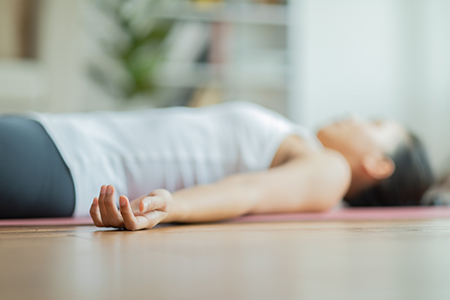
iStock Photo Credit: JomkwanYoga Nidra, a deep relaxation practice that originated in India thousands of years ago has gained increasing attention in modern clinical settings. The good news? Yoga Nidra is highly accessible, it requires no specialized equipment, only a quiet place to lay down and an audio guide. Yoga Nidra, meaning “yogic sleep” or “sleeping consciously,” is a meditative relaxation technique that guides you into a deep state of consciousness, alternating between wakefulness and sleep. While lying comfortably on your back, the practice uses guided imagery and body scanning to reduce stress and promote healing. The goal is total relaxation while retaining an awareness of your surroundings. Over time, practicing Yoga Nidra is said to promote physical, emotional, and spiritual health, with scientific evidence indicating that it helps activate the body’s natural relaxation response.
How is it practiced?
Yoga Nidra is conducted while the individual assumes the yoga posture known as shavasana, which involves comfortably lying flat (e.g., on a bed or yoga mat with blankets and pillows, etc.) with arms at a 30-degree angle to the body, palms up, and eyes closed. This is to minimize the sensation of touch and to prepare the body for relaxation and deep breathing. The practice is guided via verbal instructions (for example, pre-recorded audio files, internet videos) delivered in a soothing tone that involves a rotation of consciousness throughout regions of the body often progressing through 1) breath awareness, 2) opposing sensations, 3) visualizations, and 4) gentle reemergence. Early in the practice sequence, the practitioner mentally states an intention or sankulpa (repeated three times with strong resolve) that is concise and positive in nature (for example, I rest deeply to restore each layer of myself). Yoga Nidra is generally practiced for 30 minutes to one hour, however, there are shorter versions (for example, 15 minutes).
What are the benefits according to scientific evidence?
Yoga Nidra is a safe, cost-effective technique that has been shown in several studies, including meta-analyses and randomized controlled trials, to reduce stress and anxiety, improve sleep onset and quality, lower cortisol, decrease blood pressure, and alleviate chronic pain.
Who is it for?
Yoga Nidra is suitable for virtually anyone — beginners with no experience to advanced yoga practitioners.
Although further empirical validation of Yoga Nidra is needed, this practice may be useful alongside sleep recommendations provided in the Veteran Affairs/Department of Defense Clinical Practice Guidelines for the Management of Chronic Insomnia Disorder and Obstructive Sleep Apnea.
Ready to explore the benefits yourself? You can start today with the free online resources offered by the VA.
References
- Ahuja, N., Bhardwaj, P., Pathania, M., Sethi, D., Kumar, A., Parchani, A., Chandel, A., & Phadke, A. (2024). Yoga Nidra for hypertension: A systematic review and meta-analysis. Journal of Ayurveda and Integrative Medicine, 15(2), 100882. https://doi.org/10.1016/j.jaim.2023.100882
- Moszeik, E. N., Rohleder, N., & Renner, K. H. (2025). The Effects of an Online Yoga Nidra Meditation on Subjective Well-Being and Diurnal Salivary Cortisol: A Randomised Controlled Trial. Stress and Health: Journal of the International Society for the Investigation of Stress, 41(3), e70049. https://doi.org/10.1002/smi.70049
- Pandi-Perumal, S. R., Spence, D. W., Srivastava, N., Kanchibhotla, D., Kumar, K., Sharma, G. S., Gupta, R., & Batmanabane, G. (2022). The Origin and Clinical Relevance of Yoga Nidra. Sleep and Vigilance, 6(1), 61–84. https://doi.org/10.1007/s41782-022-00202-7
Nancy A. Skopp, Ph.D., is a licensed clinical psychologist. She has conducted large-scale military psychological health research with the Centers of Excellence for more than 15 years. Dr. Skopp is trained in trauma sensitive yoga and mind-body practices for stress reduction.