By Sharmila Chari, Ph.D. and Fuad Issa, M.D.
May 21, 2024
Updated June 10, 2026 by Lt. Col. Dan Cassidy, Ph.D., ABPP, U.S. Air Force
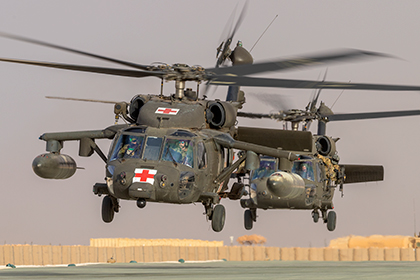
U.S. Army photo by Sgt. Steven Lewis
Austere environments create operational challenges that impact human operators. What does serving in an austere environment mean, and what are the implications for mental health management in that environment? How does an austere environment impact the delivery of healthcare in the military?
Imagine the experience of a small team of service members during and following a combat engagement. Against a backdrop of explosions, stress, and split-second decision-making, a team member is overwhelmed
and now unable to function. Whether you’re a service member or provider, you may have questions about what personnel can do to preserve their functioning — and that of those around them — during concentrated bouts of operational stress.
Operational planners seek to resource deployed units with the emergency medical assets essential for mission success. Yet, the changing nature of conflict and future multi-domain operations may complicate forward staging of specialty medical support. Far-forward care in such operations must, in such circumstances, rely on organic resources, including combat medics and self or buddy care.1
Though the U.S. military has made great strides toward the provision of medical care in austere environments, there was, until recently, no specific guidance for management of mental health conditions. In February 2024, the Psychological Health Center of Excellence published the Guideline for Forward Management of Acute Behavioral Health Conditions by Non-specialty Medical Personnel, a collaboration among the Joint Trauma System, line leaders, providers, and service representatives.2
What does this guidance cover and who is the audience?
This mental health guideline describes mental health management strategies for general medical personnel, like corpsmen and medics, who lack extensive education and training in mental health. It outlines an intervention framework for service members with acute mental health symptoms in far-forward environments and draws on prolonged field care principles. The framework encompasses a suite of interventions — categorized “minimum,” “better,” and “best” — that warfighters can use to manage common (e.g., stress reactions and sleep issues) and serious (e.g., psychosis and suicidality) mental health issues that can manifest in remote locations. This strategic framework and associated recommendations furnish non-specialty medical providers and paraprofessionals with a range of options for management of mental health presentations when specialty care is unavailable. The focus is on brief and simple interventions that promote effective stress management, reduce the severity of symptoms, and preserve combat effectiveness. The goal is to provide service members struggling with mental health symptoms in far-forward locations with additional skills and enable successful management of their presenting issues using readily available organic assets.
Unit commanders are responsible for the health and well-being of their unit, and the mental health management guidance also includes recommendations related to facilitate coordinated collaboration between command and non-specialty personnel in the management of far-forward mental health symptoms. The clinical practice guideline consolidates high-yield resources that benefit a range of medical personnel and field leadership who lack specialty mental health training but must contend with the reality of exigent mental health needs.
What next?
Ongoing research and training are underway to prevent, identify, and manage mental health casualties on the frontline. Researchers at the Walter Reed Army Institute of Research partnered with PHCoE to disseminate guidance to personnel in the field, and pilot test results are promising.3,4 Feedback from non-specialty medical providers, unit members, and leaders will enable refinement and tailoring of the training to meet service and theater-specific needs.
References
- Hoyt, T., & Hein, C. (2021). Combat and operational stress control in the prolonged field care environment. Military Review, 101(5). https://www.armyupress.army.mil/Portals/7/military-review/Archives/English/SO-21/hoyt-combat-operational-stress/hoyt.pdf
- Issa, F. (Ed.) (2024). Guideline for forward management of acute behavioral health conditions by non-specialty medical personnel. Joint Trauma System. https://deployedmedicine.com/
- Mesias, G. A., Nugent, K. L., Wolfson, M., Clarke-Walper, K. M., Germain, A., Sampson, M. K., & Wilk, J. E. (2023). Development of Training to Prepare Army Medics to Address Behavioral Health Needs of Soldiers in Far-Forward Environments Utilizing Mobile App Technology. Military Medicine, 188(9-10), e3221-e3228. https://academic.oup.com/milmed/article/188/9-10/e3221/7162987
- Nugent, K. L., Clarke-Walper, K. M., Germain, A., Wolfson, M., Mesias, G., Pulantara, W., and Wilk, J. (2022, September 12-15). Usability of a prototype mobile application for management of behavioral health and sleep concerns in far-forward operational environments [Poster Presentation]. Military Health System Research Symposium 2022, Orlando. FL., USA.
Sharmila Chari, Ph.D., is a clinical psychologist by training and currently serving as a contracted senior scientific advisor in the Research Execution section at the Psychological Health Center of Excellence. She has experience in psychological health research portfolio management, program development, conducting research and evaluation for serious mental illnesses and substance use disorders, equitable mental health care delivery, and trauma-informed programs.
Fuad Issa, M.D., is a psychiatrist and is currently the Defense Health Program Psychological Health Portfolio Manager. He previously led the Clinical Care Section within PHCoE and was the executive director for the DOD Addictive Substance Misuse Advisory Committee.
U.S. Air Force Lt. Col. Dan Cassidy, Ph.D., ABPP, is a board-certified clinical health psychologist at the PHCoE with research and applied interests in population science and health behavior change.