The Psychological Health Center of Excellence uses its data analytics expertise to provide relevant, timely, and actionable information that supports evidence-based decision-making to improve mental health care in the Military Health System. We use medical administrative data (i.e., data that’s routinely collected as part of care delivery or third-party billing) to support our analytic efforts. The datasets we use contain information about care delivered directly in military treatment facilities as well as civilian-sector care covered by TRICARE and include:
- Patient demographics (e.g., age, sex, military status)
- Recorded diagnoses according to the International Classification of Diseases diagnostic codes
- Medical procedures/activities performed (based on a variety of medical procedural codes)
- Care settings (for example, primary care, specialty mental health, or emergency department)
- Prescriptions written and medications dispensed
- Provider information (for example, medical specialty, credentialing level, or assigned clinic)
- Cost of care delivered
Our analytic services can assist with your needs for clinical surveillance, program evaluation, medical intelligence, and data visualization.
We can deliver information about the prevalence and incidence of mental health conditions among service members and answer questions such as those provided below. (Click on each question to reveal the answer.)
PHCoE supports requests from within the Department of Defense, other federal agencies, and some non-government organizations and institutions.
For assistance with your psychological health analytics needs, email the PHCoE Analytics team.
A
From 2017 through 2024 the prevalence of mental health disorders amongst active duty service members (based on healthcare utilization data) has increased from around 15% to nearly 20%. During the same time period, the incidence rate (i.e., new episodes of care) increased more gradually from about 9% to just under 12%. The prevalence of mental health conditions is highest among U.S. Army personnel and the change in the overall prevalence rate is largely driven by increased prevalence in U.S. Navy and U.S. Air Force service members.
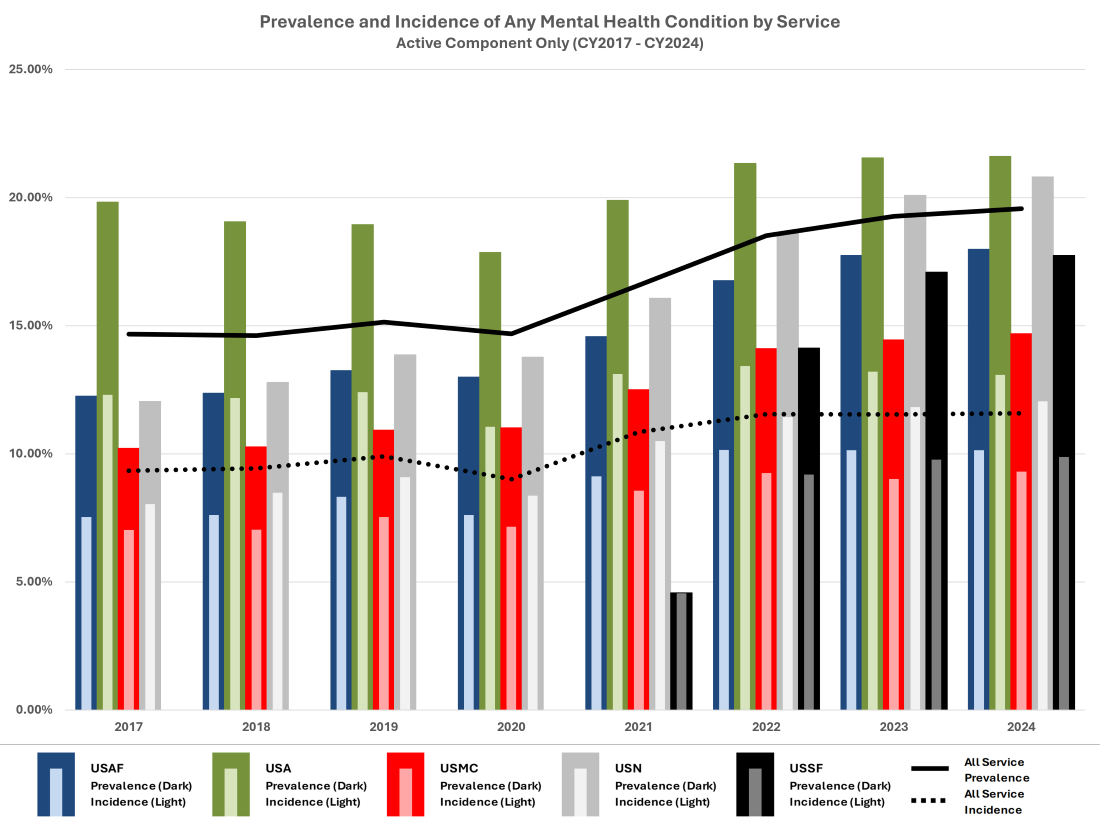
View 508-compliant version table of the Prevalence and Incidence of Any Mental Health Condition by Service, CY2017-CY2024 (Excel spreadsheet, 18K)
You also may be interested in...
FAQ
Aug. 25, 2026
Frequently asked questions about the Mental Health and Analytics division of PHCoE
You are leaving Health.mil
The appearance of hyperlinks does not constitute endorsement by the Department of Defense of non-U.S. Government sites or the information, products, or services contained therein. Although the Defense Health Agency may or may not use these sites as additional distribution channels for Department of Defense information, it does not exercise editorial control over all of the information that you may find at these locations. Such links are provided consistent with the stated purpose of this website.
You are leaving Health.mil
View the external links disclaimer.
Last Updated: June 04, 2026