By Brookie Madison, Tiffany Milligan, Psy.D., MBA, and Jose Lara-Ruiz, Ph.D.
April 7, 2026
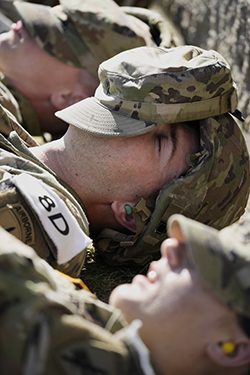
U.S. Army Reserve photo by Sgt. 1st Class Crystal Harlow
Picture this: Your day is packed with activities from morning to night, leaving you craving some "me time" by the end of the day. You had a busy day, starting with exercise, followed by your eight-hour shift, errands, school runs, dinner, and helping with homework. By the time you finish everything, it's already past 10 p.m. Instead of getting ready for bed, you find yourself on the couch, scrolling mindlessly through your phone, thinking you deserve this time for yourself. But what was meant to be a brief break turns into several hours of wasted time. The next day, you feel the consequences of staying up late.
Many of us, including service members, engage in the routine of staying up late to reclaim time for ourselves, a behavior researchers have coined “bedtime procrastination,” or “revenge” bedtime procrastination.1 BP can lead to common consequences of inadequate sleep including irritability, daytime sleepiness, fatigue, trouble focusing, and headaches.2 On average, adults 18 years and older need seven to nine hours of sleep.3 A 2023 survey of 2,005 adults by the American Academy of Sleep Medicine found that 91% of respondents admitted to losing sleep by staying up past their bedtime to binge-watch a TV show or to stream a video series.4 Additionally, 50% of respondents watch TV and 45% use their smartphones when they have trouble falling asleep, both of which can hinder sleep onset.
Researchers have investigated reasons why individuals procrastinate before bedtime. A recent study assessed 393 active-duty service members to better understand this phenomenon within the U.S. military.1 The study focused on the relationship between BP and role overload, which occurs when work demands overwhelm an individual's time and energy, leading to difficulties in performing duties effectively. The researchers also investigated whether those who engaged in BP more often experienced challenges in their day-to-day functioning at work, at home, in relationships, and physical wellbeing (e.g., fatigue). The study found that 72.5% of service members reported moderate or high levels of role overload, while 74.8% reported moderate or high levels of BP. Role overload and BP were positively associated, indicating that individuals experiencing one were more likely to experience the other. Furthermore, both BP and role overload were predictors of functional problems.
A systematic review of 43 studies on BP in civilians found two additional correlations: self-control and chronotype.5 Individuals with lower self-control were more likely to procrastinate at bedtime, while those with an “evening chronotype” (i.e., night owls) were more likely to engage in BP. Regardless of the cause, BP was associated with less total sleep time, poorer sleep quality, and more daytime fatigue.
Consequences of Bedtime Procrastination
Ultimately, this cycle of staying up late can lead to deprivation or even a sleep disorder, such as insomnia. Sleep deprivation occurs when you don’t get enough sleep or good quality sleep6, while insomnia is a clinical condition characterized by difficulty falling asleep, staying asleep, or both.7 Insomnia is typically driven by behaviors that interfere with good sleep.
Consistently poor sleep can have long-term effects on both physical and mental health. In the short-term, relatively brief disruptions to sleep can lead to problems with attention, concentration, critical thinking skills, and decision-making.8 For service members, these cognitive skills are crucial to performance in high stress situations that require quick thinking. Factors including long work hours, irregular or unpredictable schedules, and consistently early rise times also impact service members' ability to get sufficient sleep.9 Given that many factors interfering with sleep are outside of service members’ influence, it is crucial to intervene on those that can be controlled to improve sleep quality.
Getting out of the Bedtime Procrastination Spiral
Escaping the BP spiral starts with recognizing the root cause – feeling overwhelmed and not having enough personal time during busy days. One way to address this is by scheduling time for yourself throughout the day to reduce stress and feel less drained in the evening. Blocking off time on your calendar to tackle and prioritize pending work rather than multitasking, taking 10-minute walks without distractions to decompress, and scheduling 30 minutes before dinner to engage in enjoyable activities can help reclaim personal time and break the cycle of BP. While bedtime may come later for night owls than for larks, the time before bed can still be restful and preparatory for sleep. Binging television, scrolling through your phone, and playing video games all activate the brain due to the stimulating content and light emitted from the devices.10 Research indicates wind-down routines before bed improve the ability to fall asleep and stay asleep by allowing the brain to slow down. Wind-down routines typically start about an hour before bedtime and may include activities like warm showers, listening to music, or reading a book. Maintaining a consistent sleep schedule and a calm sleeping environment also facilitate relaxation and sleep induction. Any phone-checking, TV-watching, or video game-playing should occur before this wind-down time.
For those who find it challenging to change bedtime behaviors, a mental health specialist can help identify barriers. Elevated stress levels or sleep issues may require professional assistance for a quicker resolution. In summary, a well-rested warfighter is a mission-ready warfighter. Combating BP is a high-yield self-help strategy for service members who have limited control over the many external demands on their time. Understanding this behavior may help providers identify factors interfering with sleep and better tailor interventions for the service members they are serving.
References
- Barrow, T. R., Cooper, C. R., Revell, L., Haugen, T., & Gregg, B. T. (2025). The Characterization of Revenge Bedtime Procrastination in Military Servicemembers, Military Medicine, usaf519, https://doi.org/10.1093/milmed/usaf519
- Johns Hopkins Medicine. (2019). The Effects of Sleep Deprivation. Johns Hopkins Medicine Health Library. https://www.hopkinsmedicine.org/health/wellness-and-prevention/the-effects-of-sleep-deprivation
- Celmer, L. (2023, December 4). Over three-fourths of Americans lose sleep due to digital distractions. American Academy of Sleep Medicine – Association for Sleep Clinicians and Researchers. https://aasm.org/over-three-fourths-of-americans-lose-sleep-due-to-digital-distractions-sleep-experts-urge-a-change/
- American Academy of Sleep Medicine (2023). Sleep Prioritization Survey Binge-Watching TV. https://aasm.org/wp-content/uploads/2023/11/sleep-prioritization-survey-2023-binge-watching-tv.pdf
- Hill, V. M., Rebar, A. L., Ferguson, S. A., Shriane, A. E., & Vincent, G. E. (2022). Go to bed! A systematic review and meta-analysis of bedtime procrastination correlates and sleep outcomes. Sleep medicine reviews, 66, 101697. https://doi.org/10.1016/j.smrv.2022.101697
- Cleveland Clinic. (2022, August 11). Sleep Deprivation: What It Is, Symptoms, Treatment & Stages. https://my.clevelandclinic.org/health/diseases/23970-sleep-deprivation
- American Psychiatric Association. (2013). Diagnostic and statistical manual of mental disorders (5th ed.). https://doi.org/10.1176/appi.books.9780890425596
- Petrofsky, L.A., Heffernan, C.M., Gregg, B.T., & Smith-Forbes, E.V. (2022). Effects of sleep deprivation in military service members on cognitive performance: A systematic review. Military Behavioral Health. 10(3), 202-220. https://doi.org/10.1080/21635781.2021.1982088.
- Good, C.H., Brager, A.J., Capaldi, V.F. , & Mysliwiec, V. (2019). Sleep in the United States military. Neuropsychopharmacology. 45, 176–191. https://doi.org/10.1038/s41386-019-0431-7
- Solodar, J. (2025, January 31). Sleep hygiene: Simple practices for better rest. Harvard Health Publishing: Harvard Medical School. https://www.health.harvard.edu/staying-healthy/sleep-hygiene-simple-practices-for-better-rest
Brookie Madison is a contracted digital communications specialist/web content manager for PHCoE. She creates monthly social media content and e-newsletters sharing PHCoE resources and research with mental health providers, clinicians, and service members.
Dr. Tiffany Milligan is a clinical health psychologist with extensive experience in primary care behavioral health and with clinician training. She joined the PHCoE Research Execution team as a contractor in 2022 as a clinical subject matter expert.
Dr. Jose M. Lara-Ruiz is a research psychologist and leads the Health Services and Population Research program at the Psychological Health Center of Excellence.